Cinthia Soto
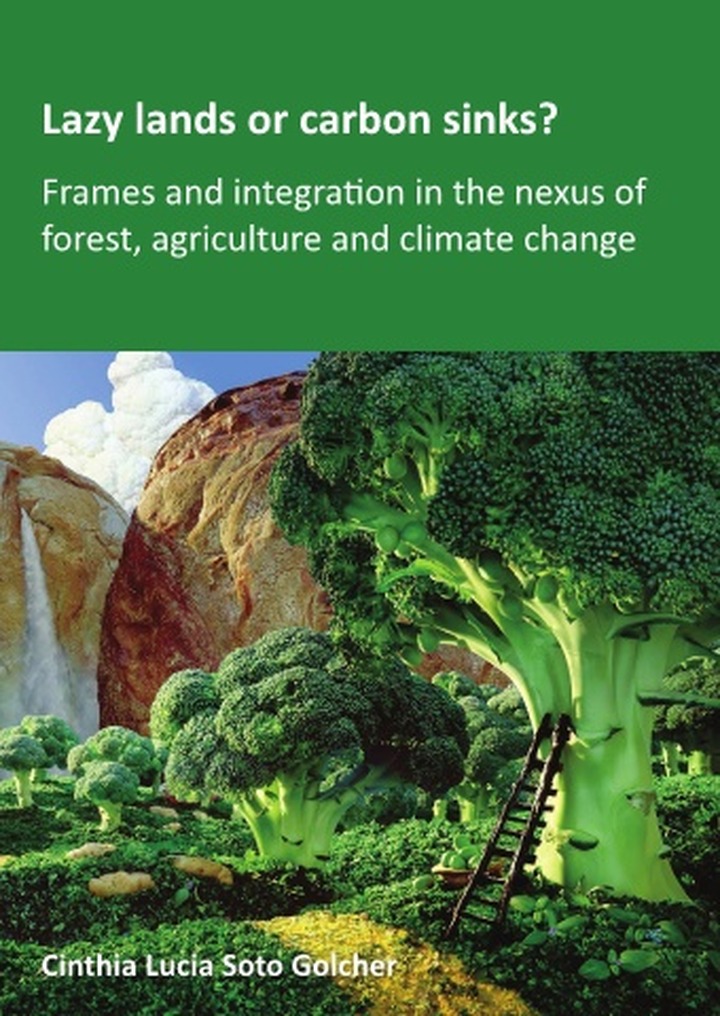


Lazy lands or carbon sinks?
Lazy lands or carbon sinks? Frames and integration in the nexus of forest, agriculture and climate change The interactions among the forest, agriculture and climate change policy domains are quite complex. On the one hand, forests provide important livelihoods and ecosystem services. These include protection of biodiversity and water sources, climate regulation, absorption of CO2, the reduction of the risks and impacts of extreme weather events, and important recreational and spiritual values in different parts of the world, just to mention a few. On the other hand, agriculture provides food, animal feed, bioenergy, and employment, and is a source of income for more than 500 million smallholder farmers globally. However, commercial agriculture is considered the main driver of deforestation. This tension has been enhanced in the past by conflicting policies (including agricultural subsidies) that promoted increasing agricultural productivity and considered standing forest as “lazy lands” (land with no economic or social value). This led to clearcutting forest to make land “productive”. While this framing has changed, and different instruments have been developed to protect and conserve forests, the expansion of agriculture into forested areas continues. Moreover, both forests and agriculture are highly vulnerable and affected by climate change. Paradoxically at the same time, deforestation, forest degradation and agriculture contribute to about one quarter of global greenhouse gas (GHG) emissions. So there is functional interplay among the three domains, as they are all connected in biogeophysical or socio-economic. As such, greater coherence can be promoted through improved coordination and integration among the domains. The global governance systems of forests, agriculture and climate change are characterized by their fragmented nature, that is, an increasing number of institutions governing each domain, a multitude of actors from different spheres of society, and a wide array of norms and discourses. Specifically, this dissertation addresses this fragmentation from a framing perspective and is positioned within global environmental governance research. It aims to further our knowledge on the role of framing in the integration of global governance in the nexus of forests, agriculture and climate change. In order to do so, three research questions are analysed: RQ1: What efforts have been taken to enhance integration among the forest, agriculture and climate change governance systems and how does framing contribute to the degree of integration? RQ2: How did forests receive an increasingly prominent place on the global climate change agenda, while agriculture is still lagging behind, and what role has framing played in this degree of integration? RQ3: How and to what extent has framing played a role in the design and evolution of the Global Alliance on Climate Smart Agriculture (GACSA)? Different conceptual frameworks are developed in each chapter to answer the research questions. These are encompassed within the Integrative Governance literature and are combined with frame theory elements. The methodologies used involve semi-structured interviews, an international workshop with experts active in one or more of the studied domains, and in-depth literature reviews and document analyses. Chapter 2 analyses and explains the extent of integration among pairs of domains (forest-agriculture; forest-climate change; agriculture-climate change) and the nexus of the three. It also analyses efforts undertaken by actors to enhance integration. It builds on interplay management and framing theory, utilizing two elements to explain the level of integration: degree of legalization (type and quantity of norms and rules) and dominant frames in each domain. The three governance systems are characterized by medium (in the case of forests) to medium-high (agriculture) and high (climate change) degrees of legalization. The dominant frame for forests has evolved over time, from being considered lazy or unproductive lands, to lungs of the Earth, and carbon sinks. In the case of agriculture, the dominant frame is characterized by its productivist nature, justified in the need to feed 9 billion people by 2050. Finally, climate change is more focused in reducing GHG emissions (mitigation) than adaptation; it is also facing important changes in the way the common but differentiated responsibilities principle is perceived, where the North-South divide is evolving into a more self-defined approach, based on national capacities and contributions (instead of commitments). The chapter draws the conclusion that integration efforts have taken different forms and are more evident in the soft law realm. It also recognizes that integration has differed for pairs of domains. While forest and climate change have a higher degree of integration, agriculture and forest, agriculture and climate change (specifically, the mitigation side), as well as the nexus of the three, present lower levels of integration. It also highlights that the (in)compatibility of frames is an important factor in the extent of integration. When frames are compatible or at least not conflicting, integration can be enhanced; the opposite is also true -- conflicting frames prevent integration. Chapter 3 addresses the integration of forests and agriculture into the climate change agenda. It compares efforts to include tropical deforestation and forest degradation (REDD+) into the UNFCCC, with similar (and less successful) efforts for agriculture. It draws upon agenda setting and frame theory to build its framework. It considers three streams in agenda setting: problem, policy and political, and how policy entrepreneurs contribute to link the streams when a policy window opens up, leading to the inclusion of an issue in the decision agenda. The role of committed policy entrepreneurs in linking the problem, policy, and political streams in the case of REDD+ has led to the creation of a legal and methodological framework in the course of the studied period (2005-2015). Political will and incentives, including readiness funds, have facilitated the creation of a trusted environment, where developing countries have been encouraged to undertake mitigation actions. Framing deforestation as a GHG emission problem, as a ‘low hanging fruit’ in terms of the solution, and expanding the frame to include other issues and gain political support have influenced forest and climate change integration. In the case of agriculture, while the problem recognizes the challenge of increasing productivity for growing populations, while keeping emissions low, the policy and political streams have faced important challenges. These include the lack of incentives and a convincing proposal (solution) that it is framed in a way that the multiple objectives of agriculture are addressed; the complexity of dealing with millions of farmers (with different sizes, resources, and practices); and the fear that addressing agriculture in a comprehensive way will lead to binding targets and trade barriers in a sector that is economically and socially important for many developing countries. Committed policy entrepreneurs that are trusted, speak in a unified voice and sustain efforts over time have been missing in the case of agriculture. Efforts outside the traditional intergovernmental mechanisms seem to be a way for moving the issue forward. Despite these difficulties, the agreement to work on the Koronivia Joint Work on Agriculture under UNFCCC could create new opportunities for enhancing the integration of the agriculture and climate nexus. Framing has played an important role in enabling or preventing integration. Chapter 4 addresses the integration of agriculture and climate change outside the intergovernmental mechanisms, namely in an international partnership, the Global Alliance on Climate Smart Agriculture (GACSA), that gathers more than 280 stakeholders from different spheres of society, including business, NGOs, governments, and farmer associations. The chapter builds on partnership literature and frame theory to develop its conceptual framework. It aims to understand how and to what extent framing has played a role in the development of GACSA. The chapter concludes that from the beginning through more advanced stages of partnership formation, framing played different roles, from more strategic framing in early stages to more unconscious and tacit framing in later phases. The concept of Climate Smart Agriculture (CSA), while apparently technical in nature, is rich in terms of different interpretations and political significance. The lack of a definition of what is and is not “climate smart” is considered positive by some, as it represents an opportunity for including different perspectives, interpretations and uses, and consequently, bringing more actors together. This view is at times countered by a negative perception of certain stakeholders, such as CSOs, who have expressed clear opposition to the CSA concept and GACSA. To them the concept is a blank check for also including non-sustainable practices, and safeguards are missing. The chapter also highlights that problem definition and solutions around GACSA and CSA seem to be focused on frames that favour productivity and technology. It also concludes that incompatible frames are an indicator of the fragmentation of global governance and that different approaches and instruments can be developed to address and integrate compatible frames among domains, as the sum of efforts will contribute to broader global goals. The final chapter 5 addresses the main conclusions and discussion of this dissertation. It builds on the empirical chapters to answer the research questions and reflects upon the theory and methods. It also provides ideas for further research and shares some policy recommendations. The chapter concludes that compatible frames are a precondition for integration. Compatible frames have the potential to enable integration or at least, not hinder it. Efforts to integrate incompatible frames among domains can result in broad and meaningless agreements, with a significant amount of time and resources invested. Even though the forest, agriculture and climate change governance systems are highly fragmented and encompass multiple frames, actors may attempt to bridge and connect compatible frames among domains. The chapter also highlights that strategic framing can be used in different ways to enhance integration (e.g. by expanding frames or reframing). Framing is then considered a skill and a necessary quality for actors engaging in integration efforts. The chapter also presents a model for framing and integration that provides some insights into how framing can be used to enhance or prevent integration. It finalizes with a set of policy recommendations, including the development of a land-use readiness fund and the need to promote approaches outside the intergovernmental frameworks, where different frames are present and the fear of binding commitments does not play a role. The dissertation concludes that the fragmentation of global governance is a fact, and incompatible frames are an important factor influencing this fragmentation. Also, while actors may connect compatible frames among domains, these frames will not necessarily support sustainable paths. This dissertation argues that we need to identify and support frames that enhance the desired transformative changes towards sustainability.
| Publicatiedatum | 2 maart 2020 |
| Universiteit | Wageningen University |
| Auteur | Cinthia Soto |
| ISBN nummer | 978-94-6395-272-9 |