Bianca Berghuis
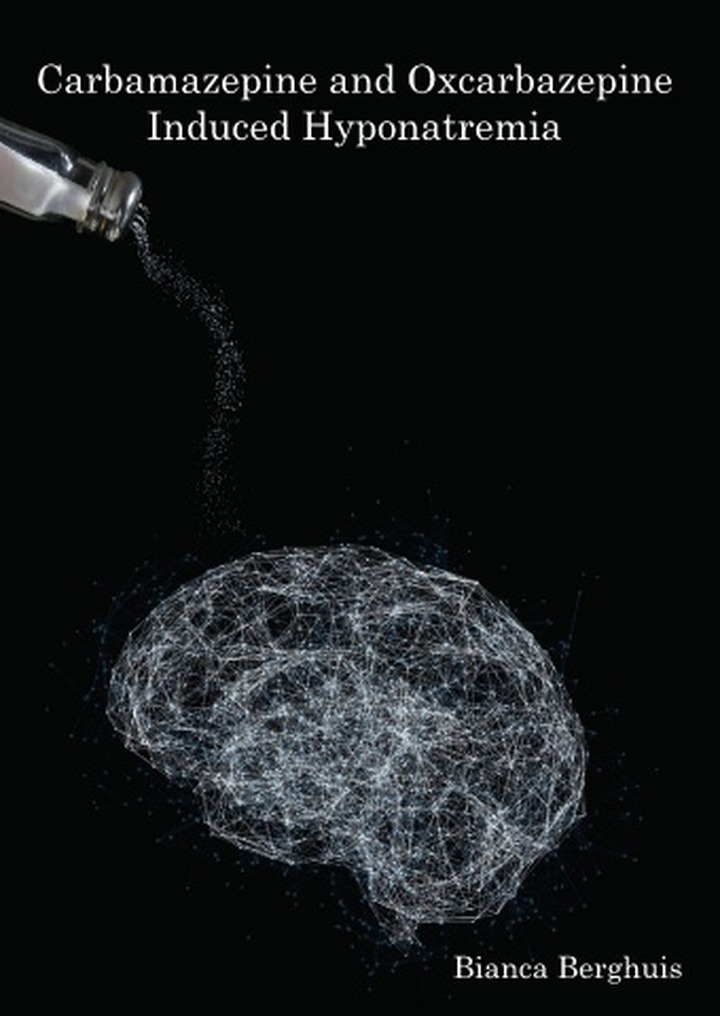


Carbamazepine and Oxcarbazepine Induced Hyponatremia
Epilepsy affects about 1% of people and is mainly treated with anti-seizure medication (ASM). Unfortunately, ASMs adverse effects (AEs) affect many people, often limiting effective treatment. The use of carbamazepine (CBZ) and oxcarbazepine (OXC) as first-line ASM in treating focal epilepsy is limited by hyponatremia. Although often assumed to be asymptomatic, hyponatremia can lead to symptoms ranging from unsteadiness and mild confusion to seizures and coma. This thesis describes the association between CBZ or OXC and hyponatremia and the clinical impact that carbamazepine- and oxcarbazepine-induced hyponatremia (COIH) has on people with epilepsy. Chapter 1 provides background information on the neurophysiology of epilepsy and the working mechanism of different types of ASM. It then focuses on the drugs CBZ and OXC and describes the current knowledge on COIH. Chapter 2 reviews the epidemiology, pathophysiology and putative genetic basis of COIH. Hyponatremia occurs in up to half of people taking CBZ or OXC and is often assumed to be asymptomatic. Chronic hyponatremia causes subtle neurological symptoms that are often wrongfully attributed to underlying disorders, direct drug toxicity, or are not recognised. COIH was initially thought to be a syndrome of inappropriate antidiuretic hormone secretion. Still, clinical and in vitro studies have shown that the antidiuretic properties of CBZ and OXC are, at least partly, explained by the direct stimulation of the vasopressin 2 receptor (V2R)/Aquaporin 2 (AQP2) pathway. No known genetic risk variants for COIH have yet been identified, but genes that code for proteins in the vasopressin water reabsorption pathway are likely candidates. In chapter 3 we assessed the occurrence of COIH in a large cohort of people with epilepsy and looked for possible determinants. Since 2010, we have collected clinical data, including ASM history, as part of EpiPGX, an international collaboration performing pharmacogenomic studies. Over 2,600 people were included from our tertiary epilepsy centre in the Netherlands, and we collected data on sodium level measurements in people who (had) used CBZ and OXC (available in 1,132 on CBZ and 289 on OXC). Our main finding was that hyponatremia (Na ≤134 mmol/L) occurred in about a quarter of those taking CBZ and almost half of those taking OXC, in line with other studies. Severe hyponatremia (Na ≤128 mmol/L) occurred in 7% in the CBZ group and 22% in the OXC group. Especially in those treated with OXC, we found a relatively high frequency of severe hyponatremia compared to others. Age over 40 years, high serum levels of CBZ and OXC and concomitant use of other ASMs were the main risk factors for hyponatremia in both treatment groups. Females on OXC were at a higher risk of hyponatremia than males. The gender difference was less clear from the currently available evidence. This may provide a clue for genetic predisposition to COIH as the vasopressin 2 receptor (V2R) gene is located on the X chromosome. In a subgroup analysis we found that an individual with hyponatremia associated with CBZ is also likely to develop hyponatremia while taking OXC. Symptoms present at hyponatremia, which could not be explained by another clear cause such as overt ASM intoxication or comorbidity were scored and found in almost half of people who had COIH. They lead to hospital admissions in 3%, primarily because of falls. Due to the study's design, we could not determine whether these symptoms could be attributed to COIH or to different causes, which led to our next study. In chapter 4 we assessed the AEs experienced by people taking CBZ or OXC and whether they could be attributed to COIH. We performed an observational retrospective study collecting data between 2017 and 2019 on serum sodium levels and AEs in 410 people with COIH and 300 with normal sodium levels from our previously described cohort. Our main finding was the occurrence of AEs in 65% of people with hyponatremia compared to 21% with normal sodium levels (OR 7.5, p=<0.001) and in 83% of people with severe hyponatremia compared to 55% in those with mild hyponatremia (p=<0.001). Significant predictors of AEs were the drug (OXC vs CBZ), and the number of concomitant ASMs. Dizziness (28% vs 6%), tiredness (22% vs 7%), instability (19% vs 3%) and diplopia (16% vs 4%) were reported more often in the hyponatremia group than in those with normal levels. Serum levels of the drug did not influence the seven-fold increased risk of developing AEs associated with COIH. Treatment of this form of chronic mild hyponatremia can improve the overall functioning of people with epilepsy. Chapter 5 describes the search for genetic factors contributing to COIH. In 1,141 individuals of a CBZ/OXC treated cohort genetic data was collected for a genome-wide association analysis to scan for common genetic determinants of COIH. From our clinical experience, susceptibility to COIH varies individually. Previously described clinical predictors of serum sodium levels only explained 11-14% of the variance in the SEIN cohort. We did not observe any genome-wide significant associations, neither with sodium level in a linear trait, nor with hyponatremia as a dichotomous trait. This finding cannot rule out genetic susceptibility for COIH completely, as rare variants and combinations of genetic variants of smaller effect size may contribute to overall risk. This chapter also assessed the clinical and genetic factors associated with CBZ metabolism. Age, number of co-medications, phenytoin use, phenobarbital use, and sodium valproate use were significant predictors of CBZ metabolic ratio. The association with the co-used ASM can be explained by either the induction of the cytochrome P450 enzyme CYP3A4, by which CBZ is metabolised in the liver, or by inhibition of epoxide hydrolase. We could not replicate the finding of polymorphisms in CYP3A4 and EPHX1 (gene encoding microsomal epoxide hydrolase) that have been associated with inter-individual variability of CBZ metabolism. Also, no genome-wide significant associations with CBZ metabolic ratio were found. Chapter 6 provides an overview of our findings and discusses their relevance. COIH is a very common AE. We discuss whether this is a clinical problem. Even mild chronic hyponatremia causes oxidative stress in the brain. Besides the AVPR2/AQP2 pathway, the renin-angiotensin aldosterone system also plays a role in inter-individual differences in the susceptibility to COIH. Hyponatremia increases the risk of hospitalisation and causes a variety of seemly mild symptoms. Treatment of COIH, by fluid restriction, dose reduction or substitution of the ASM can relieve symptoms and improve quality of life.
| Publicatiedatum | 19 december 2022 |
| Universiteit | Universiteit Utrecht |
| Auteur | Bianca Berghuis |
| ISBN nummer | 978-94-6469-089-7 |