Anouk Van Breukelen
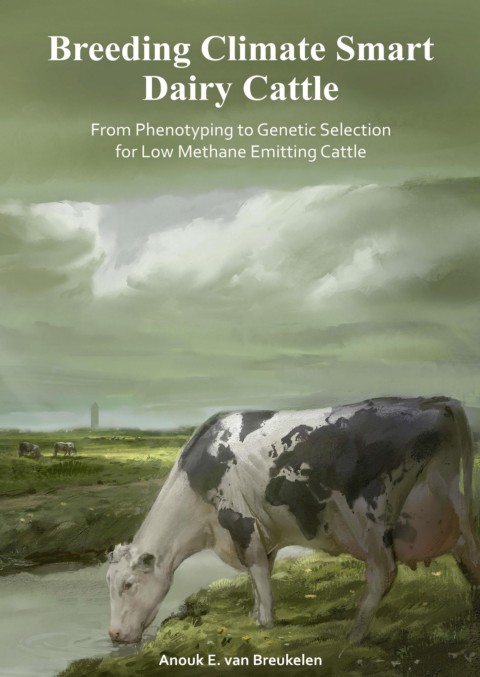


Breeding climate smart dairy cattle
Various strategies have been proposed to reduce enteric methane (CH4) emissions from ruminants, focusing on areas such as management, feeding strategies, feed additives, vaccination, and animal breeding. Among these, animal breeding currently demonstrates the greatest long-term potential, attributed to its minimal costs of implementation, along with its lasting and cumulative impact. However, incorporating CH4 into breeding programmes is still at an early stage. An important limitation to practical application has been the lack of phenotyping of CH4 emissions on enough individual cows to be able to estimate sufficiently reliable genetic parameters, which are required for informed breeding decisions. However, recent innovations have accelerated the collection of CH4 phenotypes. For this thesis, enteric CH4 emissions were measured by ‘sniffers’ that sample air from the feed bin of milking robots. The latest dataset included 74,569 weekly mean CH4 concentration (ppm) records on 7,139 cows from 68 commercial dairy farms. As the sniffers only measure concentrations and not the total grams of CH4 emitted by breath, an additional dataset was analysed that included measurements from GreenFeed (GF) units on CH4 production (g/day) on 797 cows from 16 farms (four overlapping with sniffers). The general objectives of this thesis were to: 1) define a CH4 trait from raw sniffer CH4 concentration measurements, and estimate heritabilities and repeatabilities, 2) investigate the relationship between two CH4 recording methods (sniffers and GF units), 3) investigate the effect of different recording schemes on the reliability of breeding value estimations, and 4) investigate the relationships between CH4 and other breeding goal traits. In Chapter 2, genetic parameters were estimated for various traits defined from the sniffer concentration measurements and the number of measurements that would be required to get a sufficiently high reliability of breeding values was estimated. High genetic correlations were estimated between several traits defined from sniffer CH4 measurements (≥0.78), apart from the genetic correlations with the CH4/CO2 trait, which were negative. For weekly mean CH4 concentrations (CH4c), we estimated that five records on CH4c, measured on ten different daughters would be sufficient to achieve a minimum reliability of 50% for the estimated breeding value of a bull. In Chapter 3, genetic correlations between CH4c recorded by sniffers and CH4 production recorded by the more accurate but more expensive GF units were estimated. The final data comprised 24,284 GF daily means from 822 cows, 170,826 sniffer daily means from 1,800 cows, and 1,786 daily means from 75 cows by both GF and sniffer (in the same period). Heritability estimates for GF and sniffer were similar, and the genetic correlation between CH4 recorded by the two recording methods was high and was 0.71 ± 0.13 for daily means and 0.76 ± 0.15 for weekly means. The results indicate that selection based on sniffer data could effectively reduce CH4 emissions in g/day as quantified by GF. This supports the potential of using cost-effective sniffer phenotypes in breeding programmes aimed at lowering CH4 emissions from dairy cattle. In Chapter 4, a comparison was made between genetic parameter estimates for CH4 emission from a fixed regression repeatability model and a random regression (RR) model. The RR model allowed for varying genetic variances and covariances over a lactation. The results showed that the heritability was highest mid lactation (on average 0.17 ± 0.04), and genetic correlations between lactation stages were high (0.34 ± 0.36 to 0.91 ± 0.08). Permanent environmental correlations deviated greatly over a lactation and ranged between -0.73 ± 0.08 and 1.00 ± <0.01, which highlights that it is most appropriate to model CH4c with a RR model including a random permanent environmental effect. With many full-lactation daughter CH4 records for each bull, the reliability was similar for the fixed regression and RR models. However, when data were only available for shorter recording periods at the beginning and end of lactation, using the fixed regression model led to up to a 28% reduction in reliability for bulls. Assuming the fixed regression model when the true (co)variance structure is reflected by the RR model, more than twice as long recording from the start of lactation was required to achieve maximum reliability for a bull. Therefore, applying an overly simplistic model could lead to insufficient recording and lower than predicted genetic gains based on the estimated reliability. In Chapter 5, genetic correlations between enteric CH4c and dry matter intake, body weight, and milk production traits were estimated. The results indicated that while the genetic correlations between CH4c and the other traits were generally weak, there were some positive correlations, particularly with fat production traits (fat yield and fat percentage). However, because of the weak relationships, the effects of selecting for lower CH4c on fat yield and fat percentage are expected to be small. In addition, strong genetic correlations of CH4c between different parities suggested consistency in breeding values for CH4c across parities, and the genetic correlations of CH4c with dry matter intake, body weight, and milk production traits were similar over parities. Overall, the weak genetic correlations between CH4c and production traits suggest that it is feasible to select for lower CH4c, while improving milk production and other economically important traits. In Chapter 6, the general discussion, the results of this thesis are put into a broader context, starting at evaluating the practical use of sniffers for recording CH4 emissions and ending with a reflection on how breeding for low CH4 emissions of dairy cows can be implemented in practical breeding programmes. The first part of the discussion highlights several challenges in on-farm recording with sniffers, for which suggestions for periodic maintenance and data processing are given to ensure data reliability and to improve the accuracy of measurements. The second part of the discussion describes various phenotypes from raw sniffer data, including: mean CH4 emissions, the CH4/CO2 ratio, peak traits, CH4 efficiency, and residual CH4. Here, I discuss that most traits show potential for implementation in breeding programmes, however some considerations should be made relating to the interpretability of each trait and some traits require further validation before implementation. In addition, I describe genetic correlations between mean CH4c and all breeding goal traits in the Dutch national index. The last part of the discussion focuses on strategies to ensure successful implementation of breeding for low CH4 emissions of dairy cows. I discuss methods to ensure that commercial farmers adopt breeding values and methods that aim to accelerate sustainable breeding. In addition, I discuss methods to quantify the impact of breeding for low CH4 emissions, converting sniffer concentration measurements to emissions in grams per day. Overall, animal breeding can help to significantly reduce enteric CH4 emissions of dairy cows, contributing to long-term climate goals. However, immediate implementation and optimalisation of breeding strategies is essential to be able to contribute to both short-term and long-term emission reduction targets.
| Publicatiedatum | 15 oktober 2024 |
| Universiteit | Wageningen University |
| Auteur | Anouk Van Breukelen |