Annelotte van Haaps
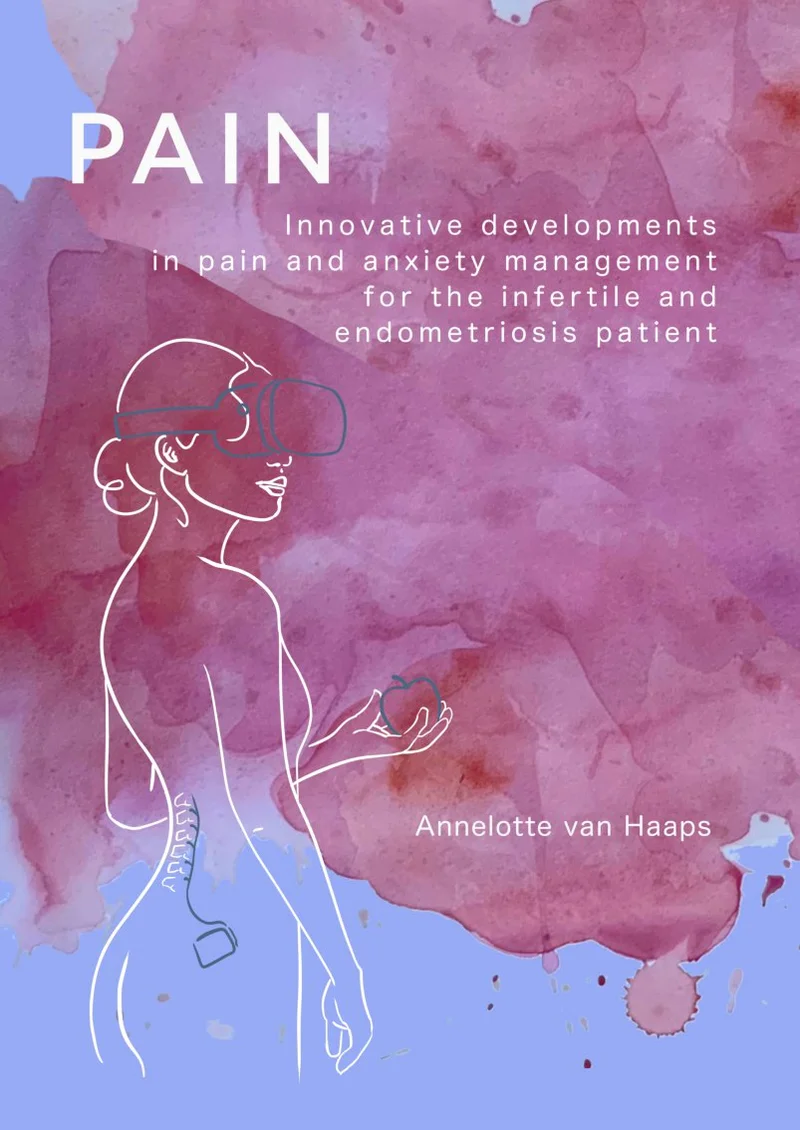


Innovative developments in pain and anxiety management for the infertile and endometriosis patient
This thesis centers around alleviating pain and anxiety, and thereby optimizing patient experiences, in the infertile and endometriosis patient. We focused on innovative approaches like Virtual Reality (VR) and Spinal Cord Stimulation (SCS), but also self-management strategies including dietary interventions which are emerging among endometriosis patients worldwide. The results are presented in three parts: Part I focused on pain and anxiety management in infertile women by using Virtual Reality. Part II focused on developing a step-by-step approach in pain management for endometriosis by using an eDELPHI procedure, and the appliance of SCS in women suffering from intractable visceral pain caused by endometriosis. Finally, Part III focused on the effect of different dietary interventions on pain and quality of life (QoL) among women diagnosed with endometriosis. Box 1 summarizes all research questions with the answers as presented in this thesis. Finally, the discussion reflects on the results and puts forward new perspectives for the future. Part I: Pain and anxiety management using Virtual Reality in the infertile patient In previous studies VR has been found effective in reducing both pain and anxiety during (acute) medical procedures. By reducing pain and anxiety, patient experiences and satisfaction can also be improved. In Chapter 2 all evidence regarding the appliance of VR in (outpatient) gynaecological procedures was collected, and a meta-analysis was performed. A reduction in worst pain and procedural anxiety during gynaecological procedures was seen, in favour of VR. In addition, four studies reported on satisfaction scores. All satisfaction scores were high with no significant difference in patient satisfaction between VR and non-VR. Improved satisfaction scores are considered important, since they are associated with better treatment outcomes, enhanced therapy compliance, less healthcare provider visits, diminished malpractice litigation and an improved prognosis. In Chapter 3 we studied the effect of VR on pain during hysterosalpingography (HSG). We found no disparity in reported average and worst pain scores between women receiving VR and women not receiving VR. When pain scores were corrected for the expectation that VR would be a good distraction from pain during HSG, we found that women reported significant higher overall and worst pain scores. Failure to meet the expectation that VR provides distraction and thus pain reduction, may play a role in this. Nonetheless, women undergoing HSG with VR expressed significantly less willingness to undergo another HSG without VR, compared to women undergoing HSG without VR. It can therefore be concluded that there was high patient satisfaction. Similarly, in Chapter 4 we evaluated the efficacy of VR on pain and anxiety management during oocyte retrieval in IVF/ICSI treatment. We found no significant differences in anxiety, overall pain and peak pain between participants receiving VR and participants not receiving VR. When looking at retrievals where 10 follicles or less were collected, we did see a significant benefit of VR on overall pain. It might be that VR is only effective up to a certain pain threshold or duration of the procedure. Where pain experienced during oocyte retrieval is manageable at first with the use of VR, it might become insufficient after a while when the pain intensifies and the duration of the procedure takes longer. The use of standard VR interventions might explain the lack of effect in this study. Not all patients react similarly and they might want to gain similar things from the VR intervention in order to achieve optimal anxiety and pain management. It can also be questioned whether infertile patients undergoing IVF/ICSI treatment are the right people to provide VR software to. They already had to change their expectations and experience a loss of control over when and how they become pregnant, but do have control over how they undergo oocyte retrieval. Box 1. Answers to the research questions of this thesis Part I Q1. What is the effect of Virtual Reality (VR) on pain, anxiety and patient satisfaction during (outpatient) gynaecological procedures? A1. VR can reduce worst pain scores and pre-procedural anxiety. This can improve patient experiences and satisfaction. This is important since it is associated with better treatment outcomes, enhanced therapy compliance, reduced healthcare provider visits, diminished malpractice litigation and an improved prognosis. Q2. Does Virtual Reality (VR) contribute to pain relief during fertility work-up? A2. Virtual Reality does not contribute to pain relief when applied during HSG. However, patients undergoing an HSG with VR were significantly less willing to undergo an HSG without VR again, compared to women who underwent an HSG without VR. Therefore, we consider patient satisfaction with VR during HSG to be high. Q3. Does Virtual Reality (VR) contribute to pain and anxiety relief during oocyte retrieval in IVF/ICSI treatment? A3. Virtual Reality does not contribute to pain relief when applied during IVF/ICSI treatment. VR was effective in retrievals with 10 follicles or less, suggesting it might be effective in shorter procedures. Part II: Standardizing pain management and the appliance of Spinal Cord Stimulation in endometriosis Until recently, there was no step-by-step approach to pain management in endometriosis treatment. Therefore, in Chapter 5 we performed a multidisciplinary consensus meeting followed by an eDELPHI procedure to reach national consensus and a step-by-step guideline for pain management in endometriosis patients. Where the first two steps adhere to the WHO step-by-step approach and consist of paracetamol followed by NSAIDs, the third step in our flow diagram consisted of the addition of Tricyclic Antidepressants (TCAs) in case of neuropathic pain. Both the use of metamizol, part of the NSAID group but causing agranulocytosis in long-term use, and opioids with a highly addictive character, are recommended to only be used short-term, for example during hospitalization after surgery. Muscarinic receptor antagonists are accepted treatment for bladder endometriosis. The use of COX-2 inhibitors were suggested but not presented as an established step in pain management as scientific evidence in human studies is lacking. It was advised to prescribe magnesium oxide with all types of pain management because of their positive effect on gastro-intestinal symptoms. Finally, proton pump inhibitors (PPIs) should be prescribed with use of NSAIDs, also when incidental. In Chapter 6 we collected all evidence regarding the appliance of SCS for visceral pain, between a broad number of diagnoses. We concluded that SCS applied for visceral pain could be effective in reducing symptoms, improving QoL and in reducing of even discontinuing pain medication use. However, complication rates, particularly with older devices, call for caution when applying SCS. Nonetheless, it seems effective and we found that SCS was more effective for patients diagnosed with endometriosis compared to other diagnoses. We considered it important that sound, prospective and preferably randomized controlled studies, with an adequate sample size and substantial follow-up are conducted in the future. Therefore, in Chapter 7 we performed a feasibility pilot study, where SCS was applied specifically in women diagnosed with endometriosis and intractable pain. We found that SCS was effective in reducing general and worst pain, dysmenorrhea, chronic pelvic pain, dysuria and dyschezia when comparing baseline to different follow-up moments. The follow-up period entailed 12 months. We saw improvements both in the self-reported QoL scores and in all but one of the core domains of the EHP-30 questionnaire. All participants but one were able to reduce their analgesics. Unfortunately, one participant requested device explantation due to lack of effect at 12 month follow-up. Box 1. Continued Part II Q1. What would be considered standard pain management in endometriosis patients? A1. The first two steps consist of paracetamol followed by NSAIDs. As a third step, TCAs could be applied. COX-2 inhibitors are presented as an option. Opioids and metamizol should only be prescribed short term. Muscarinic receptor antagonists are an accepted treatment for bladder endometriosis. Q2. Could Spinal Cord Stimulation be an effective treatment for visceral pain? A2. SCS could be an effective treatment for visceral pain caused by a wide range of diagnoses. It can reduce symptoms, improve QoL and reduce or even discontinue pain medication use. Since there are high complication rates, certain caution should be implied when applying SCS. Q3. What is the effect of Spinal Cord Stimulation on pain and QoL in women diagnosed with endometriosis, experiencing intractable visceral pain? A3. SCS is effective in reducing general and worst pain, endometriosis-related symptoms such as dysmenorrhea and chronic pelvic pain. It is effective in improving QoL scores and all but one core domains of the EHP-30 questionnaire. Users might also be able to reduce their pain medication. Part III: Dietary interventions in the chronic endometriosis patients Because standard treatment can be insufficient in reducing endometriosis-related symptoms or may be accompanied with unacceptable side effects there is an increasing interest in self-management strategies among healthcare providers and patients. One of these self-management strategies is a dietary intervention. In Chapter 8 we performed a survey study on the effect of the endometriosis diet on quality of life. We found that the endometriosis diet positively influenced QoL, even more so when there was strict adherence. We underlined the importance of identifying facilitators and barriers to dietary adjustments in women diagnosed with endometriosis. Therefore, we conducted a pilot study in Chapter 9 on the efficacy of the endometriosis diet and Low FODMAP diet on pain and QoL. We also included potential facilitators to improve dietary adherence. We found that a diet positively influenced pain scores in deep dyspareunia, dysuria, bloating en tiredness and improved QoL in six out of eleven EHP-30 domains (used to measure QoL in women diagnosed with endometriosis) after six months. We found no influence of self-reported strictness scores on the effectiveness of the dietary intervention. Over time, women reported that dietary adherence became more easy, and applying it in their daily life became easier. In addition, we provided them with materials to optimally adhere to their chosen diet. Not only the endometriosis diet and Low FODMAP diet, but also a glutenfree diet has frequently been mentioned to be effective in reducing endometriosis related symptoms. While a glutenfree diet can be effective in treating celiac disease, scientific evidence supporting the claim that it could also be effective in treating endometriosis-related symptoms is limited. In Chapter 10 we discussed why a glutenfree diet should not be recommended to women solely diagnosed with endometriosis. Its efficacy is based on only one study by Marziali et al. without a control group. In addition, no participants were testing for coeliac disease. Therefore it is possible that a strong placebo and nocebo effect, and not an actual effect, plays a crucial role in the effectiveness of a glutenfree diet in endometriosis. Women noticed symptom relief when they avoided a nutrient they thought was harmful for them. Nonetheless, there is no actual effect of a glutenfree diet on endometriosis-related symptoms. Therefore, women diagnosed with endometriosis should be recommended to adhere to healthy dietary guidelines, as advised by the World Health Organization (WHO). This obviously does not apply if there is an additional diagnosis of coeliac disease (CD). Box 1. Continued Part III Q1. What is the effect of a Low FODMAP diet and endometriosis diet on pain and quality of life in women diagnosed with endometriosis? A1. The Low FODMAP diet and endometriosis diet can have a positive effect on pain and QoL in women diagnosed with endometriosis. It is debatable whether strictness scores influence the effect of dietary interventions. Q2. Can a glutenfree diet be recommended to women diagnosed with endometriosis, and is there sufficient scientific evidence to do so? A2. There is insufficient scientific evidence to substantiate the recommendation of adherence to a glutenfree diet in patients diagnosed with endometriosis. Instead, women diagnosed with endometriosis should be recommended to adhere to healthy dietary guidelines as advised by the WHO. An exception of course, is when there is an additional diagnosis of celiac disease.
| Publicatiedatum | 3 juni 2026 |
| Universiteit | Vrije Universiteit Amsterdam |
| Auteur | Annelotte van Haaps |
| ISBN nummer | 978-94-6534-322-8 |