Anne Lippinkhof
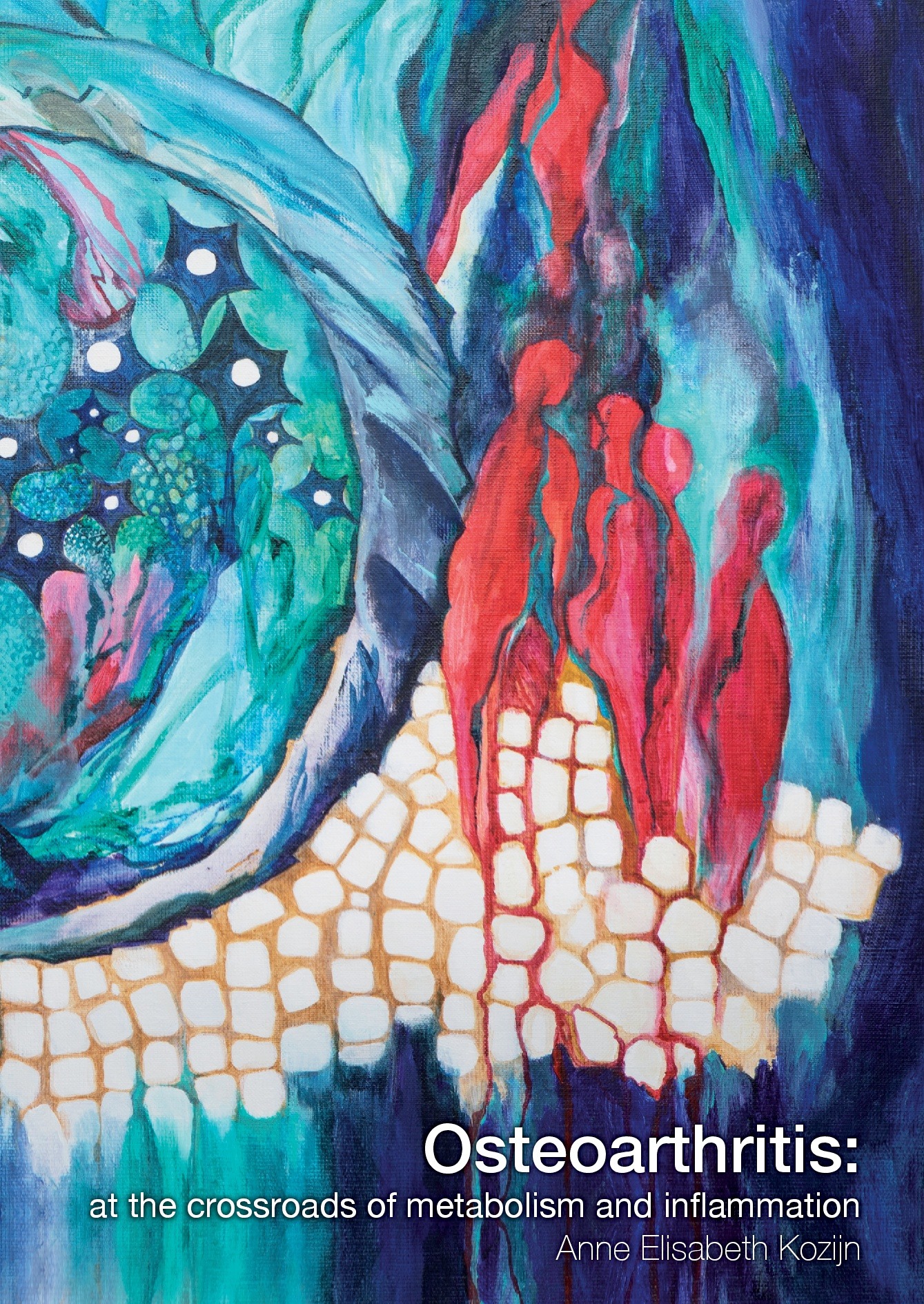


Osteoarthritis
Artrose (OA) is een invaliderende gewrichtsaandoening die wordt gekenmerkt door verlies van gewrichtskraakbeen, wat leidt tot stijfheid en pijn. De incidentie van artrose neemt toe, mede door de vergrijzing en de toename van obesitas. Dit proefschrift heeft tot doel te onderzoeken hoe metabole overbelasting bijdraagt aan de pathofysiologie van knieartrose, met een focus op de wisselwerking tussen metabolisme en immuniteit. In Hoofdstuk 2 hebben we de robuustheid en herhaalbaarheid van het dieet-geïnduceerde OA-model geëvalueerd. We toonden aan dat langdurige voeding met een hoogcalorisch dieet consequent een metabool fenotype (zoals obesitas en glucose-intolerantie) induceert, maar dat de ernst van de kraakbeenschade varieert per muizenstam. De meest consistente kraakbeenschade werd waargenomen bij muizen met een genetische modificatie die leidt tot een humane pro-inflammatoire status (muizen met humaan C-reactief proteïne (hCRP)) of bij het lipoproteïnemetabolisme (ApoE*3Leiden.CETP-muizen). We opperen daarom dat een extra trigger, naast hoogcalorisch eten, nodig is om metabole OA op te wekken. Om te evalueren of een vetrijke voeding inderdaad de ontwikkeing van OA kan verergeren, werd vetarm en vetrijk eten gecombineerd met een milde mechanische stressor (Hoofdstuk 3). OA werd geïnduceerd door microchirurgische destabilisatie van de mediale meniscus (DMM) in wildtype C57BL/6J muizen. Dit posttraumatische OA (PTOA) model is laag invasief en voldoende gevoelig om subtiele veranderingen in ziekteprogressie te bestuderen door milde triggers zoals genetische achtergrond en dieet. Vetrijke voeding (HFD) verhoogde inderdaad de ernst van de kraakbeenschade in dit model en onze bevindingen wijzen op een rol voor zowel ontregeling van lipiden als activatie van monocyten bij de progressie van OA. Op basis van deze resultaten stellen wij voor dat deze systemische factoren kunnen bijdragen aan een door voeding geïnduceerde ontsteking die verergering van kraakbeenschade mogelijk maakt. Om de effecten van een ontregeld lipidenmetabolisme op de ontstekingsstatus te ontrafelen, hebben we de ontwikkeling van metabole ontsteking zowel lokaal (in het kniegewricht) als systemisch (in het bloed) bestudeerd. In Hoofdstuk 4, een uitbreiding van de studies beschreven in hoofdstukken 3 en 5, hebben we ons gericht op de ontstekingsstatus van het lichaam van Hoffa (infrapatellar fat pad, IFP) tijdens de ontwikkeling van OA. Er zijn aanwijzingen dat de IFP een potentiële lokale bron van ontstekingsmediatoren in de knie kan zijn en daarom kan bijdragen aan de progressie van OA. De meest uitgesproken vetontsteking, gekenmerkt door ‘kroonachtige structuren’ (crown-like structures, CLS), werd gevonden bij muizen die een vetrijk dieet kregen bovenop een microchirurgische trigger (DMM). We zagen een aanzienlijk verhoogde afzetting van de macrofaag marker iNOS als gevolg van DMM-chirurgie, duidend op ontsteking, maar vonden geen verandering in de ontstekingsremmende macrofaag marker CD206. Vetfibrose was minimaal, maar de chirurgische DMM ingreep leek een trend naar verhoogde fibrose te veroorzaken. Deze data suggereren dat een vetrijk dieet IFP metabolisch gezien ‘oplaadt’ en dat de combinatie van vetrijke voeding en een trigger voor kraakbeenschade (zoals DMM) het gewricht in een metabole staat van progressieve OA brengen. Vervolgens hebben we de betrokkenheid van het aangeboren immuunsysteem bij de ontwikkeling van dieet-geïnduceerde OA onderzocht. Hiervoor hebben we mannelijke muizen van een humaan C-reactieve proteïne (hCRP) knock-in stam gedurende 38 weken voorzien van een vetrijk dieet (Hoofdstuk 5). We toonden aan dat hCRP-transgene muizen een ernstiger verloop van OA ontwikkelden in vergelijking met hun wildtype-controles op hetzelfde vetrijke dieet. Aangezien het tot expressie brengen van het humaan CRP de enige variabele was tussen beide studiegroepen, impliceert deze bevinding dat humaan CRP als een onafhankelijke trigger kan dienen om dieet-geïnduceerde OA te verergeren. Toegenomen werving van klassieke en niet-klassieke monocyten kan een mechanisme zijn waarop humaan CRP betrokken is bij het verergeren van OA. Om de resultaten van hoofdstukken 3 en 5 uit te breiden, hebben we in Hoofdstuk 6 de bijdrage geëvalueerd van verhoogde plasma cholesterolwaarden aan de ernst van dieet-geïnduceerde OA. Cholesterol is zowel betrokken bij het lipidenmetabolisme als bij ontsteking en is beschreven OA ontwikkeling te verergeren. Nieuwe, hoog-intensieve cholesterolverlagende strategieën werden geëvalueerd op hun werkzaamheid bij het stoppen of verminderen van de progressie van reeds bestaande, door het dieet-geïnduceerde OA. We hebben onbeduidende effecten waargenomen van therapeutische cholesterolverlagers op kraakbeenschade en suggereren dat cholesterolverlagende behandelingen alleen waarschijnlijk niet effectief zijn in het voorkomen van progressie van reeds bestaande OA. Wellicht verklaart de afwezigheid van ontsteking in dit model de verminderde effectiviteit van de cholesterolverlaging. Hoofdstuk 7 bevat de algemene discussie, waarin de belangrijkste bevindingen van dit proefschrift in de context van de huidige kennis en ontwikkelingen in het artrose veld worden geplaatst. Hier bespreken we de implicaties van bevindingen beschreven in dit proefschrift en stellen we voor om het metabole OA subtype te zien als een aandoening van het hele lichaam.
| Publicatiedatum | 4 februari 2020 |
| Universiteit | Universiteit Utrecht |
| Auteur | Anne Lippinkhof |
| ISBN nummer | 978-94-6380-678-7 |