Anna Huang
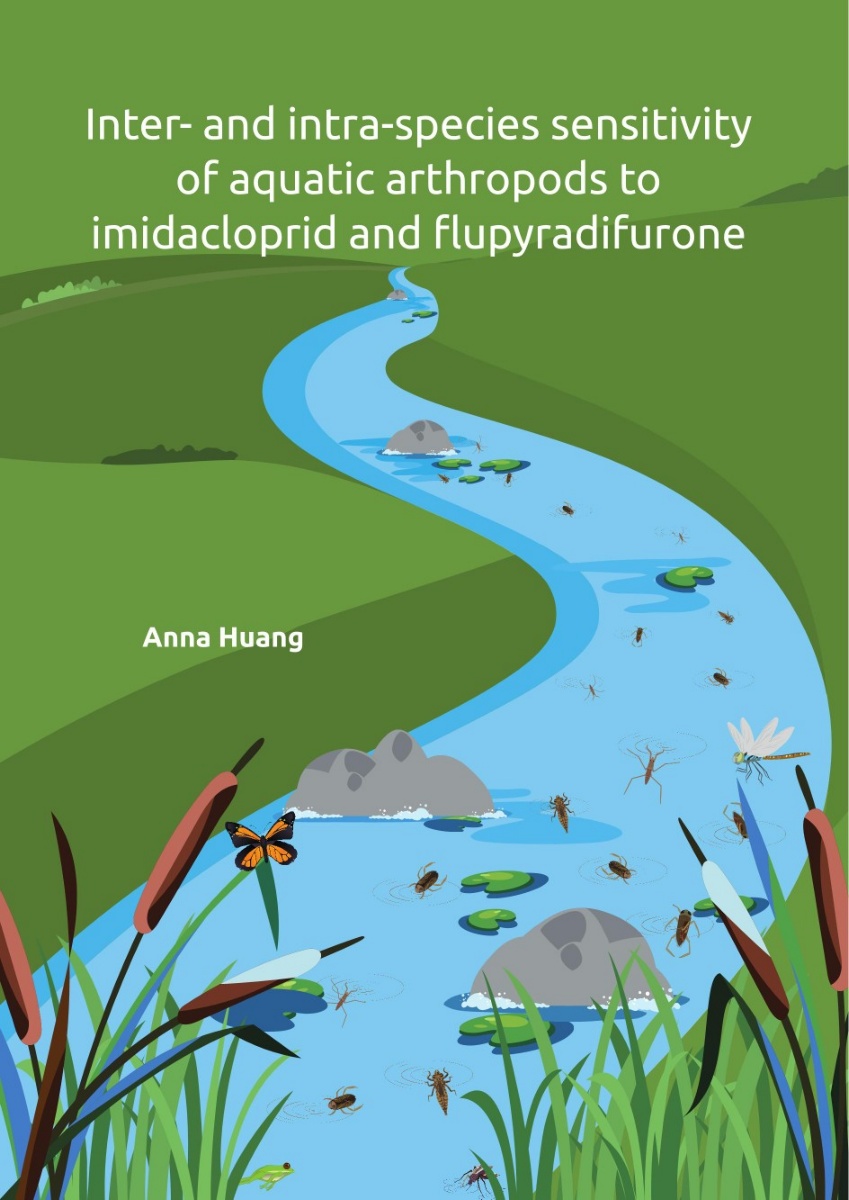


Inter- and intra-species sensitivity of aquatic arthropods to imidacloprid and flupyradifurone
Neonicotinoids (NNIs) are among the most used insecticides in the world to protect crops from harmful insects. The intensive use of NNIs, however, also brings many environmental concerns about aquatic systems since they have been detected in many water systems due to their high water solubility and persistence. In addition, scientific questions and knowledge gaps have emerged from our current understanding of the impact of neonicotinoids on aquatic systems and on protecting our environment. These questions and gaps include (1) why are some aquatic arthropods more sensitive to imidacloprid (IMI), which is the most used NNI, than other species?, (2) how can we explain differences in intraspecific sensitivity?, and (3) does flupyradifurone (FPF, an alternative to IMI) also show time-accumulative toxicity to some aquatic arthropods like IMI? The present work is carried out to address these three research questions by investigating the interspecies and intraspecies sensitivity differences of aquatic macro-invertebrates for two insecticides, IMI and FPF. In Chapter 2, we assess the toxicity and toxicokinetics of imidacloprid and a bioactive metabolite to two aquatic arthropod species, a mayfly species Cloeon dipterum (sensitive to IMI) and an amphipod species Gammarus pulex (less sensitive to IMI). Of the four tested metabolites, only imidacloprid-olefin (IMI-ole) is readily biotransformed from the parent IMI and showed similar toxicity as IMI to both species. Our results on internal kinetics of IMI and IMI-ole, and biotransformation of IMI indicate that the metabolite IMI-ole is toxic and is rather persistent inside the body tissue of both invertebrate species, especially for C. dipterum. In conclusion, as IMI and IMI-ole have similar toxicity and IMI is replaced by IMI-ole which in turn is poorly eliminated by C. dipterum, the overall toxicity is a function of dose and time. As a result, no long-term threshold of effects of IMI may exist for C. dipterum as the poor elimination results in an ongoing increase of toxicity over time for mayflies as also found experimentally in previously published papers. In Chapter 3, we investigate the size- and sex-related sensitivity differences of aquatic crustaceans to imidacloprid. We perform standard acute toxicity and toxicokinetic tests with Gammarus pulex and Asellus aquaticus. For both species, neonates, juveniles and male and female adults are investigated. For both species, the neonates are the most sensitive group. For G. pulex, the sensitivity decreases linearly with size, which can be explained by the size-related uptake rate constant in the toxicokinetic process and size-related threshold value in the toxicodynamic process. For A. aquaticus, female adults are least sensitive to imidacloprid, which could be explained by low internal biotransformation of IMI to IMI-ole. Besides, IMI-ole is more toxic than IMI to A. aquaticus, with differences being 8.4 times for females and 2.7 times for males. In conclusion, we establish size-related sensitivity differences for G. pulex and sex-related sensitivity for A. aquaticus, and intraspecies differences can be explained by both toxicokinetic and toxicodynamic processes. Our findings suggest that to protect populations in the field, we should consider the size and sex of focal organisms and that a pragmatic selection of test organisms of equal size and/or sex can underestimate the sensitivities of populations in the field. In Chapter 4, we assess the acute and chronic toxicity of FPF to aquatic arthropod species and compared it with the toxicity of IMI. We find that compared to IMI, C. dipterum and G. pulex show a slower uptake and faster elimination rates for FPF. FPF is less acutely toxic than IMI based on the HC50 values for aquatic arthropods. The chronic 28d EC50 and NOEC values of FPF were higher or similar to those of IMI. However, FPF inhibited the food consumption of G. pulex at a concentration at the same order of magnitude as the current environmental realistic concentration (NOEC = 0.3 µg/L). More environmental monitoring studies of FPF should be performed to know the environmental concentration of FPF better. In addition, a toxicokinetic-toxicodynamic (TKTD) model parameterised on the acute toxicity data predicted the observed chronic effects of FPF on G. pulex well, indicating that toxicity mechanisms of FPF did not change with prolonged exposure time, which is not the case for IMI. In Chapter 5 and Chapter 6, we explore the sensitivity differences of IMI and FPF to Gammarus pulex at different temperatures. In Chapter 5, we assess the effect of temperature on the toxicokinetics and the chronic toxicity of IMI and FPF towards G. pulex. For both IMI and FPF, the uptake and elimination rate constants increase with temperature but in different magnitudes. In addition, temperature increases the biotransformation rate of IMI and thus accelerates the formation of the toxic metabolite IMI-ole. Furthermore, we find that higher temperatures increases the toxicity of IMI and FPF over time, where the increase is higher for IMI than for FPF. In addition, the adverse effects of insecticides on sublethal endpoints (i.e., food consumption and dry weight) are exacerbated by elevated temperatures. In Chapter 6, DEB models are calibrated to understand the influence of temperature on the effect of IMI and FPF on the growth and survival of Gammarus pulex. Our results show that for both IMI and FPF, the dominant rate and threshold value tend to decrease with increasing temperature for both lethal and sublethal effects, while the effect strength and background mortality tend to increase with increasing temperature. Chapter 5 and Chapter 6 reveal that temperature influences both the toxicokinetic and toxicodynamic processes. For future studies, taking the temperature into consideration in the risk assessment of chemicals is essential in order to better assess the risks of chemicals in a world under global warming. In addition, the effect of temperature on the sensitivity of organisms is also different between species and chemicals. Thus, more studies on the effect of temperature on the toxicokinetics and toxicodynamics of chemicals are needed. Finally, in Chapter 7, I discuss the findings of my thesis, especially the importance of biotransformation in explaining the interspecies and intraspecies sensitivity differences, emphasising the important need to consider the toxic metabolite as well as the temperature in toxicity assessment. The final chapter also provides an outlook on the adverse-outcome-pathway (AOP), which links the toxicokinetic-toxicodynamic models to a deeper biological perspective, to gain more understanding of the intra- and inter-species sensitivity differences in future studies.
| Publicatiedatum | 16 november 2022 |
| Universiteit | Wageningen University |
| Auteur | Anna Huang |
| ISBN nummer | 978-94-6447-346-9 |