Ana Claudia Pacheco Correia
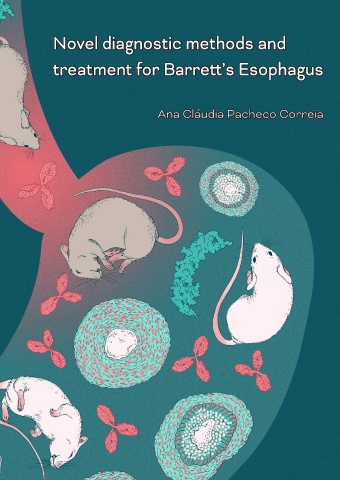


Novel diagnostic methods and treatment for Barrett’s Esophagus
PART 1 – BIOMARKERS FOR THE DETECTION OF BARRETT’S ESOPHAGUS In this part of the thesis, we focus on determining new potential biomarkers for screening BE in the general population. To date, esophageal cancer remains one of the leading causes of death in the general population. According to the World Health Organization (WHO), esophageal cancer is currently rated 8th in incidence and 6th in overall mortality, where EAC represents roughly two-thirds of all esophageal cancer cases. EAC cases are standardly diagnosed based on endoscopic examination, biopsies of esophageal tissue, and finding of intestinal metaplasia during the histological examination. BE is the main risk factor of EAC and can only be diagnosed during endoscopy assessment due to, for example, GERD symptoms. However, only a small percentage of BE patients have GERD symptoms and are still at risk of EAC. To date, it is still unclear what is the prevalence of BE in the general population. Population-wide screening is needed to determine this prevalence. However, it would be inefficient to use endoscopy-based technology, given the high cost and invasive nature. Development of more affordable screening tools and less invasive biomarkers from easily obtained samples for population-wise screening, surveillance, and diagnostic triage, is required. In Chapter 2, we have examined the levels of BMP2, BMP4, and BMP5, in blood samples from BE patients and age- and sex-matched controls as a strategy to be used as a screening tool. All three BMPs tested were elevated in the BE patients group compared to the control group. BMP2 and BMP5 were significantly different, and additionally, after multivariate analysis, BMP5 was associated with an increased risk for BE, with no association with other risk factors, such as smoking, alcohol consumption, obesity, and BE length. BMP5 seems to be an independent risk factor for BE. The limitation of blood biomarkers currently being investigated for the detection of BE, BMP5 is a good addition as a biomarker candidate. PART 2 – CHARACTERIZATION OF ANTI-BMP4 AND ANTI-BMP2/4 LLAMA-DERIVED ANTIBODIES AND MOLECULAR STRATEGY TO MINIMIZE BARRETT’S ESOPHAGUS In the second part of this thesis, we explored the capability of anti-BMP4 and anti-BMP2 llama-derived antibodies in terms of specificity, effectiveness, and their functional potential in different preclinical mouse models. The characterization of anti-BMP2/4 llama-derived antibodies was initially performed by Calpe, S. et al., where the anti-BMP2/4 llama-derived antibodies showed specific inhibition and low off-target effect in vitro, either in different cell lines or in functional organoid culture. In Chapter 3, we continue their characterizations by determining their specificity and neutralization ability compared to commercially available BMP inhibitors. Anti-BMP4 and anti-BMP2/4 llama-derived antibodies were compared with three different types of BMP inhibitors: natural antagonists (Noggin and Gremlin), small-molecules BMPR inhibitors (LDN-193189 and DMHN), and conventional anti-BMP4 monoclonal antibodies. Our llama-derived antibodies were shown to be as specific as the anti-BMP4 monoclonal antibodies. However, these commercial antibodies neutralization ability was inferior compared to our novel llama-derived antibodies. Epitope analysis suggests that monoclonal antibodies do not target the BMPR binding site, resulting in lower efficiency. Both natural antagonist and small-molecules BMPR inhibitors have lower specificity, being able to inhibit the signal not only from BMP4 or BMP2/4 but also from other BMPs in different inhibitory levels. Due to the inhibitory and specificity properties of our anti-BMP4 and anti-BMP2/4 llama-derived antibodies, we further investigated their functional capabilities in different in vivo mouse models. In Chapter 4, we initially describe a novel in vivo cryoablation mouse model. This translational mouse model consists in the study of the regeneration of the neo-epithelia after cryoablation of the squamous-columnar junction of the mice stomach. This model can potentially be used to test new pharmacological therapies for the treatment of neo-epithelial lesions, such as BE. Preliminary data on this animal model showed that by targeting BMP signaling by treating mice with mNoggin after cryoablation, the columnar epithelium failed to regenerate into neo-columnar epithelium and neo-squamous epithelium growth instead. In Chapter 5, we further used this mouse model to test our highly selective BMP2 and BMP4 llama-derived inhibitors. Here, we confirm that BMP2 and BMP4 signaling pathways were highly activated in BE tissue, while BMP7 and TGF-β pathways were highly activated in normal squamous epithelium tissue. Secondly, anti-BMP2 and BMP4 llama-derived antibodies functional abilities were tested in an in vivo organoid model, neo-columnar epithelium in a transgenic Barrett's esophagus model, and on our novel cryoablation model, described in Chapter 4. In the in vivo organoid model for BE, we successfully inhibited the development of columnar BE cells and favored the proliferation of squamous cells. In the conditional Noggin knockdown mouse model, BE-like neo-columnar epithelium is expanded from multi-lineage glands, which, with the inhibition of BMP2 and BMP4 by anti-BMP2/4 llama-derived antibodies, led to the development of a neo-squamous epithelium instead. Furthermore, in the cryoablation mouse model, inhibition of BMP2 and BMP4, upon cryoablation of the mouse stomach squamous-columnar junction, leads to regeneration of neo-squamous epithelium instead of neo-columnar epithelium. Lastly, we observed that the regeneration of the neo-squamous epithelium in the cryoablation mouse model was found to originate from the K5+ progenitor squamous cells using K5-lineage tracing mice. Altogether, since our inhibitors are highly specific for BMP2 and BMP4, they managed to promote squamous regeneration and proliferation without affecting the BMP7 role in the squamous epithelium. Anti-BMP2/4 llama-derived antibodies showed to be highly specific and selective inhibitors in vivo, without side effects. The in vivo models described here helped emphasize BMP2 and BMP4 as a crucial molecular therapeutic target for the treatment of BE.
| Publicatiedatum | 3 november 2022 |
| Universiteit | Universiteit van Amsterdam |
| Auteur | Ana Claudia Pacheco Correia |
| ISBN nummer | 978-94-6469-017-0 |