Dixit Guleria
Uniaxial Orientation of Polyethylene Films for Recyclable Flexible Packaging
21 mei 2025
TU Eindhoven
Open Ebook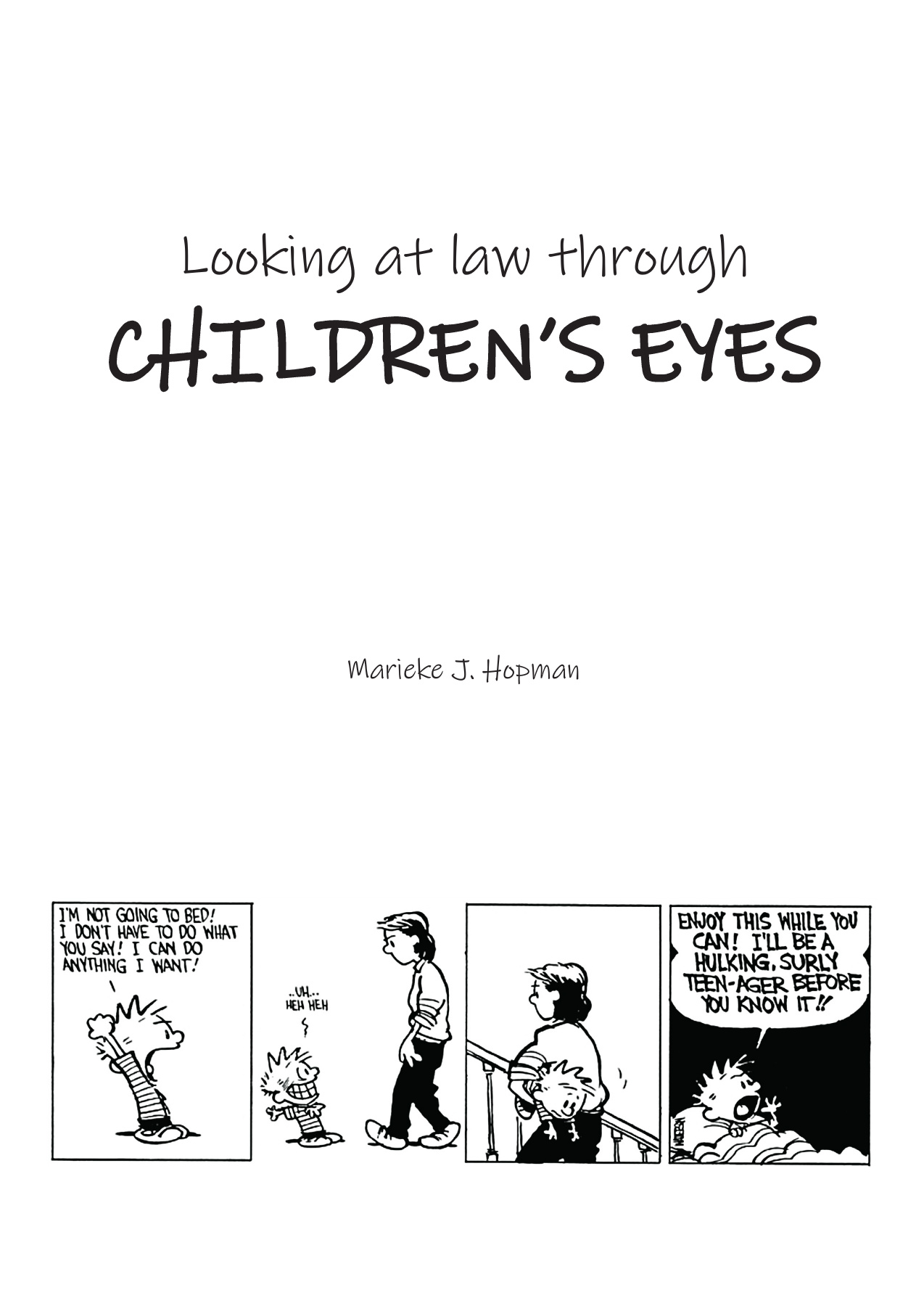
Share this project
Summary
Although all children are supposed to have rights, and children’s rights are considered universal with the 1989 UN Convention on the Rights of the Child being the most ratified human rights convention to date, children’s rights are grossly violated on a daily basis and on a global scale. This thesis aims to contribute to understanding why these rights violations happen and what can be done to improve the protection of children’s rights. It does so by incorporating a child’s perspective in the study of legal norms related to the realization/violation of children’s rights.
For children, law is not necessarily limited to what is stated in state legal codes, of which they are generally unaware, rather it is what their parents or their teachers tell them. When looking at law through children’s eyes, the rules of the household, the classroom, and other legal orders which they are members of, can in many instances be classified as law. This law, that we find when looking at law through children’s eyes, has to be recognized as part of a complete picture of law influencing the protection and/or violation of children’s rights.
To this end, in chapters 1-4 of this thesis, a theoretical framework and accompanying methodology have been developed for a potentially better understanding of children’s rights violations. The hypothesis in these chapters was that, to study children’s rights violations through a framework of legal pluralism, whereby the existence of the different legal orders and its statutory laws would be analyzed as relating to a specific child’s right in a specific area, would lead to an understanding of the legal factors involved in the violation/protection of that right. This framework consists of a definition of law (chapter 1) and a theory on and method for how to empirically find the different laws of different legal orders (chapters 3 and 4). In addition, it was hypothesized that it would be important to take the child’s perspective into account in data collection (chapters 2 and 4), and that analysis would have to take into account the power relations corresponding to the different legal orders surrounding children (chapters 1, 3 and 4).
In chapter 1, it was stated that law has to be understood as a social fact. We only notice that there is a law, because someone (an individual or a group of people) has created a rule that we (the legal community) perceive as law, only because we understand this individual or group that created the rule to be authorized to create laws. The recognition of the legislator, according to the basic norm, is therefore crucial for the understanding of law as law. Likewise, the sovereign only exists because of the recognition of the legal community of the sovereign as sovereign. That is to say that the sovereign exists and has its power only because it is recognized as such by the relevant community. Haugaard’s example made this especially clear: what distinguishes the actual Napoleon from the “napoleons” who are found in psychiatric institutions is not internal to them but the fact the former (unlike the latter) had a substantial ring of reference which validates his power.
A legal norm was argued to be different from a social norm in two ways: first, in a legal situation you cannot stop being a member of the legal community of a legal order when you have done something illegal, from the internal perspective of that order and, second, there is a power inequality between the sovereign and the subject of the legal order.
Lastly, a conceptual framework for the understanding and study of statutory law was introduced, wherein a distinction was made between A) formal written law, B) law for the community and C) hidden law.
formal written law (A) | law for the community (B) | hidden law (C)
Written: + | B1 | C1
Unwritten: - | B2 | C2
Public: + | + | -
In chapter 2, it was shown how, in society, from an adult perspective, children are perceived as being different from adult human beings. Compared to the “normal” adult, who is rational and well behaved, the child is unreasonable, immoral and unsociable – much like a madman. For this reason, the child cannot be granted political freedom, or autonomy and has to be socialized, until s/he has not overcome this condition of childhood. This binary distinction between children and adults is the basis for all law for children and the basis for children’s rights which, in many ways, are different from (adult) human rights.
In chapter 3, it was shown that, when looking at law from the child’s perspective, what is law for the child really depends on whoever the child believes is authorized to make law for her/him and whether this person, or group of people, does indeed create law. Based on this axiom, it is clear that, from the child’s perspective, law can be found in different legal orders surrounding the child, such as the household and the school, and potentially does not even include state law. Looking at law through children’s eyes therefore automatically leads to a legal pluralist understanding of law.
In chapter 4, a methodology was developed to be able to find all law applicable to, and relevant for, the understanding of the protection/violation of a specific child’s rights in a specific socio-legal context. It was stated here that, in addition to legal doctrinal research, to find formal written international and state law, it is necessary to engage in qualitative research with both legislators and addressees of the law of each (potential) legal order related to the child’s right under research. The participants in the research should therefore include the children themselves. However, it was indicated that research has shown that doing research with children as an adult is not easy and that adult researchers have a tendency to “know better” and to be biased towards information obtained from children. It is therefore important to truly listen to children, to allow them to participate in several phases of the research if possible (such as data analysis), and to allow them as much agency in the research process as possible. This, of course, comes with specific ethical considerations, such as that the child has to be enabled to give informed consent to participate in the research (ideally without needing the consent of the parent), has to be guaranteed confidentiality and anonymity, and the researcher and participant should be positioned as equals insofar as possible.
To practically realize this, a concrete method for qualitative research with children was developed, the so-called “micro-research”, which uses inquiry-based science instruction and Socratic dialogue as the foundation for its approach. Practically, a researcher who wants to understand the legal orders surrounding a child’s right, in a specific socio-legal context, has to identify possible legal orders and then, for each order, try to identify which forms of law (formal written law, law for the community and/or hidden law) may apply. Formal written law can be mostly found through legal doctrinal research and literature study; law for the community and hidden law have to be found through empirical legal research. In addition, empirical legal research is necessary to test whether indeed all relevant legal orders have been identified. Data has to be analyzed according to the theoretical framework as developed in chapters 1 and 3.
Subsequently, the theoretical framework and methodology were put to the test in three empirical case studies:
• The child’s right to education in the Netherlands (chapter 5)
• The child’s right to education in the Central African Republic (CAR) (chapter 6)
• The child’s right to nationality in the Turkish Republic of Northern Cyprus (TRNC) (chapter 7)
Each of these case studies includes empirical data from field research as well as data from literature research.
Finally, the third part of the thesis is the conclusion, which includes an answer to the main research question, divided over two chapters: first, a reflection on whether the theoretical framework and methodology as developed in this thesis do indeed lead to a better understanding of children’s rights violations in different cultural, social and political contexts and, if so, in what way, (chapter 8) and, second, whether this understanding can indeed be used to improve the concrete situation of children (chapter 9).