Dixit Guleria
Uniaxial Orientation of Polyethylene Films for Recyclable Flexible Packaging
21 mei 2025
TU Eindhoven
Open Ebook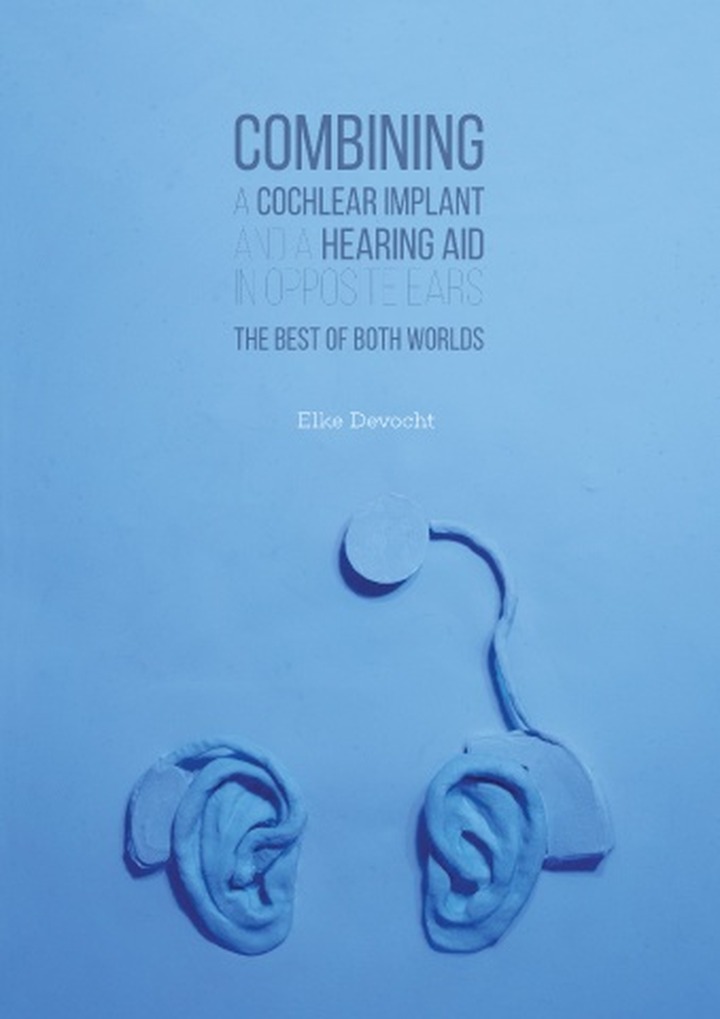
Share this project
Summary
BACKGROUND
Cochlear implantation (CI) is considered standard of care to restore the access to sound in severely hearing impaired subjects. With inclusion criteria broadening over the years, the number of CI candidates keeps increasing. Many still have useful residual hearing in the non‐implanted ear and can therefore be fitted with a conventional hearing aid (HA). When electric hearing by means of a CI in one ear is supplemented with acoustic hearing by use of a conventional HA in the opposite ear, one speaks of bimodal hearing.
Many researchers have demonstrated the benefit from a HA in bimodal listeners. Yet survey studies show that laboratory tests do not always relate to how CI recipients rate their abilities in everyday situations. Moreover little research has been carried out to assess which unilateral CI recipients are most likely to become bimodal users in the first place. Addressing the occurrence of bimodal use and the experiences of bimodal users in daily life are however very relevant topics in counseling unilateral CI recipients and providing them with a tailored fitting. Concerning outcomes, it is known that speech perception in noise still remains one of the most challenging tasks for CI recipients. This refers not only to the intelligibility of the speech but also to the effort it takes to trace speech amongst competing noise and the quality of the sound that is perceived by the CI user. Nowadays directional microphone systems are accessible for HA as well as CI. Both bimodal hearing and directional microphone systems are proven ways to improve performance in noise. They are considered to be complementary, but however have not yet been evaluated conjointly.
Finally, the CI listening experience can possibly further be improved by optimizing its frequency representation, which differs from the natural acoustic pitch percept. It is known that CI recipients can, to a certain extent, adjust to this mismatch and can achieve good levels of speech intelligibility. Yet it is still unclear what could be the potential if the CI fitting better follows the natural tonotopy, especially when electric hearing is combined with natural residual hearing. In the case of bimodal hearing, frequency matched input across ears could augment the bimodal benefit based on bilateral and binaural cues.
OBJECTIVES
The general aim of the presented research was to gain more insight into the field of bimodal aiding. The following objectives were specifically dealt with in the consecutive chapters of this thesis:
(1) Investigate the occurrence of a unilateral CI recipient becoming a bimodal user
(2) Assess bimodal experiences in daily life listening situations
(3) Measure bimodal benefit on speech perception across the range of bimodal users
(4) Evaluate monaural beamforming in bimodal recipients to improve speech perception in noise
(5) Explore the place‐pitch mismatch between electric hearing and natural acoustic hearing
METHODS
A research project was carried out among the population of adult unilateral CI recipients at Maastricht University Medical Center. (1) A retrospective cohort chart review investigated the characteristics of those patients who continued or discontinued the use of their contralateral HA. (2) Secondly, a set of bimodal self‐assessment questionnaires was sent out to query the daily life hearing experiences between both groups as well as within the bimodal group itself. (3) Thereafter a subset of subjects within the bimodal group was tested using a composed bimodal test battery measuring the degree of benefit from the HA aside the CI on different dimensions of speech perception, namely intelligibility, listening effort and sound quality. (4) Finally a subgroup of bimodal listeners was fitted with the same CI speech processor and a state‐of‐the art HA as to evaluate different directional microphone configurations when activated in the CI and/or the HA. (5) In order to explore the electric‐acoustic place‐pitch mismatch, the feasibility of a new calculation method using 3D imaging was investigated by comparing it to the pitch‐matching task performed by a single sided deaf CI recipient.
RESULTS
The database study in Chapter (1) demonstrated a bimodal HA retention rate of more than 60% one year after receiving a unilateral CI. Continuing the use of a contralateral HA was significantly associated with better pure‐tone thresholds and unaided speech scores in the non‐implanted ear, as well as a smaller difference in speech recognition scores between both ears. A combined model of these factors related to bimodal HA retention was presented. Discrimination values were proposed as to identify which unilateral CI recipients are most likely to become bimodal users.
The questionnaire study in Chapter (2) showed that unilateral CI recipients who did not use a contralateral HA score their self‐rated disability, hearing handicap and health related quality of life no different than those who did make use of bimodal aiding. However, when hearing (dis)ability was questioned within the group of bimodal listeners for the different listening situations (CI only, HA only, CIHA together), bimodal benefit could consistently be observed across various daily life hearing situations.
Chapter (3) presented the results of a bimodal test battery for speech perception. Speech intelligibility scores in quiet were better when performed bimodally compared to listening with CI or HA alone. Bilateral and binaural benefits of bimodal aiding were determined for speech intelligibility in spatially separated noise situations. At high signal‐to‐noise ratios, listening bimodally was shown to require less effort than listening with the CI alone. When rating the experienced sound quality of their bimodal hearing configuration, subjects judged it to sound significantly more voluminous and brighter than the HA alone and more voluminous, less unpleasant and less tinny compared to listening with the CI alone.
Chapter (4) illustrated that the application of a monaural beamformer in bimodal listeners could provide a substantial benefit for speech intelligibility in stationary as well as fluctuating noise. Most benefit was seen when beamforming was activated symmetrically in both CI and HA. Listening effort did not show an effect of directivity on top of speech intelligibility. Despite the benefits of directional microphones, there still remained a large difference between the performance of bimodal CI users and normal hearing listeners.
A proof‐of‐principle study in Chapter (5) revealed that the electrically evoked pitch percept matched well with the calculated frequency using the presented 3D imaging method. The new method reduced the mismatch compared to the conventional imaging method and was established as a valuable tool to predict the pitch percept on corresponding cochlear electrode positions. By means of the 3D imaging method the individual electric frequency allocation can be estimated in order to better resemble the natural acoustic tonotopy.
CONCLUSIONS
The majority of unilateral CI recipients continued to use a conventional HA after implantation. Using a HA aside the CI provided substantial benefits in diverse daily life hearing situations. Bimodal benefits were objectively demonstrated across extended dimensions of speech perception. Performance in noise could further be improved by implementing directional microphone systems in both CI and HA. It is hypothesized that reducing the place‐pitch mismatch between electric and acoustic hearing can further improve the bimodal experience. Efforts should be continued to maximize the profit of combining the acoustic and electric worlds of hearing.