Share this project
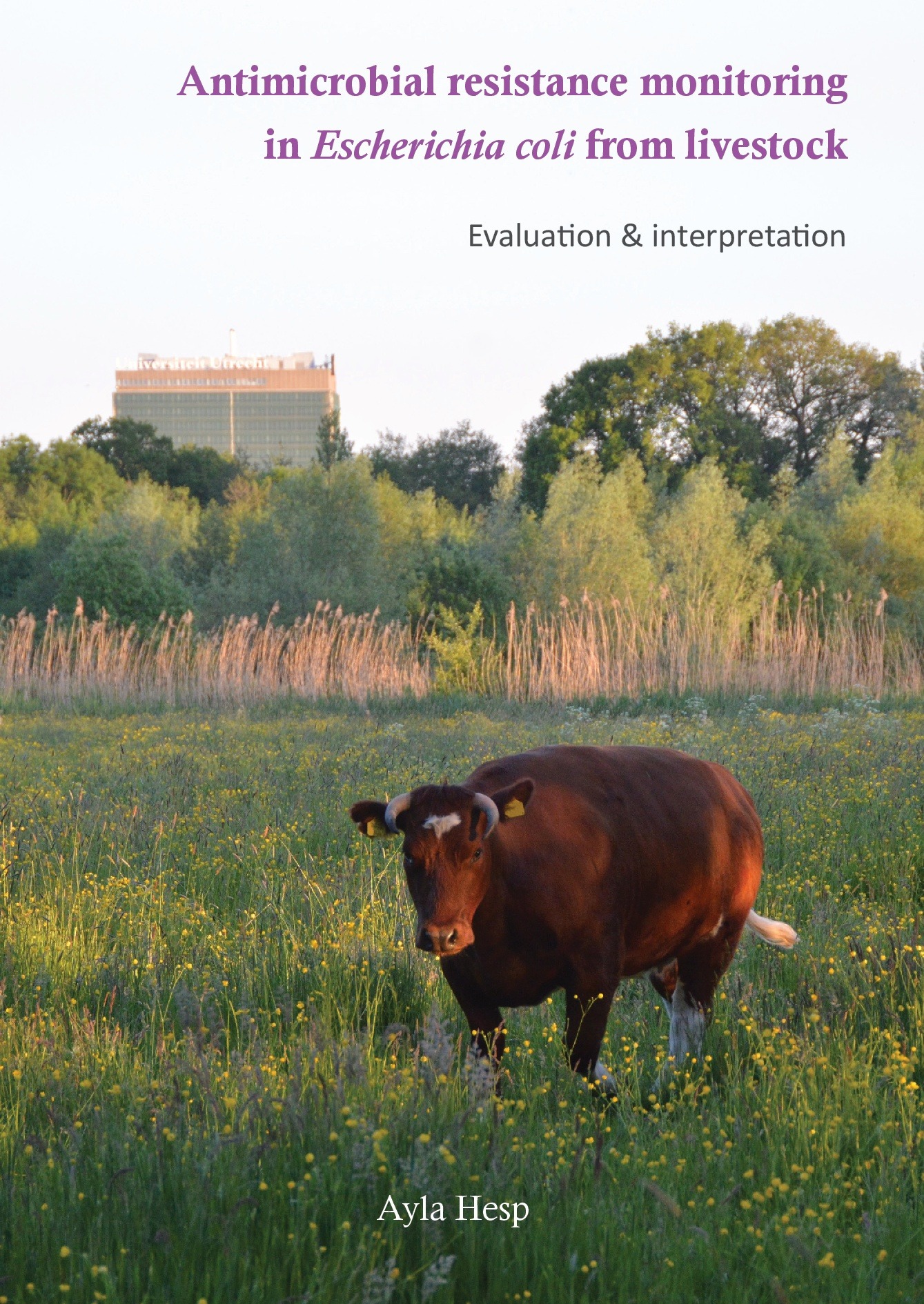
Ayla Hesp
Universiteit Utrecht
Publication date: 11 november 2021
University: Universiteit Utrecht
ISBN: 978-94-6423-504-3
Antimicrobial resistance monitoring in Escherichia coli from livestock
Summary
Effective antimicrobials are essential for adequate healthcare, but unfortunately, worldwide antimicrobial resistance (AMR) threatens this effectiveness, caused by antimicrobial use (AMU). The possibilities for development of antimicrobials are limited, and new antimicrobials will not become widely available. This leaves prudent AMU and other interventions to limit existing AMR as an important strategy and therefore, AMR must be monitored. Production animals are a relevant reservoir to monitor, because AMR may be transmitted to humans directly, or indirectly via food or the environment. This thesis is about monitoring of AMR in livestock as public health hazard in indicator organism Escherichia coli.
In the European Union, monitoring of AMR in animals as public health hazard is performed by European legislation in commensal E. coli and food-borne pathogens Salmonella and Campylobacter. The international legislation has led to harmonisation and standardisation of the sampling and the microbiological methods. Elements not prescribed create room for improvement. The evaluation and interpretation by statistical analysis of AMR monitoring results is not prescribed, but is challenging and will be more complex when the amount of data increases. The updated EU legislation in 2020 has allowed whole-genome sequencing (WGS) as alternative method to culture-based antimicrobial susceptibility testing in AMR monitoring. So far, no statistical approaches were described to evaluate WGS versus culture-based methods. Analyses can be improved for optimal evaluation and interpretation of AMR monitoring data. Therefore, the first aim of this thesis is to evaluate AMR monitoring results with statistical methods. The second aim is to improve the interpretation of AMR monitoring in commensal E. coli. The third aim is to assess WGS versus culture-based methods to monitor AMR.
Chapter 2 aims to model the time trends in AMR monitoring data in commensal E. coli from the Netherlands, 1998 to 2016, in broilers, slaughter pigs, veal calves, to evaluate if trends and trend changes as a result of interventions were observed. The rates of increase or decrease of AMR over time are captured in a model (Poisson regression). Since 2009, as a likely effect of AMU interventions, a decrease over time for most antimicrobials is found in broilers and pigs, for some antimicrobials this decrease is faster than in others. From this evaluation, we conclude that monitoring data from E. coli is suitable to quantify trends over time, to follow AMR in animal populations and measure the effects of interventions.
In Chapter 3 tools are assessed which can be used to evaluate AMR monitoring. The applicability of six different evaluation tools for integrated surveillance was assessed by case studies in eight countries. Results show that although some tools cover relevant aspects better than others, there is not one best tool for evaluation of integrated AMR surveillance: the suitability of the tool depends on the evaluation objective. In general, more scientific expertise on evaluation of AMR monitoring from an integrated perspective is needed. An online platform was created in this consortium to further develop and share evaluators experience.
In Chapter 4, a need of policy makers is addressed for a clear overview of AMR monitoring outcome, to develop and adjust policy timely. This chapter aims to summarise AMR over multiple antimicrobial classes, to develop AMR monitoring outcome indicators. A multivariate cluster analysis was applied to AMR monitoring data from the Netherlands, 2007 to 2018, in broilers, slaughter pigs, veal calves, and dairy cows. This resulted in four clusters containing combinations of resistance to multiple antimicrobial classes. These clusters are useful as monitoring outcome indicators, because they distinguish different levels of multidrug resistance (i.e. resistant to three or more antimicrobial classes) and indicate development of AMR over time and in the different animal sectors. The clusters were compared with outcome indicators reported by the European Food Safety Authority (EFSA), and were found more specific and potentially more practical. In order to apply them for benchmarking of AMR, we recommend to verify this cluster methodology with data from different countries.
In Chapter 5, AMR is described in commensal E. coli from livestock in several European countries, and the correlation between AMR and AMU in several European countries. The relationship with AMU and the outcome indicators reported by EFSA was evaluated. From this analysis, it could be concluded that there was a large variation of AMR and AMU between different countries. Based on the correlations, AMR for some antimicrobial classes was prevalent independent of AMU. The strength of correlations differed per antimicrobial class. The indicators used by EFSA did not correlate to overall AMU, indicating they are not specific.
Chapter 6 compares AMR monitoring in commensal E. coli isolated from healthy animals with clinical resistant E. coli from diseased broilers in the Netherlands, 2014 to 2019. Differences and similarities in the two types of AMR monitoring are described. Monitoring methodology in the two programs is different as they have different aims. The sample is different, the test panels of antibiotics are different (focused on human versus animal health) and the criteria (breakpoints) to determine resistance differ. Despite these differences, resistant percentages are similar for most antimicrobials. The random sample of commensal E. coli from healthy broilers seems more suitable to monitor time trends in AMR. The selected sample from diseased broilers results in a higher chance to detect low prevalent resistance. The two surveillance systems are complementary, so it is advisable to monitor AMR both in commensal E. coli from healthy broilers and in clinical E. coli from diseased broilers.
In Chapter 7, we used Bayesian latent class analysis to evaluate the accuracy of WGS (Illumina sequencing) versus culture-based AST to monitor AMR, without assuming one test as the gold standard. This was analysed in three animal populations (N=150, 50 bacterial isolates per population): veal calves, pigs, and broilers, from fresh faeces collected at farms in the Netherlands in 2014-2015. Resistance genes (identified with the ResFinder 3.0 database) were compared with broth microdilution. This showed that WGS is just as suitable to monitor AMR in E. coli from livestock as culture-based AST: both methods have high sensitivity and specificity.
Chapter 8 describes the additional benefits of WGS, in the same 150 commensal E. coli isolates from livestock. WGS reveals characteristics of resistance genes and their genetic environment (for example location on mobile genetic elements: plasmids), and relatedness of bacteria: crucial information determining the spread of resistance. In this data, no spread of genetically related bacteria was found in animal species. On some farms, identical strains were found in multiple animals, with resistance to the same antimicrobial classes and plasmids of the same replicon types. Consequently, sampling one animal per farm instead of multiple animals leads to a representative bacterial isolate collection. This indicates that the current methodology in AMR monitoring prevents bias in monitored AMR trends. As a consequence of the sequencing method (short read sequencing), plasmid location could be confirmed for few resistance genes. To improve the quality of WGS as tool for AMR monitoring, short read sequencing should be combined with long read sequencing for optimal AMR monitoring.
The conclusions from this thesis are that E. coli is a useful indicator to monitor AMR in livestock, provided that bias in the sampling is prevented, and that proper statistical methods are used for the evaluation and interpretation. As we show, the randomized sample from healthy animals is well suited to analyse AMR trends over time. Other types of samples such as risk-based sampling (for example from diseased animals) are useful to detect rare or emerging resistance, but should be used next to a random sample to ensure representativeness for the whole animal population. To improve interpretation of AMR monitoring data, quantitative analyses should be incorporated in routine monitoring, because in the future the amount and complexity of data will further increase. The validity of the statistical approaches in this thesis should be further investigated in data with more variation, from different countries. We promote further evaluation of AMR surveillance systems, and the analysis of AMR monitoring outcomes should be harmonized, next to already existing harmonization of laboratory methods.
See also these dissertations

Janine de Wit
Managing water excess and deficit in agriculture
29 mei 2026
Wageningen University
Open Ebook



Anastasia Galkina
Dear Diary: Advances in Experience Sampling Methodology Studies
16 april 2026
Universiteit Maastricht
Open Ebook
Qi Yu
The impact of a negative energy balance on porcine phenotypic and granulosa cell molecular responses
18 mei 2026
Wageningen University
Open Ebook


Zhi Wang
Political embeddedness and corporate strategies in China
4 juli 2018
Radboud Universiteit
Open EbookWe print for the following universities