Rick Volleberg
Intracoronary Optical Coherence Tomography
9 oktober 2026
Radboud Universiteit
Open Ebook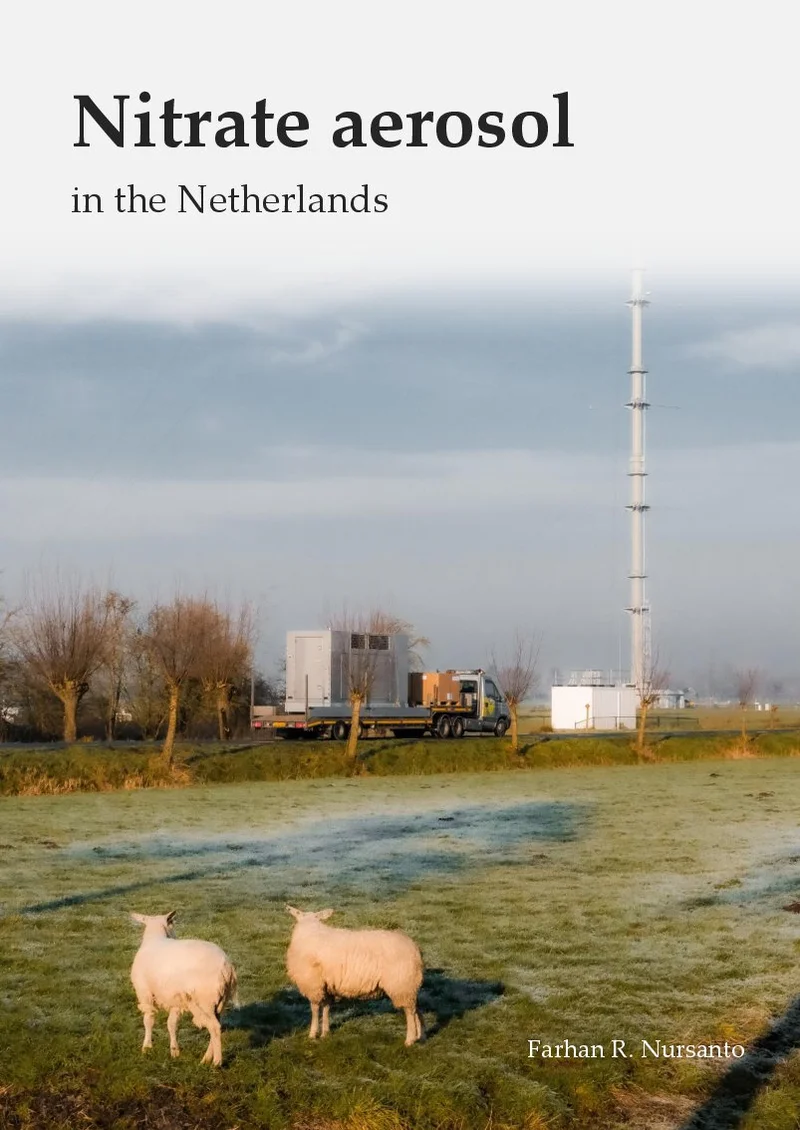
Share this project
Summary
Reactive nitrogen species such as ammonia (NH3) and nitrogen oxides (NOx) are essential for sustaining life on Earth, but their excessive concentrations harm ecosystems. With a high nitrogen deposition rate from the atmosphere, the Netherlands faces a nitrogen crisis that degrades its natural habitats. Current methods for studying the fate of nitrogen do not consider the speciation of nitrate between ammonium nitrate (NH4NO3) and organic nitrates, nor organic nitrate gas-particle partitioning, both of which determine the lifetimes, transport, and deposition of reactive nitrogen. These missing processes can lead to an inaccurate estimates of nitrogen deposition fluxes and, consequently, inefficient emission reduction strategies.
This thesis investigates the sources, sinks, and atmospheric processing of nitrate in the Netherlands, with a focus on nitrate aerosol formation and gas–particle partitioning. New particle formation and growth events involve the clustering and condensation of low-volatility compounds, including inorganic salts and highly oxidized organic molecules — some including nitrate functional groups — leading to the formation of nitrate-containing aerosol particles. The partitioning of nitrate from the gas-phase to the particle-phase depends on factors such as volatility, molecular weight, oxidation conditions, precursor composition, and temperature.
We identify the physical and chemical properties of nitrates using observations from ambient measurements and chamber experiments, as part of both intensive measurement campaigns and long-term monitoring. The role of different chemical species during new particle formation and growth is examined using a hybrid positive matrix factorization (PMF) analysis (Chapter 2). Nitrate aerosol is further speciated into inorganic and organic components using a NOx+ ratio method applied to aerosol mass spectrometry measurements (Chapter 3). The gas–particle partitioning and bulk volatility of organic nitrates are investigated through atmospheric chamber experiments (Chapter 4) and ambient observations (Chapter 5).
Chapter 2 focuses on understanding the role of different chemical species during new particle formation and growth events using measurements from the Ruisdael Land–Atmosphere Interactions Intensive Trace-gas and Aerosol (RITA) 2021 campaign in Cabauw, central Netherlands. Aerosol chemical composition measured by aerosol chemical speciation monitor (ACSM) and particle number size distributions are analyzed together using a hybrid PMF. This approach correlates organic mass spectra and inorganic species with specific particle size ranges and the results are analyzed further to identify their source regions. PMF analyses across spring, summer, and autumn identify four aerosol populations. Nucleation-mode particles are associated with ammonium, sulfate, and less-oxidized organics and are linked to westerly and southwesterly airmasses originating from the Rotterdam port and industrial region. Accumulation-mode particles are characterized by ammonium, nitrate, and hydrocarbon-like organic aerosol and are related to westerly and southerly airmasses rich in NH3 and NOx. Two additional aerosol populations are not size-resolved: a mixed inorganic–organic aerosol influenced by multiple sources, and more-oxidized organic aerosol originating from long-range transport over continental Europe. These results show that oxidized organics and ammonium sulfate play a key role in new particle formation, while nitrates play a larger role in particle growth.
Chapter 3 focuses on the speciation of particulate nitrate into NH4NO3 and organic nitrate. This has historically been achieved using the NO2+/NO+ ion ratio produced during nitrate fragmentation in the standard vaporizer (SV) of a high-mass-resolution time-of-flight aerosol mass spectrometry (HR-ToF-AMS), known as the NOx+ ratio method. While this approach is well established for SV-HR-ToF-AMS, this chapter presents the first adaptation of this method for application to the unit-mass-resolution time of flight ACSM (UMR-ToF-ACSM) with capture vaporizer (CV), which is widely used in atmospheric aerosol monitoring networks as a fine particle (PM2.5) composition monitor. The uncertainty of the method is ∼30 % for total particulate nitrate concentration <1 µg · m−3 and ∼10 % for total particulate nitrate concentration >4 µg · m−3. The method is validated using co-located CV-ACSM and SV-AMS measurements during the CAINA (Cloud-Aerosol Interactions in a Nitrogen-dominated Atmosphere) AIDA (Aerosol Interaction and Dynamics in the Atmosphere) chamber campaign.
Organic nitrates include a large range of compounds. Chapter 4 explores the formation, gas–particle partitioning, molecular weight, and yield of organic nitrates under controlled conditions in the SAPHIR (Simulation of Atmospheric PHotochemistry In a large Reaction chamber) conducted during the CHANEL (Household Chemicals Amplifying Urban Aerosol Pollution) 2024 campaign. Typical chamber studies employ single-compound precursors to reduce complexity and study specific chemical mechanisms, which do not represent the complex ambient atmospheric mixture. In contrast, the study presented in Chapter 4 introduces complex urban emission mixtures under realistic oxidation conditions in an atmospheric chamber, allowing a more accurate characterization of organic nitrate formation in the real-world atmosphere. Emission mixtures are constructed from the fingerprint of source-specific emission profiles, including volatile chemical products (VCPs), cooking emissions, and traffic, as well as more complex scenarios representing present-day and future urban environments. The reaction products are characterized using a total NOy monitor, AMS, gas chromatography, and high-mass-resolution chemical ionization mass spectrometry. The results show the importance of unsaturated volatile organic compounds (VOCs) in determining the organic nitrate yield. Enhanced particle phase partitioning is observed under nighttime oxidation by NO3 compared to daytime oxidation by OH. The average molecular weight of particulate organic nitrate produced under nighttime conditions (331±13 g · mol−1) is higher compared to daytime conditions (258±24 g · mol−1), driven by a larger contribution from oligomers. Similarly, the mass fraction of organic aerosol mass attributed to particulate organic nitrate is higher by a factor of 2.6 to 4.5 under nighttime conditions compared to daytime conditions, reflecting both increased molecular weight and lower temperatures favoring condensation. Despite differences in precursor mixture complexity and the variability of the average molecular weight of particulate organic nitrates, the bulk gas-particle partitioning coefficients of organic nitrate mixtures are consistent with the modeled volatility of oxidized monoterpene nitrates using the group contribution method SIMPOL.1 (10−4 to 10−2 m3 ·µg−1 at 18–40 °C). These findings improve our understanding of the sources, molecular weight, and volatility of bulk organic nitrate from controlled simulations of complex urban emissions mixtures.
The knowledge from Chapter 4 is subsequently applied in Chapter 5 to long-term ambient measurements in Cabauw (2023–2025). We examine the seasonal and airmass-dependent variability in nitrate aerosol pollution episodes using gas-phase species and particle-phase species observations, meteorological data, and back trajectory analysis. The adapted NOx+ ratio method (Chapter 3) is applied to quantify inorganic and organic nitrate fractions, while gas–particle partitioning is evaluated using combined ACSM and total NOy measurements, similar to Chapter 4. These observations are integrated with meteorological data and Copernicus Atmosphere Monitoring Service (CAMS) reanalysis data to characterize nitrate pollution episodes (>0.8 µg · m−3). Wintertime pollution episodes (October–February) occur more frequently and are associated with lower total organic nitrate mixing ratios (2–4 ppb) and smaller particulate organic nitrate fractions (14–43 %) compared to summertime episodes (March–September; 7–11 ppb; 30–58 %). This contrast is associated with a nitric acid (HNO3)-dominated regime in winter, where reduced photochemistry limits organic nitrate formation and low temperatures favor condensation of ammonium nitrate and less volatile organic nitrates. In summer, enhanced photochemistry promotes the organic nitrate (RONO2) formation, and higher temperatures reduce particle-phase partitioning. Airmass analysis shows that slightly over half of nitrate pollution episodes (53 %) are associated with urban coastal airmasses, characterized by higher total nitrate concentrations but lower organic nitrate fractions due to proximity to NOx emission hotspots. These findings demonstrate that the evaluation of nitrate pollution mitigation strategies must account for seasonal chemical regimes, and should consider both inorganic and organic nitrate aerosol.
Chapter 6 synthesizes the key findings of the thesis and identifies remaining knowledge gaps. The results emphasize: 1) the influence of emission source profiles on aerosol composition, 2) the significant contribution of organic nitrate to the aerosol mass in the Netherlands, and 3) the role of seasonal conditions in determining the relative production of HNO3 and RONO2 production from NOx oxidation. From these findings, we highlight the lack of accounting for organic nitrates in nitrogen transport and deposition models, which can affect emission reduction strategies. We highlight major areas for improvements including: 1) evaluation of emission reduction strategies taking into account seasonal NOx sink regimes, 2) observation-constrained chemical transport and deposition modeling from NOx hotspots to nature areas, and 3) more equipped monitoring site facilities with higher time- and mass-resolution VOC and organic aerosol measurements to better characterize organic nitrates.
Overall, this thesis advances understanding of nitrate sources, sinks, and chemical processes in a nitrogen-dominated atmosphere. By developing tools applicable to long-term monitoring sites, characterizing organic nitrate properties under realistic atmospheric conditions, and elucidating the drivers of nitrate pollution episodes, this work provides a foundation for more accurate representation of inorganic and organic nitrate in chemical transport and nitrogen deposition models.