Marielle de Vaal


More Than a Snack
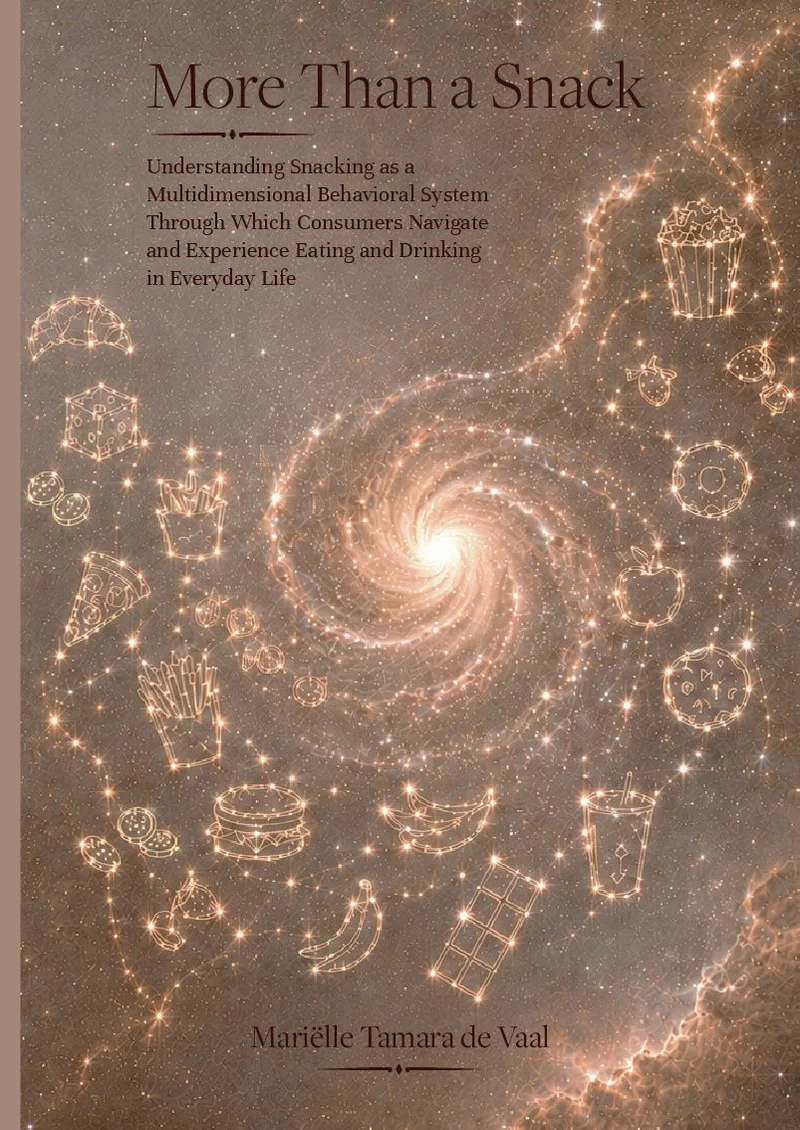
Over the past decades, eating and drinking patterns have undergone a fundamental transformation. The traditional structure of three main meals per day is increasingly giving way to a more flexible, fragmented, and individualized pattern of consumption, in which snacking is no longer positioned between meals, but is becoming the structure itself. Within this broader societal shift, driven by the global megatrend snackification, consumers increasingly engage in multiple, situational eating and drinking occasions throughout the day to fulfil a variety of physiological, psychological, and social needs. Despite its growing prevalence, snacking has long been framed as an inherently unhealthy behavior. This thesis challenges this simplified narrative by demonstrating that snacking cannot be reduced to a purely unhealthy behavior. Instead, snacking can also be a healthy behavior, and its implications for health depend on how it is embedded within consumers’ everyday lives. By adopting a situational and meaning-based perspective, this thesis shows that snacking is best understood as a dynamic and multidimensional behavioral system, instead of a rigid and fixed category of consumption. The overall aim of this thesis was to advance the understanding of contemporary snacking behaviors by examining how snacking consumption and perceptions are constructed through the interaction of product-, context-, and consumer-specific determinants, as well as through consumers’ semantic conceptualizations and meaning-making processes. To achieve this aim, the FOODLOOP study was conducted among 264 Dutch Millennials using a mixed-methods approach. Real-life snacking behaviors were captured longitudinally over one year throughout the four different seasons, using mobile-based Ecological Momentary Assessment (EMA), complemented with computational analyses and 37 qualitative interviews with cohort members to explore consumers’ perceptions and semantic interpretations of snacking. KEY FINDINGS Across the four empirical chapters, several key insights emerged. • Snacking is highly prevalent and situationally embedded. Dutch Millennials were shown to snack frequently (on average 4.5 times per day), with a substantial proportion of snacking occasions consisting of more nutritious products such as fruit, bread, and beverages, showing that snacking is not merely unhealthy but can also have a positive health impact. Snacking behaviors varied across physical, social, and temporal contexts, demonstrating that snacking cannot be understood through product characteristics alone. • Food Choice Motives (FCM) play a central role in shaping consumers’ snacking behaviors. Dutch Millennials do not merely snack out of hunger or thirst, but also out of habit, convenience, energy needs, relaxation or social interaction. Computational analyses revealed that FCM are the strongest predictors of both snack choice and nutritional quality. Health-related motives were associated with more nutritious choices, while hedonic motives such as pleasure were linked to more indulgent consumption. These findings highlight the importance of understanding not only what people eat, but why they eat it. • Snacking is a meaning-laden behavior shaped through language and perception. Consumers differentiate between distinct forms of snacking using semantic terms such as “In-betweener”, “Sweet Treat”, and “Snack”. These terms are not neutral, but reflect culturally embedded meanings, moral connotations and distinct roles, ranging from functional and health-oriented to indulgent and hedonic. Importantly, these meanings are not fixed, but shift across situations, indicating that consumers actively construct the meaning of their snacking experiences. • Beverage snacking emerges as a distinct and underexplored domain. Beverages, such as coffee, soda, alcoholic and dairy beverages, are frequently consumed as standalone snacking occasions and follow their own consumption logics that are different from those for solid foods. A duality was identified between utilitarian beverage snacking (functional, routine-driven) and hedonic beverage snacking (social, indulgent). Similar to food, the meaning of beverage snacking is not determined by the product itself, but by the interaction of situational determinants. Beverages should be considered as a distinct snacking entity within dietary research and practice. Towards a New Conceptualization of Snacking Taken together, the findings of this thesis challenge traditional dichotomy between meals and snacks. Instead, eating and drinking behaviors are better understood as a situational continuum, in which consumption occasions are fluid and constructed in relation to context, motives driving consumption, and the meaning consumers attach to it. This thesis therefore proposes a conceptual shift, where snacking should be understood as a multidimensional behavioral system, in which physiological needs, psychological motives, social interactions, temporal rhythms, and cultural meanings continuously interact. Within this system, consumers emerge not as passive recipients of food environments, but as active meaning-makers, who use snacking as a way to navigate and structure their everyday lives. Practical implications This perspective has important implications for research, policy, and practice. It calls for: • Moving beyond product- and nutrient-based approaches toward situational and meaning-sensitive frameworks to better align with the everyday contexts in which snacking occurs. • Incorporating Food Choice Motives and contextual dynamics into dietary research and interventions. • Recognizing the role of culturally-driven language and semantics, as well as broader socio-cultural trends such as snackification in shaping consumers’ dietary behaviors. • Developing tailored situational-sensitive interventions, which account for contexts where different forms of snacking occur, the roles snacking fulfills (functional versus hedonic), the motives underlying consumption, culture- and language-specific terminology, and broader socio-cultural trends shaping behavior, to better align with how consumers actually experience eating and drinking in everyday life. For you as a consumer, this means that developing a healthier dietary pattern does not require restricting or avoiding snacking. Rather, it begins with awareness of your own patterns. Ask yourself: Why do I snack? What do I choose? When, where, and with whom? What does snacking mean to me? And what best aligns with me in a given moment? Through this awareness, you may begin to more clearly recognize what supports you and what does not when it comes to your eating and drinking behaviors. This supports a more intentional alignment between your motives, goals, contexts, and choices. In this way, snacking becomes a flexible and meaningful part of daily life, which you can shape in ways that support your health, well-being, enjoyment, connection with others, and ultimately how you experience life in each present moment. IN CONCLUSION This thesis demonstrates that snacking is much more than simply eating or drinking between meals. It is a way through which consumers shape, navigate, give meaning and ultimately experience their everyday lives, emerging from a dynamic interplay between needs, habits, products, contexts, language, culture, trends, and the meanings attached to snacking. Viewing snacking in this way opens up space for a more realistic, human-centered, and effective approach to nutrition and health.
| Publicatiedatum | 25 augustus 2026 |
| Universiteit | Wageningen University |
| Auteur | Marielle de Vaal |
| ISBN nummer | 978-94-6534-511-6 |