Marisa Lourenco
Exploring Catharanthus roseus for anticancer alkaloid production in vertical farming systems
13 juli 2026
Overig
Open Ebook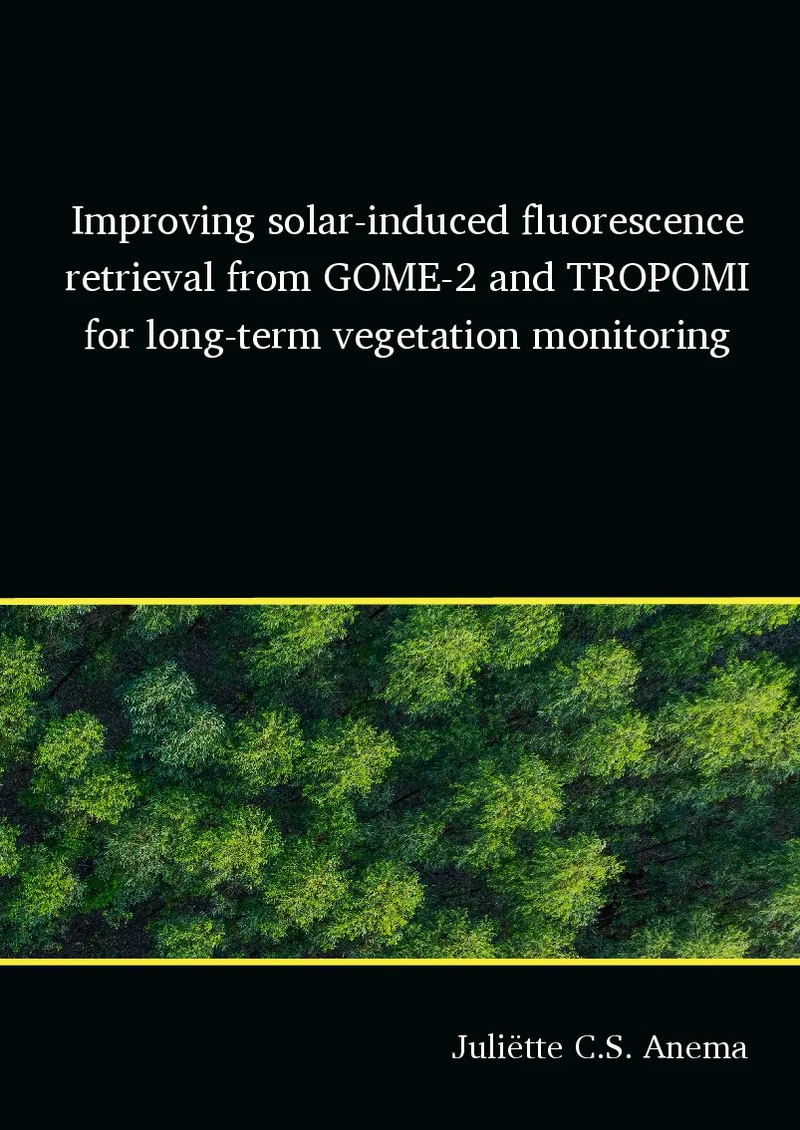
Share this project
Summary
Carbon uptake by terrestrial vegetation plays a key role in mitigating climate change by damping atmospheric CO2 buildup. Consequently, land-based mitigation technologies (LMTs) have become central to climate strategies. LMTs are defined as deliberate human actions aimed at enhancing or maintaining the land’s capacity to sequester carbon, including practices such as reforestation and agroforestry. Despite the recognised critical role of LMTs in achieving the Paris Agreement targets, the amount of carbon sequestrated and its long-term permanence remains poorly understood. Moreover, the magnitude and variability of the global land carbon sink itself remain highly uncertain. Hence, these uncertainties highlight the need for robust observational constraints on vegetation activity to improve our understanding of the land carbon sink and to support climate policy decision-making. To meet this demand, this thesis concentrates on developing and using a climate solar-induced fluorescence (SIF) data record derived from satellite retrievals to monitor vegetation dynamics and photosynthetic carbon uptake. SIF captures the faint optical signal (650–850 nm) emitted by vegetation during photosynthesis, the process through which plants assimilate CO2 . Therefore, SIF observations provide valuable and relatively direct insight into plant photosynthetic activity.
This thesis serves a dual connected aim. The first objective is to examine the use of satellite-based SIF as a robust monitoring tool for vegetation dynamics. Specifically, we focus on its use to quantify the impact of LMT implementation, as part of the Land Use-Based Mitigation for Resilient Climate Pathways (LANDMARC) project, funded by the European Union Horizon 2020 program. For SIF to meet its full potential as a monitoring tool, a consistent long-term record is needed. Long-term multi-decadal observations facilitate the detection of continuing LMT efforts and the capturing of climate variability. Yet, such climate records of SIF are sparse. Operational life times of individual sensors are limited (generally around 10 years). Additionally, differences in sensor characteristics complicate harmonising across sensors to create a single coherent long-term record. This challenge leads us to the next objective: constructing a climate satellite-based SIF record exhibiting spatial and temporal stability. Satellite sensors from the Global Ozone Monitoring Experiment-2 (GOME-2) series were exploited to retrieve far-red SIF data (from 734–758 nm) as part of EUMETSAT’s Atmospheric Composition Satellite Application Facility (AC SAF).
The GOME-2 series was selected because, taken together, it provides a continuous operational record (since October 2006) spanning over 18 years (and counting). The series consists of three sensors (GOME-2A, GOME-2B, and GOME-2C) with an identical design, launched in sequence on board the Metop satellites. The GOME-2 sensors enable SIF retrieval at almost daily global coverage, supporting continuous global monitoring. Their identical design offers high potential in constructing a harmonised, coherent across-sensor SIF record, by minimising differences introduced by varying sensor characteristics. However, data quality issues within each record limit their use for robust monitoring and for across-sensor harmonisation. In particular, GOME-2 observations are heavily affected by calibration issues, such as reflectance degradation, in which the sensor loses sensitivity to the measured light. In this thesis, we found that these effects are present from early in each record, exhibit sensor-specific patterns, and vary significantly with time, wavelength, and scan angle (Chapters 2, 3, and 5). Failing to correct these instrumental artefacts thoroughly can cause false temporal trends in SIF and introduce east-west biases in the observations. Moreover, the sensor-specific artefact effects cause observations from the different GOME-2 sensors to diverge over time, despite their identical design. Hence, it’s essential to properly correct for these instrumental artefacts. The following paragraphs describe how these challenges were solved.
The retrieval of consistent SIF is first assessed by examining how the retrieval algorithm could accurately account for these internal inconsistencies. Here, we build on the methodological heritage of the Solar-Induced Fluorescence of Terrestrial Ecosystems Retrieval (SIFTER) algorithm, initially developed for GOME-2A retrieval. Chapter 2 presents the updated version, SIFTER v3, which introduces an advanced correction compensating for the observed degradation patterns. This correction explicitly models the behaviour of the reflectance degradation and its key dependencies of time (at daily time steps), wavelength, and scan angle throughout the entire record. The latter factor is previously neglected in GOME-2 SIF retrievals. Our findings highlight the need to account for the dependence of GOME-2 reflectance degradation on scan position. It introduces an east-west bias of similar magnitude to the time-dependent degradation (up to 8 % for GOME-2A), whose substantial impact on record stability is widely recognised. Additional algorithmic improvements further enhanced the retrieval robustness of SIFTER v3. The improved algorithm advances the spatiotemporal consistency of SIF and provide a stable foundation for robust vegetation monitoring. This stability was demonstrated by using SIFTER v3 to retrieve GOME-2 SIF from GOME-2A (2007–2017, Chapter 2), GOME-2B (2012–2023, Chapter 3), and GOME-2C (2019–2024, Chapter 5). The degradation correction settings were tuned for each sensor to align with the observed degradation characteristics.
Next, we assessed how well the individual GOME-2 records could function as a single coherent record, demonstrated using GOME-2A and GOME-2B SIF in Chapter 3. We found that the calibration corrections within SIFTER v3 not only resolved internal inconsistency but also served as the foundation for harmonising the two records. The retrieved GOME-2A and GOME-2B SIF records show strong coherence across various regions. However, in some areas, a slight step change is observed in the time series at the transition from GOME-2A to GOME-2B. This thesis presents a framework to detect and, when needed, correct for such step-change effects. Aside from instrumental effects, consistent sampling is shown to play a substantial role in ensuring temporal consistency. During the overlapping period of GOME-2A and GOME-2B (July 2013 to December 2017), the sensors observe SIF under different viewing geometry ranges (−35° to +35° versus −54° to +54°). This sampling difference can lead to discrepancies of up to 15 % between GOME-2A and GOME-2B across regions and periods with high vegetation activity. Co-sampling under similar viewing conditions reduces the bias between GOME-2A and GOME-2B SIF within 2 %. The robustness of the combined GOME-2A and GOME-2B SIF record, and its suitability as a single coherent dataset, is underscored by its high correlation with independent GPP data from the global FluxSat dataset. Together, these results demonstrate that the GOME- 2A and GOME-2B data can be used as a single coherent long-term record through calibration and intersensor bias corrections, and consistent sampling.
Preliminary evaluation of GOME-2C, in Chapter 5, indicates that it captures similar seasonality and magnitude as GOME-2A and GOME-2B over most regions, but with noted differences over the Amazon. This discrepancy may reflect more substantial South Atlantic Anomaly (SAA) effects over GOME-2C. The SAA denotes a region over the South Atlantic and South America where elevated radiation levels can introduce noise into satellite observations. Despite this discrepancy, the GOME-2C results overall indicate the potential to combine observations from all three GOME-2 sensors into a continuous time series from 2007 to the present (and counting).
Furthermore, we demonstrated the strong potential of SIFTER v3 to extend SIF retrieval beyond GOME-2 sensors. We present the first results of SIF retrievals from the TROPOspheric Monitoring Instrument (TROPOMI) using SIFTER v3. The consistent application of the retrieval algorithm across different sensors helps limit intersensor biases and enables comparisons of SIF across missions. SIF comparability across missions benefits from complementary sensor characteristics, such as different overpass times. For instance, TROPOMI offers an overpass time in the early afternoon (13:30), whereas GOME-2 observes in the late morning (09:30). We retrieved TROPOMI SIF for a single day (6 February 2024) over the Amazon (shown in Chapter 5). Minimal adaptations to SIFTER v3 were made to optimise its performance, while maintaining consistency in retrieval methodology. A comparison of our TROPOMI SIF data with the alternative TROPOSIF product indicates that SIFTER v3 performs better over this area and on this day. Notably, SIFTER v3 resulted in more than three times as many valid retrievals (62 % versus 18.6 %). This provides confidence in the algorithm’s ability to retrieve robust long-term SIF from both GOME-2 and TROPOMI.
The demonstrated ability to construct long-term SIF records supports the use of satellite-based SIF for vegetation monitoring. In our 2024 study (Chapter 4), we examined how SIF could be used to quantify the impact of interventions, such as LMT implementation, on photosynthetic carbon uptake. We evaluated the effects of two distinct changes in vegetation cover: (i) eucalyptus wildfire in Australia and (ii) large-scale reforestation in China, using the then-available SIF data from TROPOMI (Caltech product) and GOME-2A. Although the GOME-2A record spanned from 2007 to 2018, only part of it was suitable for time series analysis due to instrumental artefacts that affected temporal stability. This instability motivated the development of the improved SIFTER v3 algorithm, published in 2025 (Chapter 2). Finally, the reforestation impact was assessed from 2007 to 2012, with a simple degradation correction applied to ensure temporal stability. Our results demonstrate the strength of satellite-based SIF in capturing vegetation responses to interventions, including both prompt, disruptive and slower, more gradual land-cover changes. We showed how SIF can be used in combination with supporting in situ and satellite data, for example, land use and soil moisture, to align SIF with the intervention and attribute the detected changes to their respective drivers. A framework for applying SIF in intervention monitoring is presented in Chapter 5. For SIF to serve as a reliable monitoring tool, its spatial resolution and temporal coverage must match those of the intervention. Overall, this work shows that carefully retrieved and interpreted satellite-based SIF can provide valuable assessments of vegetation responses to land-based interventions.
The results of this thesis enhance the potential of satellite-based SIF to support improved understanding of vegetation dynamics and photosynthetic carbon uptake worldwide. We developed methodological improvements to the SIFTER algorithm that advance the robustness and consistency of SIF retrievals. Consistent GOME-2 SIF records were constructed using the improved SIFTER v3 algorithm: GOME-2A (from 2007 to 2017), GOME-2B (from 2012 to 2023), and GOME-2C (from 2019 to 2024). The SIFTER v3 algorithm is shown to serve as a building block for constructing coherent long-term SIF records from the GOME-2 series, which can be used for vegetation monitoring purposes. We also demonstrated the potential of SIFTER v3 to retrieve robust SIF from TROPOMI, thereby contributing to the standardisation of SIF time series across satellite sensors. Finally, this work demonstrates how satellite-based SIF can be used to quantify vegetation responses to interventions. A practical SIF-based monitoring framework is presented, integrating SIF with supporting in situ and remote sensing data to attribute detected changes to the intervention. These results provide a solid foundation for the future use of satellite-based SIF in global vegetation monitoring.


Maria Victoria Iriarte Barbosa