Titia Sulzer
Advanced Analysis of Complex Aortic Aneurysm Repair
11 september 2026
Erasmus Universiteit Rotterdam
Open Ebook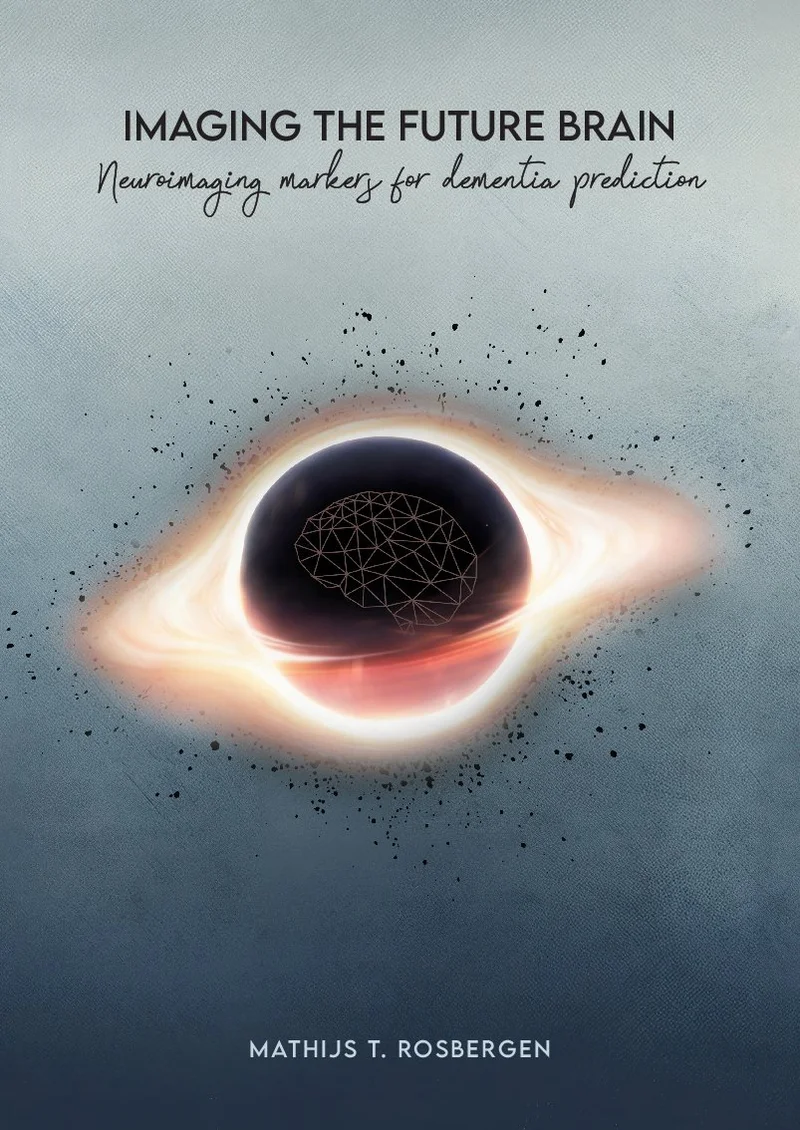
Share this project
Summary
Dementia is a complex syndrome characterized by progressive cognitive decline that interferes with daily life. Its variety of causes and trajectories make early prediction challenging and it often goes undetected during early stages. Absolute numbers of dementia are growing, with 57 million individuals affected worldwide, including 310.000 in the Netherlands.
Early identification of individuals at high risk for dementia is crucial for improving treatment and engaging in preventive strategies. Advanced magnetic resonance imaging (MRI) techniques and machine learning methods offer promising tools for detecting early brain changes and identifying new predictors for dementia. Despite the development of dementia prediction models, their implementation in clinical practice has been limited. Therefore, the aim of this thesis was to investigate the role of MRI in identifying individuals at high risk of dementia, to assess how neuroimaging can enhance the performance of dementia prediction models, and to explore strategies for the implementation of such models in clinical practice.
The aim of Chapter 2 was to study the role of white matter imaging markers in assessing and predicting brain health in elderly adults. Chapter 2.1 shows that machine learning can be applied to unravel distinct white matter patterns using multimodal brain MRI. Patterns with poor brain structure showed to have a higher prevalence of cardiovascular risk factors, lacunes, and microbleeds. Additionally, I showed that these patterns are associated with different risks for dementia, stroke, and mortality. Models with these patterns also outperformed models with only a single imaging marker for dementia and mortality.
In Chapter 2.2, I compared predictive value of multiple diffusion MRI markers of the brain for cognitive decline and dementia risk. I showed that peak-width skeletonized mean diffusivity (PSMD) and mean diffusivity (MD) had a superior model fit and discriminatory value for dementia risk, compared to other measures. For cognitive decline, PSMD was the optimal predictor, indicating that PSMD is the preferred measure of structural white matter integrity in prediction of cognitive decline and dementia.
Chapter 3 dives into the realm of grey matter as indicator of dementia risk. In Chapter 3.1, I focused on the size of different subcortical grey matter structures and their association with 5-year dementia risk. Participants with subjective cognitive decline or mild cognitive impairment from two memory clinic-based cohorts and one population-based cohort were included in this study. I showed that smaller hippocampal volume and amygdalar volume were consistently associated with increased dementia risk in individuals with subjective cognitive decline or mild cognitive impairment, independent of other subcortical grey matter structures. This underscores the potential of these structures for dementia prediction in a clinical practice.
While Chapter 3.1 focusses on subcortical grey matter, Chapter 3.2 revolves around the thickness of specific cortical grey matter regions and its association with dementia risk. This novel neuroimaging marker showed strong associations with dementia risk in a previous study and I assessed this association within the population-based Rotterdam Study. Although the imaging marker was associated with dementia risk, it did not outperform hippocampal volume for dementia risk stratification. This highlights the importance of replication studies in establishing robust biomarkers for dementia prediction.
Chapter 4 sheds light on the perspectives of the public towards dementia prediction and on the development of these prediction models. In Chapter 4.1, I combined qualitative and quantitative research methods to determine the different views on dementia prediction in the general population. I showed that there is a substantial group of individuals who have the desire of wanting to know their dementia risk. Additionally, I showed that a family history of dementia was one of the primary factors driving individuals’ desire to know their dementia risk, while fear and the lack of effective interventions were the main reasons for those who preferred not to know their dementia risk. Furthermore, while there was a wide variety in how individuals perceive their dementia risk, most people tended to perceive their risk as relatively high.
These insights formed the foundation for the development of the dementia prediction models in Chapter 4.2. Therefore, this study included dementia-free individuals over 60 years of age, who had either subjective memory complaints or a family history of dementia. I developed two prediction models: a basic model with easily accessible predictors suitable for primary care settings, and an extended model incorporating advanced predictors, including neuropsychological assessment, genetics, and brain imaging, designed for use in a memory clinic setting. Both models achieved good discrimination for 5-year and 10-year dementia prediction, compared to age-only models. Calibration showed an underestimation of absolute risks. The incorporation of cognitive, genetic, and imaging data did not substantially improve discrimination overall, but did lead to somewhat better calibration within 5 years, compared to the basic model. Moreover, it may contribute in further refining risk estimation within high-risk groups.
To conclude, in Chapter 5, I summarized my key findings within a broader context and discussed important methodological considerations. I also discussed the implications of my findings and provided directions for future research to further improve our knowledge on imaging markers for dementia prediction. Additionally, this chapter reflects on how dementia prediction models can be successfully implemented in clinical practice, and how they may contribute to the development of prevention strategies and targeted treatment for dementia.