Rocca Chin On
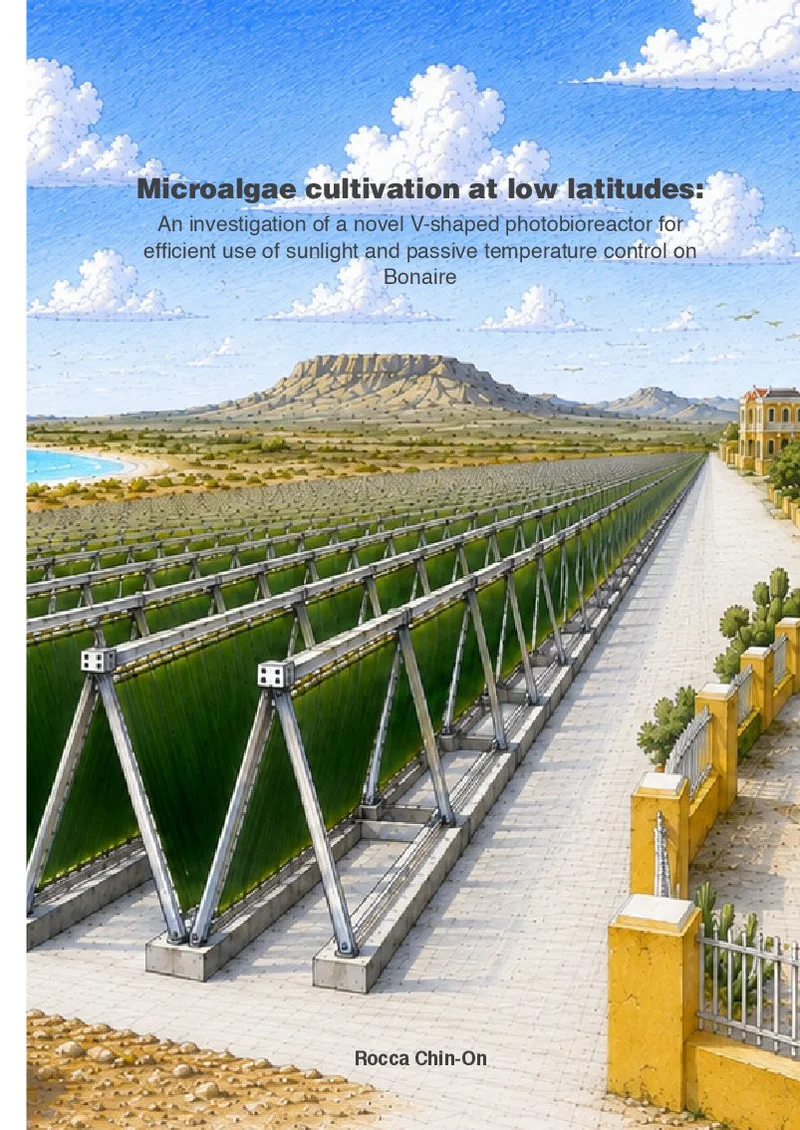


Microalgae cultivation at low latitudes
As the Earth’s population continues to grow, worldwide demands for food, fresh water, energy and materials rapidly increase. Attempts to meet these growing demands have led to several global challenges, including the depletion of non-renewable resources, climate change, and environmental pollution. Within the emerging concept of a Biobased Economy, microalgae have been recognized as a promising renewable biomass source from which a wide range of food and non-food products can be derived, such as cosmetics, supplements, feed, chemicals, fertilizers, and biofuels. The cultivation of microalgae can offer multiple advantages, such as year-round production, high growth rates, high protein and oil yields, and the possibility to use brackish or seawater, non-arable land or offshore locations, and reclaimed nutrients and CO2 from waste streams. Nevertheless, the production costs of microalgae need to be further reduced for large-scale applications, particularly for bulk products. Economic feasibility can be improved through a combination of efforts to maximize biomass productivity, minimize inputs, and valorize all components of the biomass. The research aim of this thesis has been to investigate a novel cultivation system for microalgae at low-latitude locations, where abundant sunlight and constant climate facilitate favorable conditions for year-round production of microalgal biomass. The focus of the research has been to improve biomass yield on light and areal biomass productivity, and to eliminate the need for active temperature control, both of which can both help lower overall biomass production costs. In Chapter 2, a novel V-shaped photobioreactor design is proposed, consisting of two reactor panels inclined towards the north and south, to capture and dilute sunlight at low latitudes. A mathematical model was developed to simulate sunlight entering a V-shaped photobioreactor during several days of the year, from which the maximal biomass productivity was estimated for Chlorella sorokiniana on Bonaire, assuming clear-sky conditions and light-limited growth. The model results show that biomass productivities of 38.3-50.5 g m-2 d-1 and photosynthetic efficiencies of 2.5-3.3% can be achieved in V-shaped photobioreactors, with values increasing with the inclination angles of the reactor panels. The biomass productivities in V-shaped photobioreactors are estimated to be 1.4 times higher than those in a flat horizontal photobioreactor, primarily due to light dilution resulting from the V-shaped configuration. The intensity of sunlight at midday was found to be diluted from values of around 2000 μmol PAR photons m-2 s-1 to average values down to nearly 500 μmol PAR photons m-2 s-1, depending on the day of the year and the inclination angles of the reactor panels. The model results show the potential of the V-shaped photobioreactor design for improved light dilution and areal biomass productivity. In Chapter 4, outdoor experiments are described in which a prototype of a V-shaped photobioreactor was tested for the cultivation of Picochlorum sp. (BPE23) on Bonaire. Picochlorum sp. (BPE23) is a local thermo-tolerant microalgae that was isolated from a saltwater body on Bonaire and had been selected for its high growth rate at 40°C. The biomass productivity of the microalgae was determined at different dilution rates in outdoor continuous dilution and repeated batch experiments, without any form of temperature control. While temperatures increased to 35-45 °C during day time, high average biomass productivities of 28-31 g m-2 d-1 and photosynthetic efficiencies of 3.5-4.3% were achieved in the continuous dilution experiments. In the repeated batch experiments, microalgal cells likely experienced stress due to sudden changes in light and temperature after daily dilution. Oxygen production measurements were performed at different temperatures to determine the maximum photosynthetic rates of the reactor cultures. Dense cultures of Picochlorum sp. (BPE23) were characterized by high maximum photosynthetic rates compared to previously reported data for Picochlorum and rates of other microalgae, particularly at a temperature of 39°C. In other oxygen evolution experiments and lab-based growth experiments in flat panel photobioreactors, Picochlorum sp. (BPE23) was also found to be characterized by a high specific growth rate and a low maintenance rate compared to other microalgal species, such as Neochloris oleoabundans and Nannochloropsis sp. (Chapter 3). The results in Chapter 3 and 5 highlight the robustness and potential of Picochlorum sp. (BPE23) for fast growth under changing outdoor conditions. In Chapter 5, the possibility of passive temperature control in a novel V-shaped photobioreactor is investigated for a low-latitude location. A mathematical temperature model was developed to simulate the reactor temperature and relevant heat fluxes during the year on Bonaire. Two scenarios were simulated; one in which the V-shaped photobioreactor is used on land, and one in which the photobioreactor floats on water in a basin. The average temperature of the land-based photobioreactor was found to be 35°C, while the average temperature of the floating photobioreactor was found to be 32°C. Nevertheless, the temperature fluctuation in a floating photobioreactor (i.e. 30-33°C) was found to be much smaller than that in the land-based reactor (i.e. 30-42°C) due to the buffering effect of the water body. In a worst-case scenario, in which convection above and below the reactor is assumed to be limited, the temperature in a floating photobioreactor was found to remain largely below 40°C, whereas the temperature in the land-based reactor was found to fluctuate up to 48°C. Still, for both the land-based and floating photobioreactors, the estimated reactor temperatures were found to be suitable for the cultivation of mesophilic and temperature-tolerant microalgae such as Picochlorum sp. without temperature control. In Chapter 6, the key findings of this thesis are presented and discussed. Additionally, the maximum theoretical biomass productivity of Picochlorum sp., Neochloris oleoabundans, and Nannochloropsis sp. in a large-scale V-shaped photobioreactor located on Bonaire are estimated. This estimation was based on the biological parameters determined in Chapter 3 and the mathematical model developed in Chapter 2. These productivities were found to be 46.5, 49, and 39 g m-2 d-1, respectively, demonstrating the high growth potential of the Bonarian Picochlorum strain. The results highlight the importance of knowing the light intensity and temperature to which microalgal cultures are exposed in a specific cultivation system and location during the day and year. Based on this knowledge, microalgal strains should be selected that perform optimally under those conditions to maximize biomass productivity. In a final step, the novel V-shaped photobioreactor is evaluated in Chapter 6 by means of a techno-economic model and SWOT analysis. The biomass production costs for Picochlorum sp. (BPE23) in a V-shaped photobioreactor on Bonaire were estimated to be 2.24 € kg-1 of dry weight at a production scale of 100 ha and 7.05 € kg-1 of dry weight at a scale of 1 ha. These costs were lower than the biomass production costs in other systems at the same location, due to the relatively high photosynthetic efficiency that can be achieved in a V-shaped photobioreactor and the absence of active temperature control. To lower the biomass production costs even further and to advance the commercialization of microalgal biomass, several opportunities must be investigated further such as the use of renewable energy (e.g. solar and/or wind energy), the use of direct air capture or flue gas as a source of CO2, and the development of biorefinery approaches and higher added-value products or experiences. This chapter concludes with the main conclusions and recommendations of this thesis.
| Publicatiedatum | 7 september 2026 |
| Universiteit | Wageningen University |
| Auteur | Rocca Chin On |
| DOI nummer | 10.18174/680951 |