Paul de Graaf
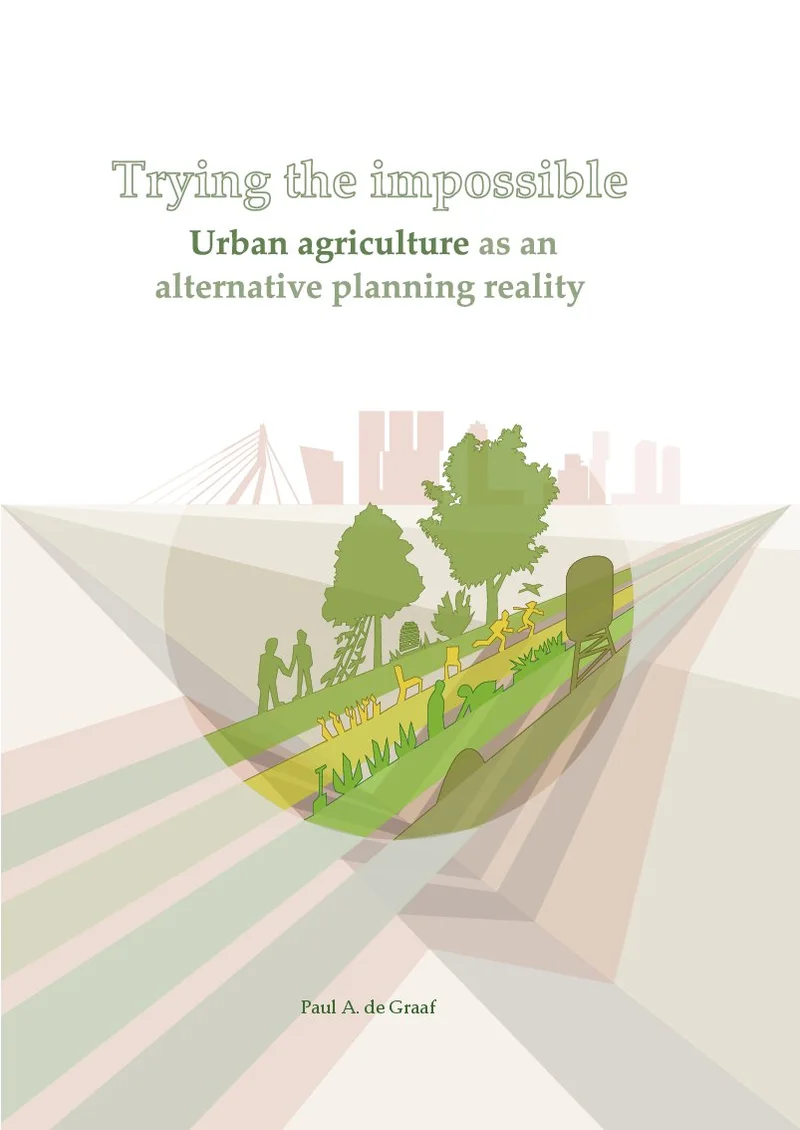


Trying the impossible.
Problem statement The emergence of bottom-up civic initiatives in the first decades of this century poses a challenge for city administration in general and spatial planning in particular. The traditional division of roles between planners who determine the spatial layout of the city on behalf of the government and citizens and other social actors who comply with this arrangement has long been under pressure due to changing insights into how society functions. But bottom-up civic initiatives go a step further. They take matters into their own hands and enter the planner’s territory. The tensions that this creates for urban spatial planning are particularly evident in the development of urban agriculture projects. It is therefore useful and necessary to investigate, analyse and understand practical experiences with this interaction. Until now, this has mostly been done from the perspective of the planning government or from the bottom-up initiators. There are still few studies that have examined this interaction over a longer period of time in a specific spatial context, taking into account both top-down and bottom-up perspectives. This research distinguishes itself by studying the interaction between planners and bottom-up initiators in the field of urban agriculture in Rotterdam in the period 2006-2018. Aim and design of the study The aim of this study is to gain insight into the interaction between bottom-up initiatives and government spatial planners in the realisation of urban agriculture projects. It looks at the worldviews and ideas about planning (so-called conceptualisations of planning) that underlie their actions, and how this interaction influences spatial planning, in particular the urban agriculture policy developed by the municipality. The research is designed as a retrospective case study of the practice of spatial planning for urban agriculture in the city of Rotterdam between 2006 and 2018. The case study includes the study of ten prominent urban agriculture projects developed by bottom-up initiatives during this period, and the actions, plans and policy measures of spatial planners with regard to urban agriculture. It is a qualitative study that uses interviews with stakeholders in combination with a review of grey literature such as project websites, project plans and local (online) news, and analysis of plans and completed projects. The interviews with planners are mainly interpreted on the basis of theoretical concepts from planning theory, while the interviews with initiators have been analysed in a more “grounded” manner, with recurring themes in the interviews being used to theorise about the possible role of initiators as spatial planners. The information from the interviews and other sources has also been incorporated into a timeline of events and developments that maps the policy-making process around urban agriculture and links it to the development and planning of individual projects. Key findings The interaction between planners and initiators was studied at three levels: 1) the development of strategy and policy on urban agriculture within the Rotterdam planning context; 2) the worldviews and actions of bottom-up initiatives in planning and implementing urban agriculture projects; 3) the interaction between planners and bottom-up initiatives in a number of important projects. A sub-question from the research is answered at each level. 1) How do municipal planners understand and conceptualise spatial planning and how does this influence the planning of urban agriculture in practice? (Chapter IV) I have demonstrated that different theoretical conceptualisations of planning can be recognised in the way planners talk and think about planning in general and in their thinking about the planning of social initiatives in particular. From the Rational conceptualisation that formed the basis of the discipline in the last century, in which social actors are the object of analysis and solution by the planner-expert, to Neoliberal planning, which focuses on the market and businesses as social actors, and Pragmatic planning, in which citizens are allowed to participate as local experts, to recent conceptualisations of planning such as Collaborative planning, in which social actors are seen as equal partners in arriving at a shared truth, or Post-structuralist planning, in which they are involved as co-creators of one or more shared narratives. The crisis of 2008-2014 opened up opportunities for these new conceptualisations of planning. Urban agriculture initiatives that wanted to make use of temporarily available building land were facilitated and a policy vision was developed for this purpose. In practice, old and new conceptualisations were intertwined in the implementation of urban agriculture policy. Particularly in the city, with its complex stacking of space claims, some of the planners involved were alarmed by the consequences of new conceptualisations of planning for their own position and for the functioning of the current system. Real questions about responsibility and liability, support and representation played a role in this. However, the involvement of other societal actors also undermined the authority and thus the self-image of the planner as an expert. Initiators were therefore only accepted as equal partners to a certain extent. 2) How do bottom-up civic initiatives for urban agriculture understand and conceptualise the spatial design of their initiative and their role in it? (Chapter V) The research shows that initiators often had strong ideas about the planning and design of the city. These ideas were reflected in the action perspective chosen by the initiators and the strategies they applied in realising their initiative. The initiator’s worldview was often strongly linked to the development and design of the initiative’s practice. These urban agriculture initiatives put ideals into practice. However, the precise definition of urban agriculture, and especially the expectations of what urban agriculture can contribute to the city, varied greatly among the initiators. These expectations translated into different ambitions for what the initiative wanted to achieve in terms of spatial planning. Initiatives took on different roles and applied a variety of planning strategies in response to both location- and time-specific circumstances and the planning actions, ideas and policies of the municipality. Four different action perspectives could be distinguished, each representing a different attitude towards the government: the active citizen, the social entrepreneur, the independent planning professional and the NGO representative. However, these roles do not constitute a blueprint but rather reference points within a range of different action perspectives. This pluralism and diversity of voices were an essential part of the urban agriculture movement in Rotterdam from 2006 to 2018. It is precisely the diversity of approaches in the practice of urban agriculture that offers creative potential; an experimental laboratory for urban spatial planning from which lessons can be learned. Their unique contribution consists of trying out different ideas in practice. The experience and knowledge this yields complements that of the municipality and its planning department. 3) How do the views on planning of municipal planners and bottom-up initiators and the strategies they use relate to each other and do they converge or clash around the realisation of urban agriculture initiatives? (Chapter VI) The planners and other civil servants involved in the creation of urban agriculture initiatives operated in a field of tension between planning policy and unruly practice. A small group of planners, with the support of the councillor, initiated new policy, or rather the ambition and narratives that were to lead to new policy, and the people on the ground, often project managers, area managers or members of a neighbourhood team, had to realise those ambitions. A tailor-made approach was needed to steer this in the right direction, but in practice the planning department remained stuck in an ad hoc approach, without real policy implementation. The initiators sought and found ways to deal with this sometimes enthusiastic but always inconsistent government. They actively engaged with different conceptualisations of planning and adapted their action perspective – as far as possible – by applying different strategies and associated situated, place- and time-bound roles. They approached their interaction with planners as a role-playing game. With situated roles, they reinforced their strategies to create space for their projects. These roles were used to break through, question or supplement the municipal planning system. The fact that this also has a price is suggested by the fact that the initiatives that were more facilitated by planners conformed more strongly to more classical planning strategies than other initiatives. Discussion The Rotterdam 2006-2018 case study shows that the interaction between municipal planning and bottom-up initiatives is determined both by the diversity of worldviews and action perspectives of the initiatives and by the way in which the municipality thinks about planning with and for bottom-up initiatives. A better understanding of this diversity and pluralism (multiformity) and a more complete picture of it is an important prerequisite for realising the potential of these initiatives. A dialectic of conceptualisations: the pluralistic contribution of urban agriculture initiatives The plurality of worldviews and action perspectives in bottom-up initiatives in the field of urban agriculture translates into a diversity of ways in which they contribute to urban planning. These contributions take place at three levels: 1) Physical-spatial: initiatives provide physical interventions that introduce food production as a function in the city’s public outdoor space, and in its wake also a place for social interaction and knowledge exchange. 2) Professional: initiatives influence the image, idea and expectations of urban green public space and develop other ways of planning that space bottom-up, from idea to realisation. 3) Political and social: initiatives challenge the principles on which we as a society base the design of space and often implicitly criticise the prevailing social rules and norms. This gives the initiatives a political dimension. When parts of the public outdoor space are designed through bottom-up civic initiatives, spatial, professional and political choices about the design of the city become visible and open to discussion. In this context, food supply is sometimes, but certainly not always, the political theme. It is a broadening of the social debate with spatial means. From this perspective, it is important to give this diversity, this pluralism, a place in the city, regardless of the social and cultural contributions that these initiatives also make. The municipal planning of urban agriculture initiatives can be interpreted as a dialectic of conceptualisations. Firstly between different conceptualisations of planning embedded in the municipal organisational structure of which the planning department is a part, and secondly between these conceptualisations and bottom-up conceptualisations of planning. This dialectic between municipal planners and initiators can be seen as the process of creating space for prefigurations in planning, that is is played out in the planning process: in the (strategies of) initiating, shaping and anchoring of urban agriculture. A parallel municipal planning reality The Rotterdam 2006-2018 case study shows how municipal planning sought ways to integrate the emergence of urban agriculture initiatives into the planning of the city. This proved to be no easy task. The reasons for this lie in the tension between, on the one hand, the organisational structure of the municipality and existing policy frameworks and planning practices and, on the other hand, innovative policy intentions in the field of urban agriculture. The diversity of the urban agriculture initiatives themselves also played a role. The ways in which planners dealt with this reflect the different conceptualisations of planning that coexist within the municipality. One could say that an “alternative planning future” was being tried out, a form of prefiguration of a different way of planning that existed alongside current policy. In this parallel planning reality, Collaborative and Post-structuralist conceptualisations of planning were experimented with in order to get to grips with the diversity and plurality of initiatives. Interpreted as a form of Prefigurative planning its approach can be characterised through three features: 1) the planner as facilitator; 2) a focus on creating conditions; 3) a pluralist multi-disciplinary approach. However, it was not possible to break with the Rational and Neoliberal perspective that attempts to capture the contribution of initiatives in financial terms of yield, revenue model and aesthetic terms of final image and tidiness. The tension between the two had to be constantly mediated by the planners involved, who often adopted a Pragmatic attitude in the implementation of the policy, focusing on the here and now and less on the bigger picture or the long-term vision. The way in which the municipality facilitated initiatives both stimulated and inhibited their innovative character. This parallel reality continues to exist to this day. Relevant conceptualisations for planning bottom-up initiatives The lessons from the Rotterdam 2006-2018 case study can be translated in a number of ways into more consistent and targeted planning of and with urban agriculture initiatives. The study suggests a number of possible lines of thought, each with its own challenges and dilemmas. The range of Rotterdam conceptualisations of planning that now coexist are not so much competing ideas as complementary strategies for navigating the current complex reality of Rotterdam planning. Greater awareness of these coexisting ideas about planning, and the implications they have for the way bottom-up initiatives are approached, treated and involved, opens the way for conscious choices to be made about how and when to involve these initiatives. In relation to this, the prefigurative value of urban agriculture initiatives has been overlooked until now. Prefigurative planning can be conceptualised as planning that aims to strengthen a city’s resilience by realising and testing possible, and seemingly impossible, futures. Urban agriculture initiatives can play an important role in this, and already do, but they are not always seen in this light, let alone approached in this way in planning. By consciously making room and planning for initiatives that explore possible futures for the city, even or especially if they are critical of current planning, municipal planning can gain valuable knowledge. Planning could focus on creating the right conditions for the emergence of such initiatives (through self-organisation), with less emphasis on use of certain means and more on the goals to which these initiatives contribute. This does require trust on the part of the government and relinquishing a certain degree of control over the end result. In addition to the dilemma between control and trust, there is also a tension between equal treatment and equal access to (government) resources on the one hand, and a need for differentiation and tailor-made solutions for initiatives that make a special contribution on the other. A tailor-made approach to initiatives might do justice to the specific character of each initiative, but raises questions to its viability and its legitimacy. It would results in a mosaic of tailor-made administrative arrangements parallel to the traditional municipal planning apparatus. The urban agriculture planning practice studied in Rotterdam already resembles such a mosaic, with the essential difference that it was not guided by a vision; there is no central control from municipal planning. Nor have the lessons learned from various – sometimes successful – approaches tried out in Rotterdam been recorded and incorporated into policy. Given the tension between this structure and the parallel reality of new inclusive conceptualisations of planning, direction and vision should come from a planning actor who knows how to navigate this tension. This ‘planner as facilitator’; a civil servant or independent professional, should have personal commitment and a clear mandate to colour outside the lines if necessary. This director, curator or broker can act as a representative and guardian of a shared vision, developed together with bottom-up initiatives. Within the framework of such a jointly developed vision, the municipality can collaborate with urban agriculture initiatives on common goals in the longer term. However, a fair, tailor-made approach does require a change in the working culture within the municipality, with long-term commitment from the civil servants involved, a good municipal memory, and scope for civil servants to act in the spirit of legislation and regulations and with a focus on goals. Also, the question of representation and its underlying ideas of democracy needs to be addressed by explicating different ideas about and expectations of democracy and the role of planners and civic initiators in it. Finally, it is important to remain vigilant about the conforming influence of excessive government interference from planning on the innovative, exploratory nature of bottom-up initiatives. Next steps Urban agriculture initiatives challenge municipal spatial planning to think and act differently, but they also contribute ideas about how this could be done and try them out in practice. In doing so, they engage in a form of prefigurative planning that is already being considered in theory but is not yet widely used in municipal planning. Although there are practical and structural limitations, the experiences examined in this study show that it is possible to make room to try out innovative ideas for urban planning in practice, taking into account the complex, multifaceted reality. In order for these experiments to find their way into mainstream planning municipal organisations have to open up to changes in the roles and responsibilities of planning and other departments, and commit to the outcomes of these experiments. The implementation of Adaptive framework rules might help to strike a balance between accountability and freedom for civic initiatives to prefigure alternatives. This framework could contribute to the development of a workable interface that in practical terms mediates between surviving in the now and living the ‘not yet’, and might make the existence of many civic initiators less precarious. In any case, under the conditions described above, initiators can be equal partners in planning. It may help if initiators work together more closely. It is not necessary to label them as planners in order to recognise them as creative co-designers of new conceptualisations of planning and of a new planning practice in which the impossible is made possible, even if only for a certain time in a certain place.
| Publicatiedatum | 14 september 2026 |
| Universiteit | Wageningen University |
| Auteur | Paul de Graaf |
| Order nummer | 19303 |
| DOI nummer | 10.18174/680884 |