Anneloes Smitsman
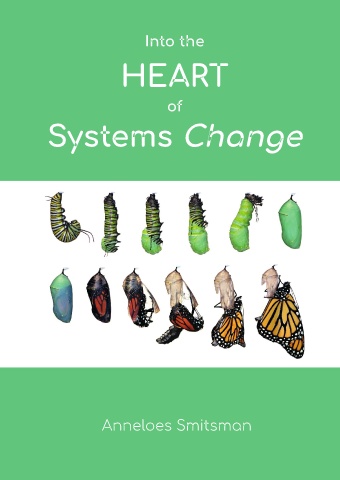


Into the Heart of Systems Change
8, 10, and 11. By exploring the thrivability worldview through these qualities and behaviours of living systems as a thrivability pattern, it can serve to guide the design process for the development of new thrivability growth systems that are inclusive of the infodynamics and qualities of living systems. This dissertation also contributes to a growing field of what is called new paradigm research that is starting to describe and explain scientifically what our indigenous cultures have known since the beginning of our humanity; Life is a holographic unified reality (Laszlo and Laszlo, 2016; Currivan, 2014; Sahtouris, 2000; Capra and Luisi, 2014). This contribution is made in the form of six first authored publications that include co-author contributions from: Prof. dr. Alexander Laszlo, Prof dr. Pim Martens, Dr Jude Currivan, Dr Kurt Barnes, Asoc.Prof dr. Ad Smitsman, Dr. Gilberte C.K. Chung, and Dr. Pavel Luksha. Furthermore, the peer interviews and dialogues from chapter 10 have all been published via the EARTHwise Youtube Channel, and have been shared on social media and in other ways to enable more people from around the world to benefit from my conversations with: Nora Bateson (daughter of Gregory Bateson), Dr Ervin Laszlo, Jean Russell, Dr Daniel C. Wahl, Joe Brewer, Dr Jean Houston, Dr Elisabet Sahtouris, Judith Rosen, Hereditary Chief Phil Lane Jr., Sheri Herndon, Lawrence Bloom, and others. The dissertation includes many short stories for experiencing the issues and system dynamics that are addressed through this research. The stories invite us to go Into the Heart of Systems Change together, to avoid the dualism that is often present in academic research where people are described as research objects as if we have no relationship with them. Distance does not always make us objective, as is often assumed in academic method. Distance can also reduce comprehension. Through the stories of this dissertation we can live into those questions together and open to the living context behind the data (appendix 7). Visual of Into the Heart of Systems Change Figure 12.4. Overview of Systemic Barriers & Transformational Strategies https://bit.ly/346Cg2L Figure 12.5. Evolutionary Learning & Development for Thrivability Bildung. https://www.kumu.io/anneloes3/transformational-change-for-thrivability#learning-development-for-thrivability Figure 12.6. Visual & Transition Map for a Thrivability Civilization https://www.kumu.io/anneloes3/transformational-change-for-thrivability#transition-map-to-thrivability-civilisation Figures 12.4, 12.5, 12.6 on the previous pages provide a visual of the entire dissertation. These maps are explained in chapters 3 and 8, in detail. These maps can also be read dynamically on Kumu via the reference in footnote. This map starts with the desire to grow, and shows the two different trajectories that have emerged in the exploration of that desire as explained here earlier. The map also shows how the systemic barriers manifested and the transformation strategies that were applied, and embedded in the Thrivability Bildung section of the map, and how a new Thrivability Growth model can be developed from the patterns and behavioural dynamics that are generated from thrivability systems. This transition map is already serving as significant input for ongoing future research. Future Research The responses from collaborators who have read parts of this dissertation and have seen the systems map of the Thrivability Pattern, the Future Archetypes, and the transition map to a Thrivability Civilization, confirm that there is a strong interest in future research for the development of a new thrivability growth model based on the research results of this dissertation from at least a few thought leaders and thrivability practitioners. Three collaborations have already started based on the interest in this work. The first collaboration is with Lawrence Bloom from Dakia Global Enterprise for the possibility of implementing the EARTHwise Value Currencies™ and Thrivability Growth model to their business operations and joint ventures. The second collaboration and application is through the Tipping Point Festival (TPF), a citizen-led, science-backed, global game-plan in response to climate change. The TPF invited me to join their team in June 2019 and to use TPF as the first global case-study for applying the research results of this dissertation. My organization EARTHwise Centre has become the project host for TPF since September 2019, which is now being developed as a thrivability system for facilitating the transition to a thrivability civilization. The third collaboration is with Ralph Thurm and Bill Baue from R3.0 (previously Reporting 3.0) to explore how the research results and an ongoing collaboration can support the next iterations of their blueprints for Organisational Thrivability and System Value Creation, where I have joined as an advocation partner since August 2019. https://www.kumu.io/anneloes3/transformational-change-for-thrivability To learn more about TPF visit - https://www.earthwisecentre.org/tpf These collaborations also show the importance of developing a thrivability growth matrix that can serve as a new progress and success matrix, with the capacity to measure and report on this as part of formal reporting mechanisms and responsibilities. It is suggested that these thrivability reporting schemes include the behavioural dynamics that the EARTHwise Value Currencies™ makes visible and measurable. By making the behavioural transactions visible it provides clear indicators for where systemic barriers might be present and the extent to which those are transforming. Each of these collaborations also provide possibility for longer term evaluations and research. A further suggestion for future research is the implementation of the profiles of the five future archetypes in education. To train students and teachers in the unique competencies and awareness that the five future archetype profiles provide and to create learning tasks through collaborative projects that brings those skills together. Another suggestion for future research is to design new evaluation indicators and processes on the basis of the 7 infodynamics and conditions for evolutionary learning, as discussed in chapter 8 of this dissertation, and to implement this into mainstream educational systems. Completion & New Beginnings Tomorrow began about 13.8 billion years ago. Tomorrow is already given to us now, as was yesterday, too. Thrivability emerges from within and our climate crisis cannot be resolved without the wisdom of the heart. There is so much that is happening right now that our minds cannot comprehend yet our hearts can embrace. It is time to become the future creative human that we can be, each of us is a point of singularity. Together by connecting the dots we bring the pattern of thrivability into being, and this is what attracts a future of a more thrivable version of ourselves into being, here and now - thrivability begins within. They say the longest journey is the distance between the head and the heart, academia has long increased that distance. It is time we reduce this now. It is my hope and intention that this dissertation beyond all the other reasons for which it was written, also shows that the knowledge of the head and the heart can be integrated as one coherent body of knowledge and wisdom. This story is about you and me and our children, our world, and their future. We began this story long ago, when one became many. We all desire to grow. Growth is wonderful and intrinsic to Life, yet it is time and necessary that we explore a more complete growth model than the one we have promoted for the growth of our modern societies. Our indigenous cultures already have the principles and practices for a growth model where Life is and remains at the centre. Perhaps we can listen now and include their knowledge in the knowledge bank and protopias of our modern societies to grow wise together. Thank you for joining me and millions of others from around the world on this Journey Into the Heart of Systems Change for a thrivability world and future. Publications & Interviews Into the Heart of Systems Change Interviews - Youtube Playlist. EARTHwise Youtube Channel : https://goo.gl/51uRMd Smitsman, A & Chung C.K.C. (2018). Mauritius: Theory and Practice of Education for Sustainability. In Letchamanan, H &, Dhar, D. (Eds.). Education in South Asia and the Indian Ocean Islands. London: Bloomsbury. Smitsman, A & Currivan, C. (2019). Healing our relationship with Gaia through a New Thrivability Paradigm. In Wright, J. (Ed.) Quantum Thinking for Agroecology: Theory and Practice for the Farming of Tomorrow. Taylor and Francis [in press]. Smitsman, A., Laszlo, A. & Barnes, K. (2018). Attracting our Future into Being: The Syntony Quest. World Futures: The Journal of New Paradigm Research. DOI: 10.1080/02604027.2018.1499850 Smitsman, A., Martens, P. & Laszlo, A. (2019a). The Polarization Effect: Healing our Worldviews. Systema 2019, Vol 7 (1). https://bit.ly/2wWg6Bu Smitsman, A. & Currivan, J. (2019). Systemic Transformation - Into the Birth Canal. Systems Research and Behavioural Science (January 2019), 1–10. https://doi.org/10.1002/sres.2573 . Smitsman A. & Smitsman A.W. (2019). The Future-Creative Human - Exploring Evolutionary Learning [publication pending]. Smitsman, A., Laszlo, A. & Luksha, P. (2019b). Evolutionary Learning Ecosystems for Thrivable Futures - Crafting and Curating the Conditions for Future-fit Education. World Futures: The Journal of New Paradigm Research [in press].
| Publicatiedatum | 18 december 2019 |
| Universiteit | Universiteit Maastricht |
| Auteur | Anneloes Smitsman |
| ISBN nummer | 978-94-6380-610- |