Teuni Rooijackers
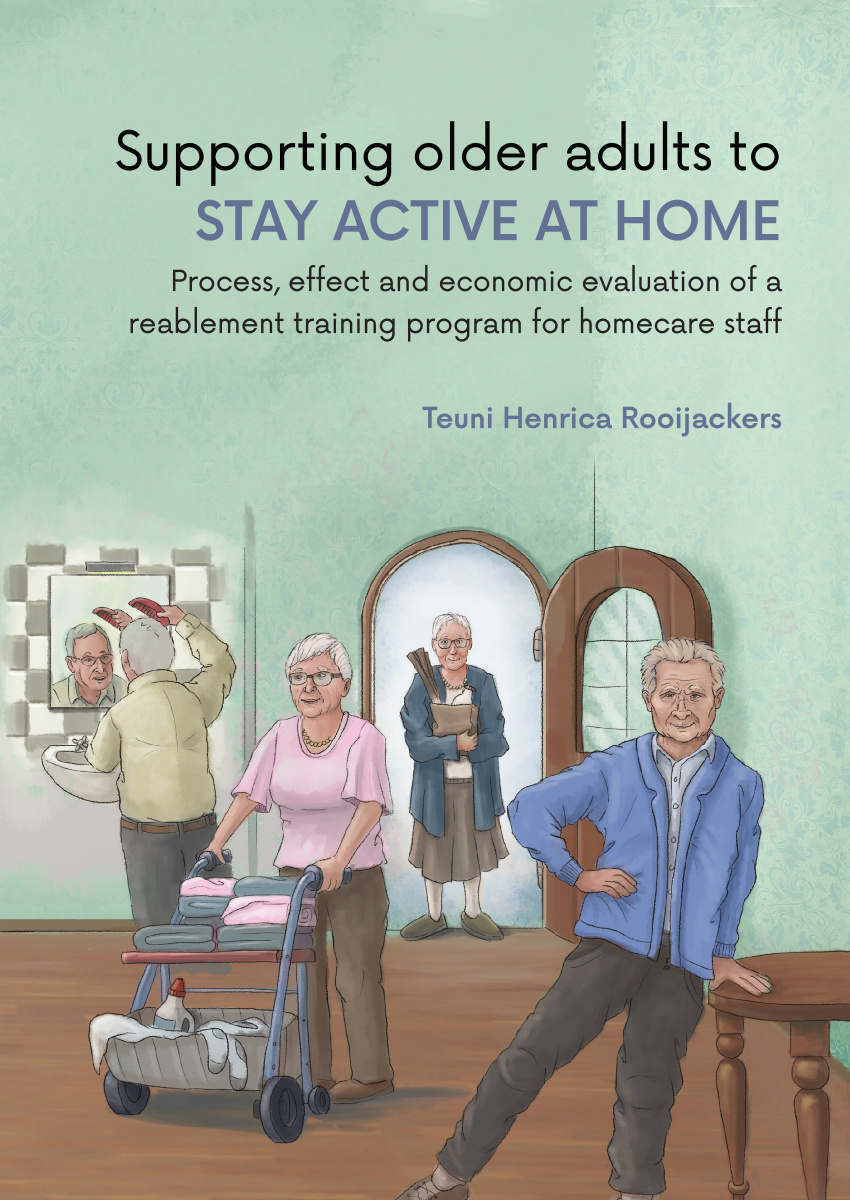


Supporting older adults to STAY ACTIVE AT HOME
'Stay Active at Home' has been positively evaluated in two pilot studies in 2016 and 2017. Prior to possible national implementation, the training program should first be evaluated on a larger scale. This dissertation describes the process, effect and economic evaluation of the 'Stay Active at Home' in a cluster randomized trial. Introduction Chapter 1 provides information on aging in the Netherlands, the importance of staying active and independent in later life, and the role that homecare staff can play in this regard. For homecare staff, promoting independence requires a different way of thinking and working. Reablement is introduced as an approach to change the behavior of homecare staff. The studies in this thesis are part of the evaluation of ‘Stay Active at Home’, a reablement training program for homecare staff (i.e., nursing and domestic staff). Accordingly, the first chapter provides a brief description of ‘Stay Active at Home’. It concludes with the overall aim, objectives, and outline of the research in this thesis. Study protocol Chapter 2 describes the study protocol of the 1-year cluster randomized controlled trial (c-RCT) to evaluate ‘Stay Active at Home’. Ten Dutch homecare nursing teams from five working areas in the south of the Netherlands participated. Teams were pre-stratified by working area and equally randomized to the intervention group or control group, along with their clients and, if applicable, clients' domestic workers. All nursing staff from the selected nursing teams were eligible to participate in the study. Clients were eligible if they met the inclusion and exclusion criteria: ≥65 years old, not terminally ill or bedbound, no serious cognitive or psychological problems, and able to communicate in Dutch. Finally, the domestic workers of clients who met the criteria were also eligible to participate. A total of 264 clients and 313 staff members participated in the study. Staff in the intervention group received the 9-month reablement training program, consisting of program meetings, practical assignments, and weekly newsletters. The program meetings were divided into a kick-off meeting, bi-(monthly) team meetings over a 6-month period, and a booster session at nine months. During the kick-off meeting, information was provided on why a reorientation of homecare is needed. Each team meeting then addressed a skill to facilitate the implementation of reablement in practice: 1) motivating clients, 2) increasing clients’ engagement in daily and physical activities, 3) implementing goal setting and action planning, 4) involving the social network of clients, and 5) assessing clients’ capabilities. In the booster session, staff practiced conversational skills in role-plays with professional actors. Team managers were also invited to the program meetings; they also received the weekly newsletters. Staff in the control group received no training and provided care as usual. Four related sub-studies were conducted to evaluate ‘Stay Active at Home’: (1) a process evaluation, (2) a client-level effect evaluation, (3) a staff-level effect evaluation, and (4) an economic evaluation. Each sub-study is summarized below. Objective 1: Evaluation of the implementation, potential mechanisms of impact and context of ‘Stay Active at Home’ Chapter 3 describes the results of the process evaluation alongside the c-RCT that was conducted using an embedded mixed-methods design. Data on the implementation (reach, dose, fidelity, adaptations, and acceptability), potential mechanisms of impact (staff knowledge, attitude, skills, and support), and context were collected from all staff in the intervention group (N = 154) using logbooks, registration forms, checklists, and log data. In addition, focus group interviews were conducted with a subset of staff (n = 23) and program trainers (n = 4). ‘Stay Active at Home’ was largely implemented as planned. On average, staff attended 73% of the program meetings, conducted 57% of the practical assignments, and consulted 57% of the weekly newsletters. Staff were generally satisfied with the training program, particularly appreciating its practical elements (i.e., role-plays, booklet with practice exercises, and weekly newsletters) and the team approach. They experienced positive changes in their knowledge of and attitude toward reablement, learned new skills or further developed existing skills, and perceived social and organizational support from colleagues and team managers. The extent to which staff implemented reablement varied. Perceived contextual facilitators (e.g., digital care plans) and barriers (e.g., resistance to change from clients or their social network) seemed to play a role in this. Suggestions for improvement included more interactive teaching methods, coaching on the job, and providing information about reablement to clients, their social network, and other relevant stakeholders. Objective 2: Evaluation the effectiveness of ‘Stay Active at Home’ with respect to client outcomes Chapter 4 presents the results of the effect evaluation at the client level. A total of 264 older adults participated in the c-RCT (n = 133 intervention group; n = 131 control group). Data on sedentary behavior (primary outcome), daily, physical and psychological functioning, and falls were collected at baseline, six months (fall data only) and twelve months, using accelerometers (Actigraph GT9X Link), questionnaires (GARS and PHQ-9), and physical performance tests (SPPB). Data were analyzed according to the intention-to-treat principle, with the primary outcome condition being that clients had ≥1 valid accelerometer wear day of ≥10h of wake/wear time. This was the case for 245 clients (n = 125 intervention group; n = 120 control group). At baseline, clients were on average 82.1 (SD 6.9) years old, 67.8% were women, and 67.4% had a low educational level. Mixed effects linear and logistic regression showed no statistically significant differences between the intervention group and control group for most outcomes. However, a small effect to the detriment of the intervention group was found for physical functioning (-0.6; 95% CI -1.1, -0.1). A subgroup analysis by working area identified an effect in favor of the intervention group for daily functioning in instrumental activities of daily living in one working area (-3.7; 95% CI -7.4, -0.0). This was the working area that adhered most closely to the training program. In conclusion, no convincing evidence was found for the effectiveness of ‘Stay Active at Home’ compared to usual care on the selected client-level outcomes. Objective 3: Evaluation the effectiveness of ‘Stay Active at Home’ with respect to staff outcomes Chapter 5 presents the results of the effect evaluation at the staff level. A total of 313 staff members participated (n = 154 intervention group; n = 159 control group). Data were collected on self-efficacy and outcome expectations regarding client activation at baseline, six and twelve months, using scales developed for the current study. At baseline, staff were on average 47.7 (SD 11.2) years old, predominantly female (98.4%), had a low level of education (52.0%), an average work experience of 11.5 (SD 10.0) years, and an average workweek of 19.4 (SD 6.5) hours. Mixed effects linear regression showed no statistically significant differences between the study groups for either outcome between baseline and six months or between baseline and twelve months. A sensitivity analysis that compared intervention group staff with ≥50% compliance to the program meetings (n = 125) with all staff in the control group showed an effect in favor of the intervention group for self-efficacy between baseline and twelve months (1.9; 95% CI 0.1, 3.7), but not for outcome expectations. In conclusion, no convincing evidence was found for the effectiveness of ‘Stay Active at Home’ compared to usual care in terms of staff self-efficacy and outcome expectations regarding client activation. Objective 4: Evaluation the cost-effectiveness and cost-utility of ‘Stay Active at Home’ at the client level Chapter 6 describes the results of the economic evaluation. A cost-effectiveness and cost-utility analysis were conducted from a societal perspective over a 12-month time horizon. Cost and effect data were collected from 264 older adults at baseline, six and twelve months. Cost data included ‘intervention’, ‘healthcare’, and ‘patient and family’ costs (collectively, societal costs) and were assessed using an adapted version of the iMTA Medical Consumption Questionnaire and client records or estimated using bottom-up micro-costing. Effect data included sedentary behavior and quality-adjusted life years (QALYs) assessed using accelerometers and the EQ-5D-5L, respectively. Data were analyzed according to the intention-to-treat principle, provided clients had ≥1 valid accelerometer wear day (n = 245). Mixed effects linear regression with multiple imputation and bootstrapping found no statistically significant differences between the study groups for all cost and effect outcomes, with the exception of lower domestic support costs in the intervention group (€-173 [95% CI -299, -50]). The average total societal costs per client over the study period (12 months) were €20,254 in the control group and €22,469 in the intervention group (including €625 for the intervention). From a societal perspective, the cost-effectiveness of ‘Stay Active at Home’ did not exceed 20%, regardless of the willingness to pay (€0‒€50,000) and the effect outcome chosen. This indicates that overall a low probability was observed that ‘Stay Active at Home’ was cost-effective compared to usual care. These findings were confirmed by sensitivity analyses from the healthcare perspective (n = 245), for complete cases (n = 165 for sedentary behavior; n = 185 for QALYs), and for clients without extreme cost outliers (n = 237). Discussion and Conclusion Chapter 7 summarizes the main findings of all studies included in this thesis, followed by methodological and theoretical considerations. It further describes implications for practice and research that follow from the findings of this thesis. In summary, the process evaluation showed mostly positive findings, but also suggestions for improvement. No unequivocal evidence was found for the effectiveness of ‘Stay Active at Home’ compared to usual care in terms of client and staff outcomes, nor for its costs and cost-effectiveness. Methodological aspects made it difficult to unravel why the intervention was not effective (e.g., no insight into actual staff behavior) or possibly explain the lack of beneficial effects (e.g., chosen target group or outcome measures). Theoretical aspects may also have played a role, including the rationale and content of ‘Stay Active at Home’ in relation to other reablement approaches, the complexity of changing staff behavior where a ‘one size fits all’ approach may not be appropriate, and the possible need for system changes in healthcare to better implement reablement. In conclusion, there is insufficient evidence to justify widespread implementation of the ‘Stay Active at Home’ reablement training program in its current form. The studies in this thesis have led to several suggestions for improvement of the training program and can provide a starting point for optimizing ‘Stay Active at Home’ and developing new training programs and interventions in the field of reablement. This ideally takes place in co-creation with relevant stakeholders from practice, research, education and policy.
| Publicatiedatum | 14 september 2022 |
| Universiteit | Universiteit Maastricht |
| Auteur | Teuni Rooijackers |
| Order nummer | FTP-202604101051 |
| ISBN nummer | 978-94-6423-878-5 |