sun yanru
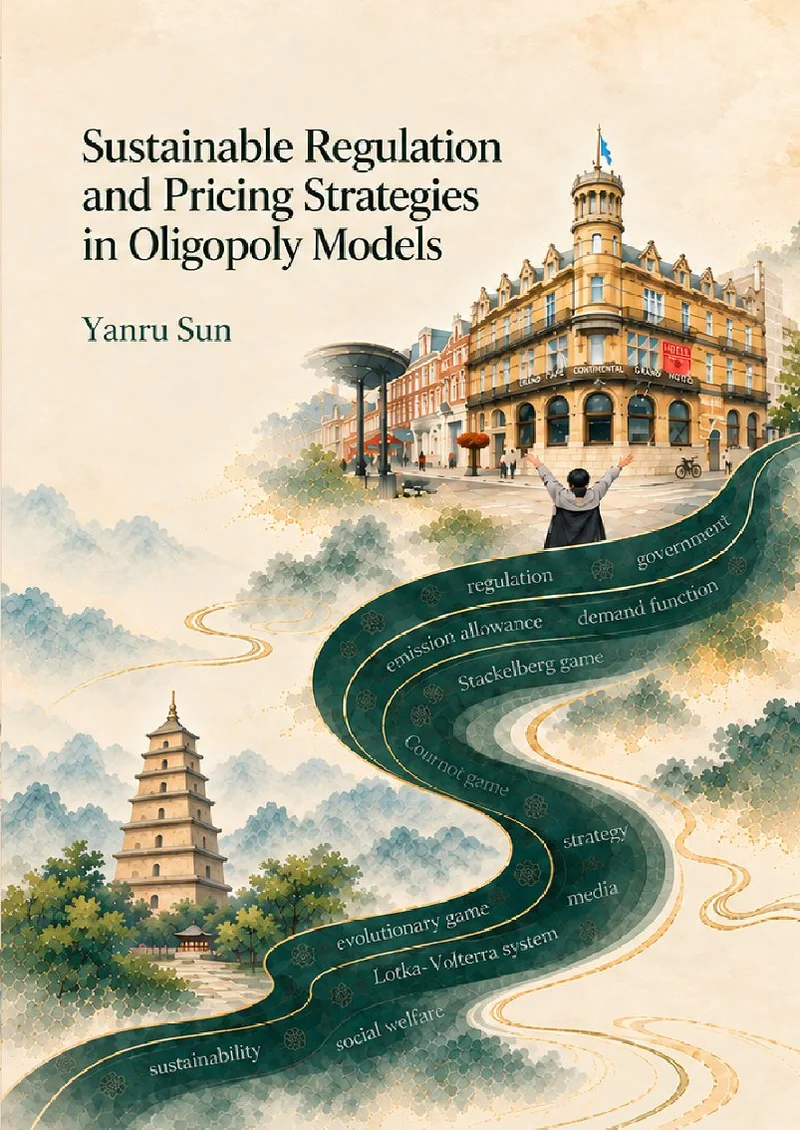


SUSTAINABLE REGULATION AND PRICING STRATEGIES IN OLIGOPOLY MODELS
Economic development has not only accelerated the dynamics of economic activities, but has also resulted in severe environmental pollution. This thesis applies oligopoly models to analyze sustainable regulation and policy designs. It also uses dynamic models to explore the dynamic evolution of firms’ strategy frequencies and prices.
Chapter 2 studies the effect of media supervision on the CSR behaviors of firms through a Stackelberg-Evolutionary game model. Firms play an evolutionary game in which one fraction of firms uses a CSR strategy, while others use a traditional strategy. Without intervention, firms using the CSR strategy will become extinct in the long run. To increase the fraction of firms using the CSR strategy, the media is introduced as a Stackelberg-leader to supervise and expose firms. The media determines the optimal level of supervision, which affects the demand of firms. Firms are Stackelberg-followers and in the evolutionary game under media supervision. The results show that there exists a unique Stackelberg-Evolutionary equilibrium. In equilibrium, there is a strictly positive fraction of firms that use the CSR strategy. This emphasizes the effectiveness of media supervision.
Chapter 3 analyzes the constraints of emission allowances on firms’ output and pollution level, and explores the optimal allocation by the government to maximize social welfare. In this chapter, first, the Cournot model is extended by introducing a strategic variable that represents the level of pollution in the profit function of firms. We show that, in equilibrium, each firm adopts the maximum pollution level. To reduce emissions, a Stackelberg game model is proposed to analyze the effect of government intervention. In the first stage, the government determines the allocation of emission allowances to maximize social welfare, balancing economic welfare and social damage. In the second stage, firms play a Cournot game with capacity constraints due to emission allowances. We show that there is a unique Stackelberg equilibrium. In the general case, in the Stackelberg equilibrium, the government only chooses one out of a limited number of allowance allocations in equilibrium. When the damage function is linear, in most cases, the government-optimal allocation is either to enforce zero pollution or to allow firms to pollute freely.
Chapter 4 develops a dynamic surge pricing model in which sales are forecast by the solution functions of a Lotka–Volterra system. This system determines the pricing model, where price choices by firms are continuously updated. Based on the sales forecast, this chapter extends the inverse demand function by incorporating the impact of marginal sales. The dynamic price is a smooth function that initially increases, then decreases, and ultimately stabilizes at a constant level. Sufficient conditions are derived for the global asymptotic stability of the equilibrium points of the dynamic surge pricing model. Compared with the static Cournot model, the dynamic surge pricing model increases the profitability of firms in the long run.
| Publicatiedatum | 2 november 2026 |
| Universiteit | Universiteit Maastricht |
| Auteur | sun yanru |
| ISBN nummer | 978-94-6534-733-2 |