Shuiqing He
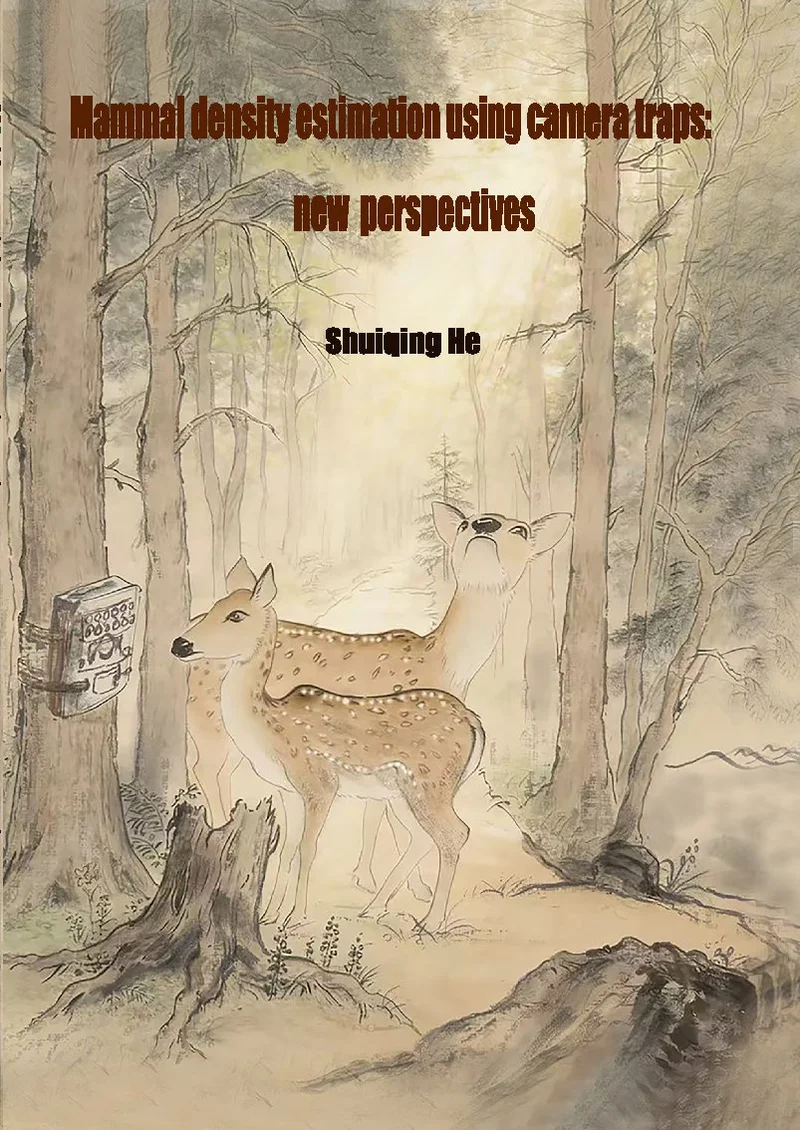


Mammal density estimation using camera traps
Reliable estimates of wildlife abundance are fundamental to ecological research and conservation, yet remain difficult to obtain for many species that are nocturnal, elusive, or unmarked species. Over the past decades, camera traps have become a central tool for wildlife monitoring because they provide non-invasive observations across broad spatial and temporal scales. However, camera-trap data do not directly reflect animal density. Instead, observed capture rates are shaped by detection processes that depend on biotic and abiotic factors including sensor properties, deployment geometry, animal movement, body size, and environmental conditions. As a result, variation in detectability represents a key limitation for inference from camera-trap data and can therefore be seen as “the Achilles’ heel” of camera trapping. This thesis addresses how wildlife density estimation from camera-trap data can be improved by explicitly accounting for detection processes and detectability, with a focus on unmarked terrestrial mammals that cannot be individually identified. Using the Random Encounter Model (REM) as a analytical framework, the thesis examines how deployment decisions, detection geometry, and data structure jointly shape what can be inferred from camera-trap encounters. Rather than treating camera deployment as a fixed design choice, the work views deployment orientation and detectability as integral components of density inference. At the site level, this thesis extends the REM to vertically oriented camera traps. Vertical deployments can substantially reduce camera damage, theft, and data loss in high-risk field conditions, but they alter detection geometry relative to conventional horizontal setups. By reformulating detection-zone geometry and associated parameters, this work demonstrates that density estimation for unmarked species can be maintained under vertical deployment when changes in detectability are explicitly incorporated. Empirical comparisons between vertical and horizontal deployments show that protection and detectability are linked through a measurable trade-off, governed primarily by the relationship between mounting height and species-specific effective detection distance. Deployment height therefore emerges as a parameter that directly influences detection probability and density inference, rather than a purely logistical decision. Beyond site-level estimation, this thesis addresses the challenge that most existing camera-trap datasets consist capture-rate information only and lack the additional parameters or specific study design required for full density estimation designed for unmarked species these years. To improve the interpretability of such data, the thesis develops a mass-relative abundance index (mRAI) that accounts for systematic differences in detectability among species. By incorporating scaling relationships between body mass, movement behaviour, and detection processes, mRAI improves correspondence between capture rates and independently estimated density across species. This provides a practical approach for comparative and macroecological analyses where direct density estimation is not feasible. Taken together, the chapters demonstrate that variation in detection processes underlies both methodological and practical limitations of camera-trap–based inference. By adapting detection geometry to alternative deployments and correcting capture-rate indices for detectability, this thesis extends the conditions under which camera-trap data can be used to reflect animal abundance in a more robust way. These contributions do not eliminate all sources of bias in camera-trap data, nor do they resolve all camera-trap–based limitations. Rather, they provide concrete and tested approaches that reduce data and equipment loss, improve inferential robustness, and enable more effective use of the exisiting camera-trap datasets. More broadly, this work highlights that future progress in camera-trap ecology depends on recognising the detection process as the link between animal density and observed data. As camera traps continue to expand in number, spatial extent, and application, their scientific value will increasingly depend on deployment strategies and analytical frameworks that explicitly address variation in detectability. By linking deployment design, detection geometry, and scalable inference, this thesis contributes a coherent framework for improving wildlife density estimation from camera-trap data across local, regional, and macroecological scales.
| Publicatiedatum | 10 juni 2026 |
| Universiteit | Wageningen University |
| Auteur | Shuiqing He |
| Order nummer | 18735 |
| ISBN nummer | 978-94-6534-415-7 |