Isaura Wayop
Enhancing antimicrobial stewardship in veterinary medicine
4 juli 2025
Universiteit Utrecht
Open Ebook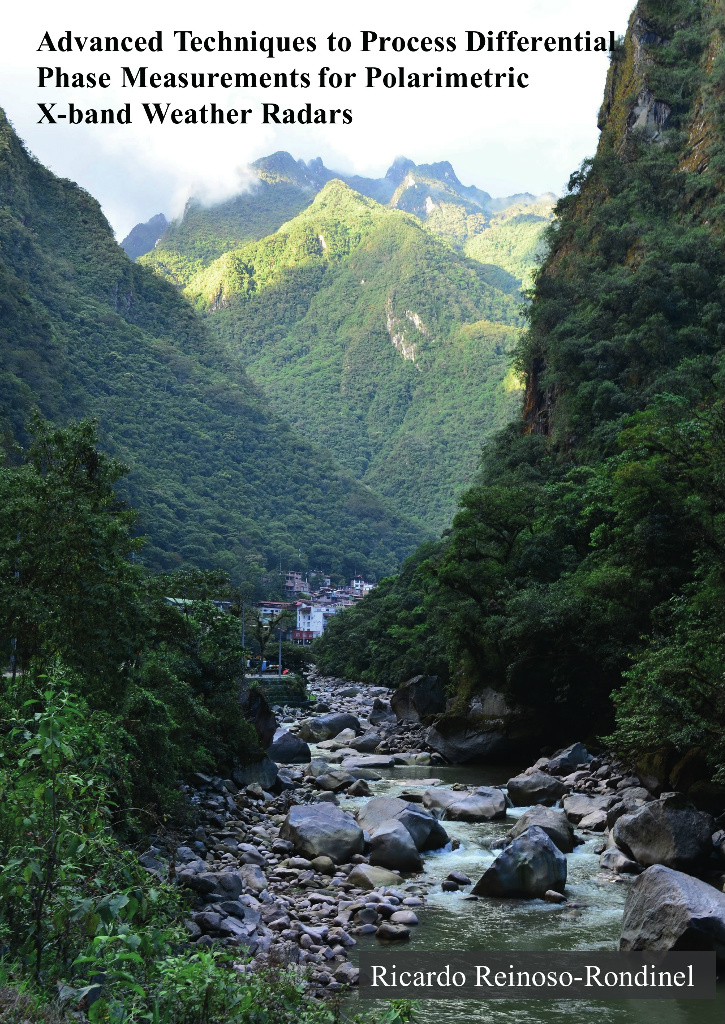
Share this project
Summary
Observations of weather phenomena have attracted many researchers because of their
microphysical complexity, space-time variability, and more important, their impact on
human life. In the efforts of studying weather, researchers have used a diverse num-
ber of instruments to obtain both in-situ (towers, tethered balloons, and weather station
networks) and remote (radar, lidar, satellite) measurements. In this study, weather mea-
surements are obtained using ground-based weather radars, which are able to scan over
a large space domain. Radar measurements require complex processes to extract reli-
able information that can be used by weather institutions, companies, and citizens. In
this thesis, innovative methods are presented to process weather radar measurements,
acquired at X-band frequencies, with the aim of capturing the natural variability of storm
events.
Weather radars acquire data from scanned hydrometeor targets, such as groups of
rain and ice particles. In Chapter 2, general concepts regarding weather radars and scat-
tering theory are discussed, with an emphasis on X-band frequencies. At these frequen-
cies, the signal that is transmitted and received by the radar can be significantly atten-
uated by hydrometeors. One way to mitigate such limitation is by using polarimetric
technology in which two signals are transmitted, one in the horizontal and one in the
vertical plane. In this context, polarimetric variables such as reflectivity Z , differential
reflectivity ZDR , specific differential phase KDP , specific attenuation A, and backscatter-
ing differential phase δhv are defined and their relations in rain are studied using scat-
tering simulation.
The benefits and limitations of using a polarimetric X-band radar for the observa-
tion of convective weather are examined in Chapter 3. For such purpose, a squall line
event over North-Western Europe is used and multiple data sources, which are available
in the Netherlands (NL), are introduced. Radar observations are obtained from two op-
erational C-band radars and one research polarimetric X-band radar, hereafter IDRA, to
compare Z observations at different spatial and temporal resolutions. It is demonstrated
that the observations from IDRA, at 30 m and 1 min resolution, provide a more detailed
structure of a specific region of the squall line compared to those from C-band radars at
1 km and 5 min resolution. However, observations behind regions of heavy rain were not
possible using IDRA due to total attenuation.
In Chapter 4, a method is proposed to estimate accurate KDP in rain at X-band fre-
quencies. In the formulation of the KDP estimator, measurements of Z and ZDR , after
attenuation correction, are included to obtain KDP estimates at range resolution scales.
This method is demonstrated using four storm events, associated with light and heavy
rain, observed in the NL by the X-band IDRA radar. It is shown that the proposed method
is able to accurately estimate KDP in both light and heavy rain with standard deviation
values in the order of 0.1 ◦ km−1 while maintaining the structure of the storms.
Based on the method given in Chapter 4, Chapter 5 suggests advanced methods to improve estimates of A and δhv in convective storm cells that are observed at X-band
frequencies. Three established methods to estimate A are implemented while two meth-
ods to estimate KDP are considered. The five methods are examined using three storm
events, observed within a maximum range of 15 km. Because the three methods to esti-
mate A require KDP estimates, the analyses show that improved estimates of A are pos-
sible when the KDP technique given in Chapter 4 is employed. In contrast, incorrect esti-
mates of A are seen when KDP is calculated by the conventional range-filtering method.
Moreover, δhv -KDP scatterplots exhibited significant agreement to empirical relations
and quantitative analyses showed that the accuracy of δhv is on the order of 1.5◦.