Reinier de Vries
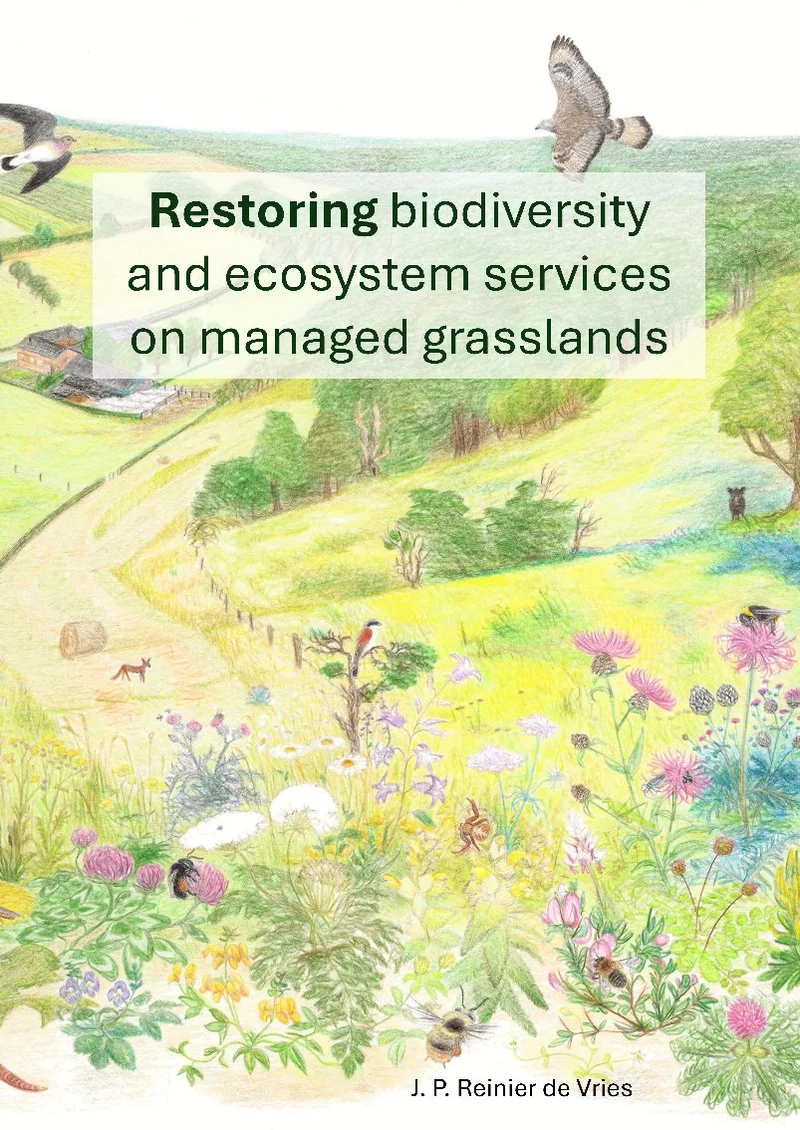


Restoring biodiversity and ecosystem services on managed grasslands
Agriculture has become the leading cause of global environmental change and biodiversity loss, threatening the resilience of ecosystems around the globe. Grassland ecosystems, most of which are nowadays maintained by humans for livestock keeping, have suffered particularly severe habitat and biodiversity declines. This also threatens the delivery of a wide range of ecosystem services that underpin human well-being and agriculture itself. Therefore, governments and public organizations aim to restore degraded grassland ecosystems, but their actions have so far not resolved the main causes of degradation. For example, Europe’s agri-environmental policies already exist for decades but the intensive land use practices that erode the continent’s rich grassland biodiversity, including high fertilization inputs, stocking rates and harvesting frequencies, are still expanding. Despite substantial research emphasis on the advantages of biodiversity for agriculture, farmers remain reluctant to adopt biodiversity-friendly practices at a larger scale. In this thesis, I investigated socio-economic and management-related constraints to more effective restoration of biodiversity and ecosystem service delivery on managed grasslands. All chapters are based on data collected in a study area in the south of the Netherlands where land use ranges from very extensively used semi-natural grasslands to highly intensive production grasslands. This gradient reflects the land use intensification trend that takes place in managed grasslands across the world’s temperate regions. Starting from a broad socio-economic perspective, this thesis evaluated whether restoring biodiversity-based ecosystem services creates win-wins or trade-offs between grassland farmers and society (chapter 2). A broad range of ecosystem service indicators was measured in the field, and interviews with farmers were conducted to assess each grasslands’ management and annual production. Next, its contribution to the income of farmers was estimated by the gross margin of forage production at field level. Of all investigated ecosystem services, only nitrogen fixation by legumes contributed significantly to grassland productivity, and this contribution was minor compared to the effect of fertilization. Farmer income was largely determined by productivity and traded off strongly with biodiversity, nutrient retention and carbon sequestration, all of which are public goods. Multiple public goods increased in parallel with biodiversity. This implies that the restoration of grassland ecosystems benefits society but not farmers. Therefore, ecological restoration programs require societal support that makes the delivery of public goods economically rewarding. Biodiversity underpins the supply of multiple public goods, but the impacts of land use intensification on many taxonomic groups remain understudied, especially among arthropods. Therefore, chapter 3 investigated the effects of land use intensification on grassland arthropods in a space-for-time study. Land use intensity was measured by annual productivity, and arthropods were surveyed in May, June and July along fixed transects by sweep-netting and pollinator counts. All specimens were counted per order and a broad selection of groups was identified to species level. From low to high intensity levels, Diptera numbers increased and stabilized overall arthropod abundance, while most other orders declined sharply in abundance and overall species richness halved. Further insight was obtained by examining the distributions of individual species along the sampled land use intensity gradient. At high intensity levels, most species declined or disappeared completely (85% resp. 64% of all identified species), but a small group of widespread species (9%) increased. It is probable that such ‘winners’ cause the stability of overall abundance levels. Furthermore, these species-level analyses revealed stronger biodiversity losses than more widely used diversity metrics. The highest losses occurred between low and medium levels of land use intensity. This means that low-intensity grasslands, which are nearly lost in many agricultural landscapes, are crucial for most arthropod species. The laboriousness of biodiversity inventories severely constrains the scale of current biodiversity evaluations. Therefore, chapter 4 examined whether flower metrics can be used as general biodiversity indicators for arthropods and plants in grasslands. In parallel to the arthropod surveys presented in chapter 3, plant and flower species richness and total flower cover were surveyed along the same fixed transects. Flower richness showed consistent linear relations with plant and arthropod species richness. Flower cover showed more variable relations with plant and arthropod richness, and if linear these relations were largely explained by flower richness as well. Flower richness also reflected the increase of arthropod richness from spring to summer and its exponential decline with increasing land-use intensity. Therefore, flower richness qualifies as a broadly representative indicator of grassland biodiversity. This can facilitate the evaluation of restoration outcomes because flower richness can be measured efficiently across large areas, but is also directly relatable to site-level management decisions. When relevant indicators are measured at site level, they can also be used to tailor restoration measures at a local basis. This thesis tested whether the effect of reduced mowing on grassland flowers depends on productivity and floral composition (chapter 5). In twelve grasslands with varying productivity levels, four test plots were set up in which each forb species’ flower cover was recorded every few days during the main growing season (April-August), while the plots were mown zero to three times. Hence, both the cover and richness of flowering forbs could be traced over time in each plot. The results showed that reduced mowing only enhanced flowering at lower productivity levels, but flower recovery after mowing also went faster at lower productivity levels. These responses are probably both driven by the increased competition for light at high productivity levels, which suppresses flowering but also enhances the impact of mowing. Furthermore, effects of mowing were strongly dependent on the phenology and recovery potential of local forb species. Only a few species recovered fully under frequent mowing regimes, but half of all species recovered fully after a single spring cut. Restoration outcomes can therefore be improved by tailoring mowing regimes to the site-specific floral composition. Possible adjustments include to retain uncut refuges that preserve late-flowering species in low-productive habitats, and partial spring cuttings to promote flower regrowth from July onwards. The restoration of biodiversity-rich grassland ecosystems requires a drastic extensification of modern land use practices. Financial rewards for public goods can enable farmers to do so. Society, not individual farmers, must therefore take responsibility for the public goods that these ecosystems provide. In most modern agricultural landscapes, safeguarding public goods requires increased areas of restored grassland habitats, especially of high-quality habitats that sustain the majority of grassland biodiversity. However, most current restoration efforts do not succeed to restore desirable habitat qualities. Adverse influences from surrounding land use, but also knowledge gaps and suboptimal management strategies impair the effectiveness of current restoration schemes, such as Europe’s agri-environment schemes. These schemes can be improved by tailoring their management to site-specific conditions, and result-based payments can motivate farmers for this, provided that restoration outcomes are measured across contracted fields. This requires a more thorough understanding of understudied taxa as well as large-scale evaluation of broadly applicable biodiversity indicators. Furthermore, ecosystem restoration needs to be integrated with sustainable food production systems in landscape-level management plans that optimize the allocation of the different functions that landscapes provide. With appropriate spatial planning, locally tailored management and fair financial support, managed grasslands can support both food security, ecosystem functions and biodiversity in accordance.
| Publicatiedatum | 28 mei 2026 |
| Universiteit | Wageningen University |
| Auteur | Reinier de Vries |
| ISBN nummer | 978-94-6534-403-4 |