Mugni Hadi Hariadi
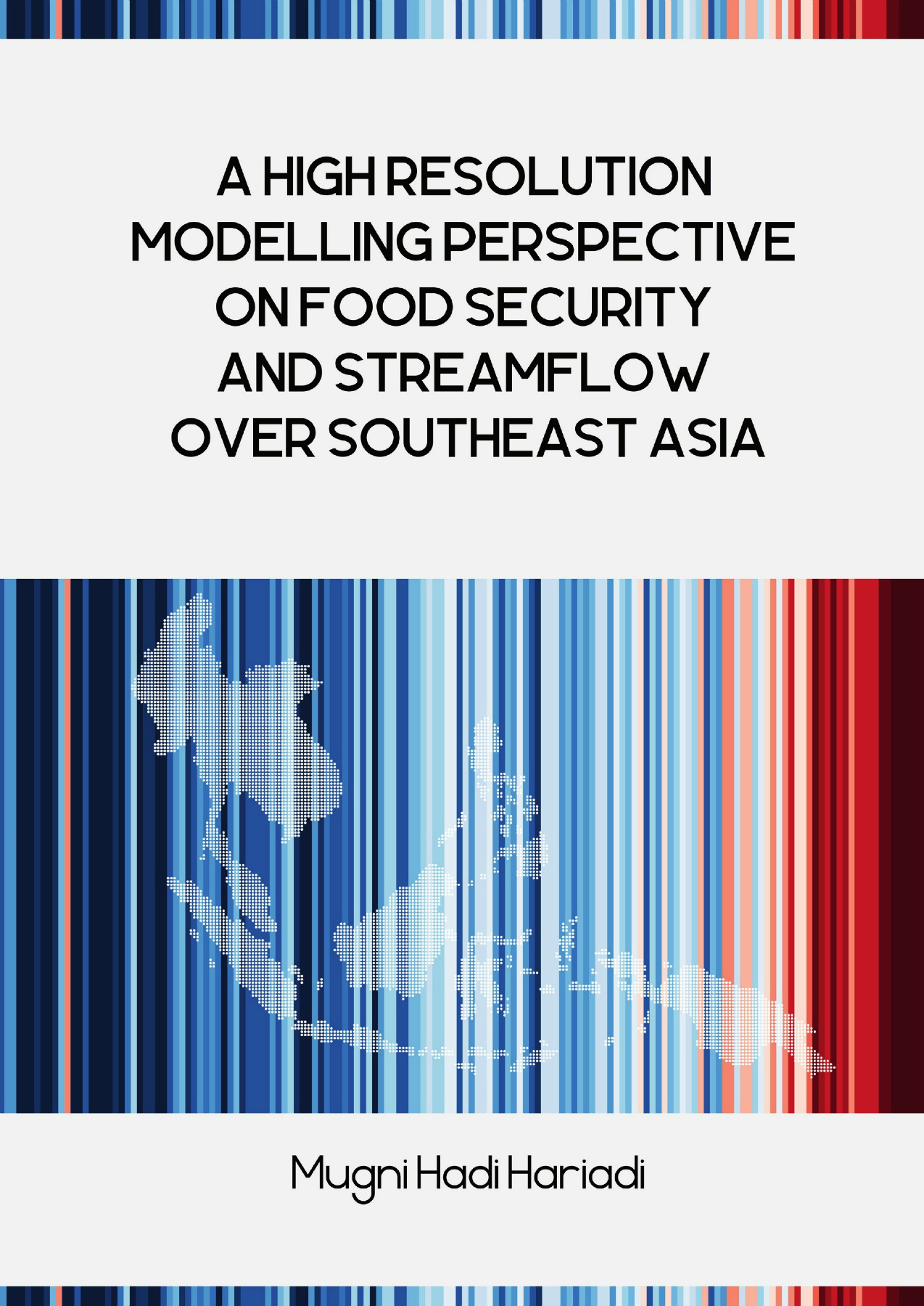


A high resolution modelling perspective on food security and streamflow over Southeast Asia
This thesis assesses the performance of various climate model experiments in representing rainfall patterns in Southeast Asia, with a particular focus on the rainy season and extreme rainfall events. It also examines projections of future rainfall patterns and their implications for streamflow dynamics, as well as agriculture, particularly rice production. In the first two chapters of this thesis, datasets from regional climate models (RCMs) based on the Coupled Model Intercomparison Project phase 5 (CMIP5) outputs under CORDEX are compared with datasets from the High-Resolution Model Intercomparison Project (HighResMIP). The comparison evaluates the models’ accuracy in representing monsoon characteristics and extreme rainfall. Generally, the HighResMIP models provide a more precise representation of monsoon onset, total rainy-season precipitation, and extreme rainfall events. Both coupled and sea surface temperature-forced HighResMIP models align better with observational data than CORDEX models. However, there are still biases in rainfall intensity simulation, indicating the need for bias correction before further applications. Accurate monsoon rainfall modelling is crucial for Southeast Asia’s agriculture, where delayed monsoons can limit the possibility of multiple crop cycles annually. HighResMIP’s historical coupled and atmosphere-forced runs (Hist-1950 and HighresSST) show better alignment with observational data than CMIP5’s regional climate models, particularly in capturing the onset date and total seasonal rainfall across the region. High-resolution models from the HighresSST experiment also performed comparably to lower-resolution versions, effectively capturing monsoon characteristics. The HighresSST experiment, in particular, provided the most accurate representation of monsoon onset anomalies and seasonal precipitation under different El Niño-Southern Oscillation (ENSO) conditions, though it slightly underestimated the magnitude of onset date shifts. These findings emphasize the value of high-resolution models for improving climate projections in Southeast Asia, providing crucial insights to guide agricultural strategies and adaptation in the face of climate variability. For extreme rainfall, observations indicate high rainfall intensities in regions impacted by tropical cyclones and prolonged dry spells in parts of Indochina and southern Indonesia. HighResMIP models, whether coupled or sea surface temperature-forced, align more closely with these observed patterns than the CORDEX models. However, challenges remain in accurately capturing precipitation intensity, as model biases persist, especially affecting rainfall intensity indices. These biases are more pronounced in CORDEX than in HighResMIP and are present across both low- and high-resolution versions of HighResMIP. The similar performances of HighresSST and Hist-1950 runs suggest reliable performance from the ocean model components. Furthermore, the comparable outcomes between low- and high-resolution HighResMIP models indicate that increasing resolution does not necessarily enhance model accuracy for these variables. In the last two chapters of this thesis, the focus shifts to future climate scenarios, projecting changes in extreme rainfall and streamflow events and their implications for extreme streamflow and rice production. The analysis highlights that Myanmar may face particularly significant challenges compared to other mainland Southeast Asian countries. Across the Indonesian maritime continent, regions like Sumatra and Java are projected to see up to a 40% increase in the length of dry spells, while extreme high rainfall is expected to intensify in Borneo and Papua’s mountainous regions. The streamflow analysis further shows that climate change impacts are more noticeable in low flow events than in high flow events. Rivers in areas such as the central Mekong catchment, Sumatra, Peninsular Malaysia, Borneo, and Java are projected to experience more frequent and severe low flow events. In fact, the probability of future low flow occurrences increases significantly, reaching an average rise of 101% over Sumatra and 90% over Java. Notably, rivers with steep hydrographs, which are more prone to flash flooding, are expected to see greater changes in both extreme high and low streamflow events. Meanwhile, rivers with flatter hydrographs may face a higher risk in the probability of low flow change. The thesis also delves into how changes in cumulative rainfall and shifts in the monsoon season adversely affect rice production across Southeast Asia. For instance, a notable reduction in rainfall is evident in the December-January-February period over mainland Southeast Asia and the Philippines, with decreases reaching up to 33% and 15% in specific areas, respectively. In Indonesia, the June-July-August period shows widespread rainfall reductions, with some regions experiencing declines as steep as 48%. This rainfall decrease is also coupled with delays in the monsoon onset and shortened rainy seasons throughout much of the region. A striking example is in the southern Philippines, where the rainy season is shorter by up to 27 days compared to usual. These shifts in rainfall timing and quantity pose significant challenges for rainfed rice production, as they disrupt the water availability essential for optimal crop growth. While increased rainfall during the second growing season in parts of Mainland Southeast Asia and the Philippines improves rice yields, declines during the first and third seasons, particularly in Java, substantially reduce yields. The third season in Java experiences the most severe yield loss due to reduced rainfall and the shorter rainy season. Simulations of rice irrigation also indicate that rising temperatures contribute to shorter growing seasons, further diminishing yields. Adapting to these conditions is essential to mitigate rice production losses. However, preliminary analysis suggests that switching to crops with C4 photosynthesis alone may not be sufficient. Instead, enhancing and optimizing current agricultural systems to address potential yield gaps appears as a necessary and effective strategy.
| Publicatiedatum | 16 april 2025 |
| Universiteit | Wageningen University |
| Auteur | Mugni Hadi Hariadi |
| ISBN nummer | 978-94-6510-570-3 |