Mojtaba Keykhasaber
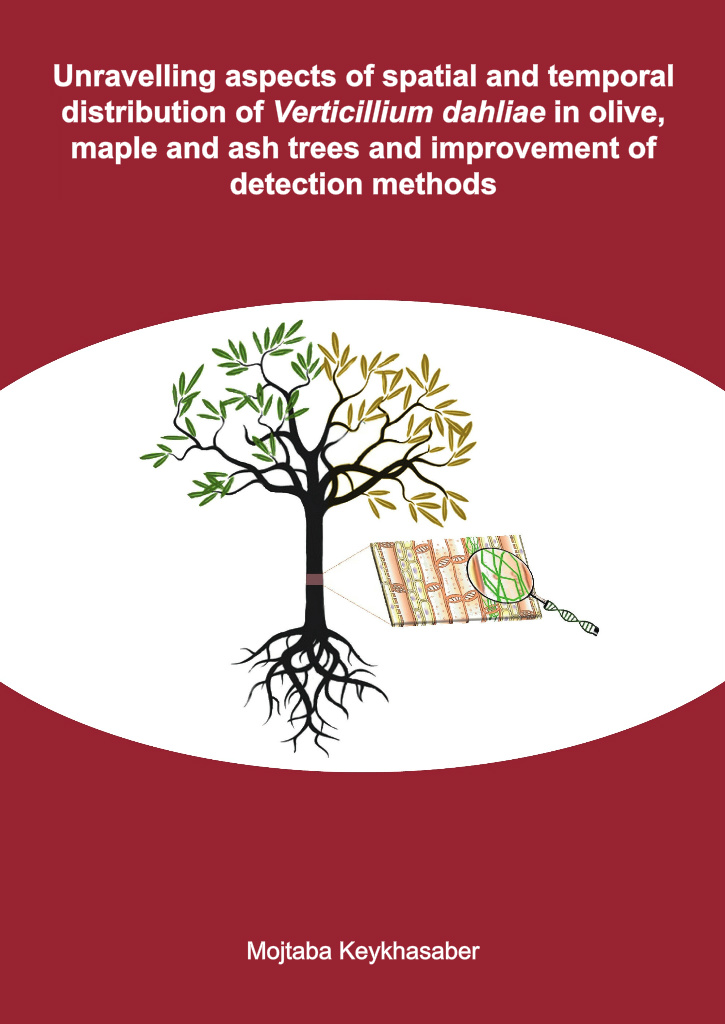


Unravelling aspects of spatial and temporal distribution of Verticillium dahliae in olive, maple and ash trees and improvement of detection methods
Vascular wilts caused by xylem-colonizing pathogens are among the most devastating plant diseases that affect a wide range of plant species worldwide. Chapter 1 is the general introduction to the thesis outlining the process of infection by vascular wilt pathogens. Vascular wilt pathogens, which comprise bacteria, fungi and oomycetes, are generally soil-borne micro-organisms that infect their host plants through the roots. They traverse the cortex of the roots and enter the xylem vessels, after which they proliferate within these vessels, causing blockage of water and mineral flows that may result in partial or complete wilting or death of whole plants. Verticillium wilt disease caused by the soil-borne fungus Verticillium dahliae Kleb. is among the major vascular wilt diseases in herbaceous crops as well as woody plants. Verticillium wilt is intensively studied in herbaceous hosts, whereas little is known about Verticillium wilts of woody hosts. This chapter is completed with an outline of the PhD research project. Verticillium wilt is a serious problem in olive-growing regions and in tree nurseries worldwide. In Chapter 2, we review common and differentiating aspects of Verticillium wilt, caused by V. dahliae, in woody hosts, with further emphasis on olive, ash and maple. The establishment of new planting sites on infested soils, the use of infected plant material and the spread of highly virulent pathogen isolates are the main reasons of increasing problems with Verticillium wilt in tree cultivation. The use of practices to avoid spreading of the disease and to reduce soil inoculum levels, combined with resistant host plant cultivars if these are available, are discussed as the most effective measures to deal with Verticillium wilt disease. It is underlined that improvement of methods for early detection and accurate diagnosis of the pathogen in diseased trees, planting material and at cultivation sites prior to planting is essential in this regard. Information on the distribution of V. dahliae in infected trees helps to design an appropriate and efficient sampling method for reliable detection of the pathogen in diseased trees. In Chapter 3, the distribution of V. dahliae in young twigs and leaves of infected olive trees is studied by real-time quantification of V. dahliae DNA. Analysis of twig and leaf samples collected from different sides of the crown of infected olive trees showed a non-uniform distribution of the fungus within infected parts of diseased olive trees. It was demonstrated that testing of combined samples comprising subsamples from at least 5 twigs from different sides of the tree, or 5-10 random leaves, can reliably detect the pathogen. V. dahliae isolates that infect olive trees can be classified as defoliating (D) isolates that are highly virulent, or non-defoliating (ND) isolates that are generally less aggressive. Discrimination of these pathotypes is important in order to predict the severity of disease, and decide on appropriate disease management strategies. This is particularly important due to the alarming spread of highly virulent isolates of the D pathotype worldwide. In Chapter 4, a novel method is designed for accurate discrimination and sensitive detection of D and ND isolates of V. dahliae. Through comparative genomics of multiple D and ND isolates of V. dahliae a region was identified that is present in all sequenced ND isolates, while absent from all D isolates. Based on this presence-absence polymorphism, a set of primers was designed spanning this region that was able to generate differentially sized amplicons for isolates that belong to the different pathotypes. Additionally, a nested-PCR assay was designed to increase the sensitivity and improve detection of D and ND isolates in planta. In Chapter 5, the relation of the dynamics in pathogen distribution in infected plants to the differences in extent and severity of disease caused by D and ND isolates in resistant and susceptible olive genotypes is studied. To this end, the distribution of a D (VNN7) and a ND (V4) isolate of V. dahliae in root-inoculated young plants of a susceptible (Picual) and a partially resistant cultivar (Frantoio) of olive and its relationship to the disease progression was investigated using real-time PCR. The amount of pathogen DNA detected in the two cultivars correlated with their susceptibility to Verticillium wilt, with lower quantities of V4 and VNN7 DNA detected in ‘Frantoio’ than in ‘Picual’. Also quantities of pathogen DNA in VNN7-inoculated plants were higher than quantities of pathogen DNA in V4-inoculated plants. The distribution patterns of D and ND isolates in the lower, middle and top parts of tested olive cultivars showed that differences in symptom severity were related to amounts of the pathogen in lower and middle parts of the trees, since colonization of the pathogen in top parts of the stem of inoculated plants was minor and was not significantly different between treatments. Moreover, microscopic analysis of infection and colonization processes of V. dahliae in olive plants inoculated with GFP-labelled isolates revealed that colonization of the above ground tissues of infected olive plants is by means of conidia transported upward with the xylem sap stream. In Chapter 6 we investigated the spatial and temporal distribution of V. dahliae in relation to disease progression and recovery in stem-inoculated maple and ash trees. These species differ strongly in vascular anatomy with maple having a diffuse porous xylem anatomy whereas ash has a ring porous xylem anatomy. Results showed that differences in the xylem anatomy of ash and maple did not significantly affect the speed and extent of the upward spread of the pathogen in stem-inoculated trees. Nevertheless, the xylem of ash trees is much less supportive for growth and survival of V. dahliae than that of maple trees, as in the year after inoculation disease incidence and also quantities of V. dahliae detected in maple trees were significantly higher than in ash trees. Moreover, V. dahliae could not be reisolated at all from ash trees that had recovered from disease. However, it could be detected by PCR in some cases in the xylem formed in the year of inoculation, never in the xylem formed in the year after inoculation. Nevertheless, V. dahliae easily could be detected in the wood of diseased ash and maple trees in the year after inoculation. Notably, despite the presence of a layer of terminal parenchyma cells between growth rings, in ash trees showing disease symptoms in the year after inoculation V. dahliae was present in the xylem of the new growth ring. It was also observed that in stem-inoculated trees V. dahliae can move downward from the point of inoculation into the root collar, which may provide an avenue for infection of new growth rings in ash trees. Finally, in chapter 7 the major results described in this thesis are discussed and placed in a broader perspective.
| Publicatiedatum | 1 maart 2017 |
| Universiteit | Wageningen University |
| Auteur | Mojtaba Keykhasaber |
| ISBN nummer | 978-94-6343-014-2 |