Michael Kermah
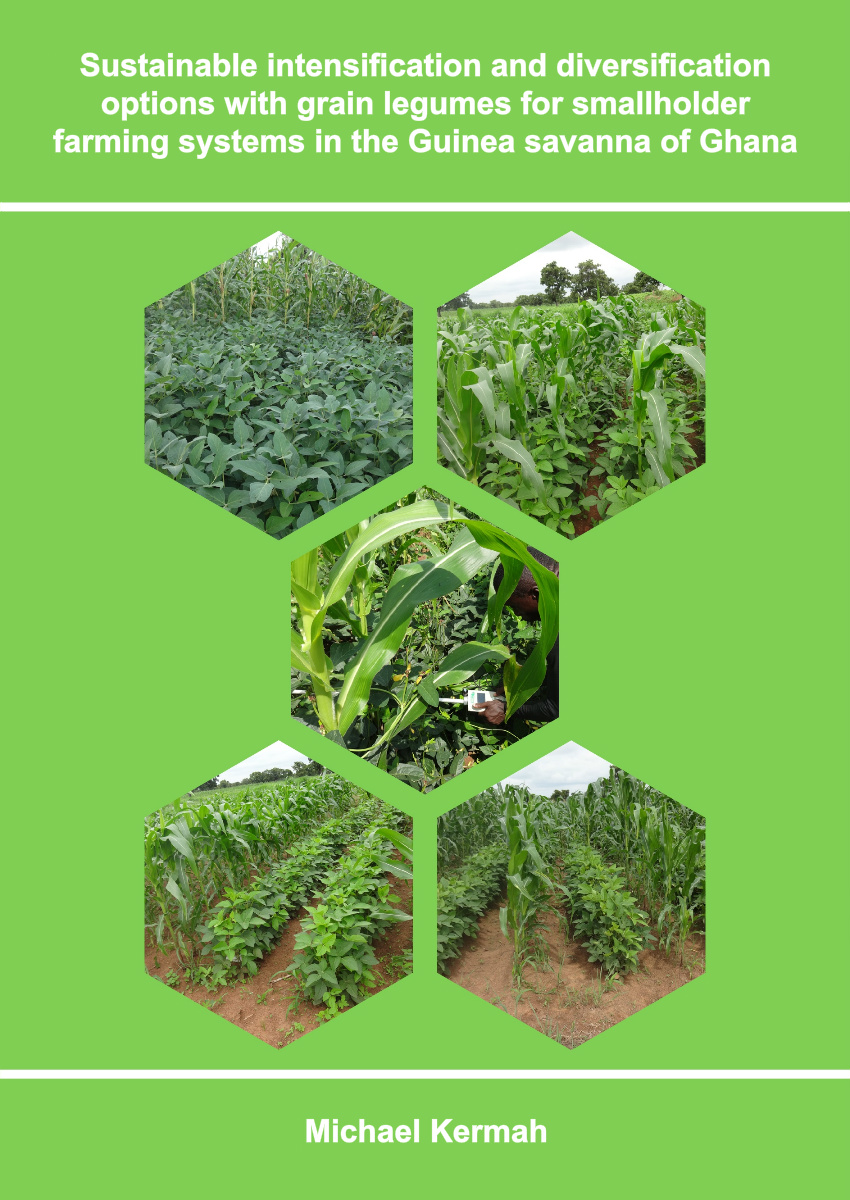


Sustainable intensification and diversification options with grain legumes for smallholder farming systems in the Guinea savanna of Ghana
Food security is a critical issue in the Guinea savanna of northern Ghana where about 60% of the rural population mostly smallholder farmers are food insecure. Food security results from poor crop yields and the inability of households to purchase required supplemental food. Poor crop yields result from low soil fertility compounded by erratic rainfall in the single cropping season. Rapid population growth means that the numbers of food insecure people are likely to increase. This necessitates sustainable intensification and diversification to increase crop production per unit area of land to meet the growing food demand. This thesis focused on testing spatial and temporal intensification and diversification options suitable for the variable biophysical and socio-economic conditions of smallholder farming systems in the Guinea savanna to increase productivity, mitigate the risk of crop failure, and thus to increase food self-sufficiency and income of smallholder farms. One site in the southern Guinea savanna (SGS: favourable soils and rainfall) and one in the northern Guinea savanna (NGS: poor soils, less rainfall) were used for the study. In each site, on-farm experiments were conducted on three fields differing in soil fertility (fertile, medium fertile, poorly fertile). The amount of N2-fixed and N contributed by grain legumes (cowpea, groundnut, soybean) to soil fertility improvement in sole and intercropping were quantified. The potential of replacement intercropping of maize with grain legumes in increasing resource use efficiency and crop productivity relative to sole crops was determined. The productivity of relay (additive) intercropping relative to the more common legume-cereal rotation system was assessed. Thereafter, scenario analysis was performed with household data from the N2Africa Ghana project supplemented with data from the on-farm experiments and literature to test the potential impacts of intensification and diversification options on household food self-sufficiency. The scenarios included: I – intensification of grain legumes alone; II – intensification and diversification through additive intercropping; III – intensification of both maize and grain legumes to achieve 80% of the maximum yield of maize and the grain legumes under farmers’ current practices. Sole legumes fixed a larger amount of N2 (up to 183 kg N ha-1) than under intercropping (up to 97 kg N ha-1). The soil N balance was generally positive and similar between intercrops and sole crops suggesting that both systems could be sustainable. Low soil N stimulated grain legumes in the poorly fertile fields and in the NGS with poorly fertile soils to rely more on atmospheric N2 for growth. However, the larger production of biomass in fertile fields and in the SGS with generally more fertile soils and higher rainfall resulted in 11 to 31 kg ha-1 more N2-fixed in fertile fields than in poorly fertile fields, and 9 kg N ha-1 more in the SGS than in the NGS. Nevertheless, larger biomass and grain yields in fertile fields and the SGS were achieved with greater uptake of N leading to more positive soil N balance in poor fields and the NGS. Across all fields and sites, intercropping enhanced efficiency in the use of land and radiation resulting in a 26% to 46% yield advantage over sole cropping indicated by land equivalent ratios of 1.26 in maize-soybean intercropping to 1.46 in maize-groundnut system. Intercropping also gave generally larger net benefits than sole cropping of maize or grain legumes. Intercropping of maize and grain legumes within the same row was more productive and profitable than distinct alternate row arrangements of the two crops. The legumes in poorly fertile fields were more competitive with the maize crop than in fertile fields due to the greater reliance on atmospheric N2 for growth and less shading by maize leading to 23% greater intercrop yield advantage. The efficiency and productivity of intercrops were also 14% greater in the drier site in the NGS than in the wetter site of the SGS. Yet the absolute larger grain yields achieved in fertile fields and in the SGS with comparatively better soil fertility and rainfall resulted in greater net benefits. This suggests that intercropping is beneficial both in poor and fertile fields, and in favourable and adverse biophysical environments except that the benefits take different dimensions. Legume-cereal rotation is superior in increasing the yield of maize without N fertiliser compared to relay cropping of maize and rotation of maize with a natural fallow. The yield of maize that succeeded groundnut and soybean in rotation without N fertiliser increased by 0.38 t ha-1 in NGS to 1.01 t ha-1 in SGS compared with continuous cropping of maize due to residual N and non-N benefits. Sowing of cowpea at the onset of the season and relaying maize at least 2 – 4 weeks later led to maize yield decline ranging from 0.29 t ha-1 in the wetter SGS to 0.82 t ha-1 in the drier NGS due to inadequate rainfall. When maize was sown at the beginning of the season and cowpea was relayed at least 3 – 5 weeks later, the cowpea yield reduction was similar between the SGS and NGS and ranged from 0.18 t ha-1 to 0.26 t ha-1. Over two seasons, the cumulative grain yield of sowing maize first and relaying cowpea was similar to that of the legume-cereal rotation systems even though the cowpea failed to yield in the first season. This indicates that such relay cropping is a promising ecological intensification and diversification option suitable for increasing crop productivity in smallholder farming systems in the Guinea savanna and under adverse climatic conditions. The scenario analysis showed high levels of food insufficiency with current farming practices (baseline) in the Guinea savanna as only 56% of farm households in Northern region and 45% each in Upper East and Upper West regions of northern Ghana achieved 12 months of food self-sufficiency. In addition, 21% of households in the Northern region and 37% each in Upper East and Upper West regions were food self-sufficient for six months or less. The tested intensification and diversification options with grain legumes increased the proportion of food self-sufficient households across the Guinea savanna by 25% in Scenario I, 36% in Scenario II and 43% in Scenario III compared with the baseline situation. The share of farm households that could survive on their own food production for a maximum of half a year decreased by 19%, 24% and 27% in Scenarios I, II and III, respectively relative to the baseline. The food self-sufficiency ratios of 70 – 93% of food self-sufficient households across the three regions ranged from at least 20% to over 300% above the threshold of one (1). This suggests that through intensification and diversification with grain legumes, most farm households will be self-sufficient in food and also generate marketable surpluses to earn income. These potential benefits resulted from the comparatively greater grain yields from intensification and diversification compared to the current cropping practices. Therefore, grain legumes provide promising strategies to contribute to achieving household food self-sufficiency and improved income in the Guinea savanna. However, the total size of land cropped matters, and improved access to markets and credit are needed to acquire the relevant inputs. The long-term sustainability of the tested intensification and diversification options is not certain. For this reason, further research using simulation modelling work is required to assess long-term nutrient balances, especially of N, and to predict likely changes in soil organic carbon and sustainability of the benefits.
| Publicatiedatum | 10 februari 2020 |
| Universiteit | Wageningen University |
| Auteur | Michael Kermah |
| ISBN nummer | 978-94-6395-228-6 |