Mexx Holweg
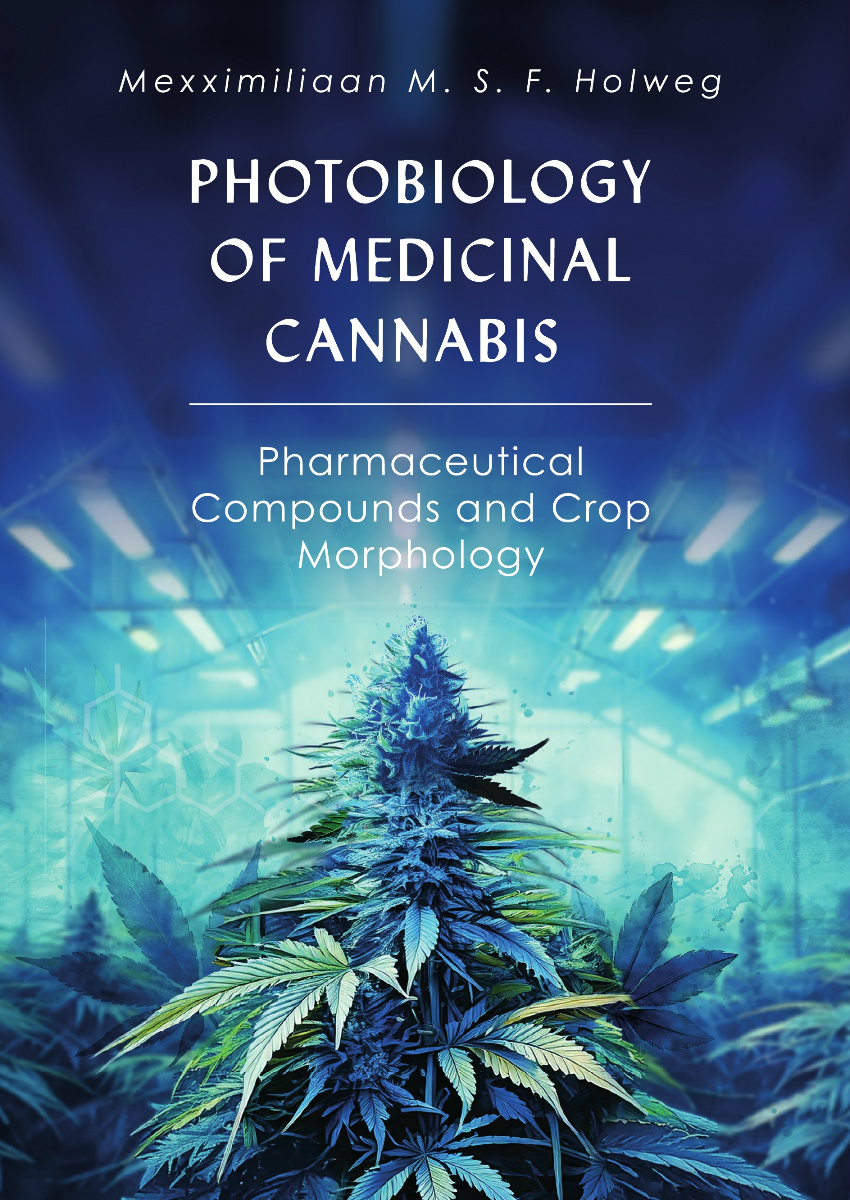


Photobiology of medicinal cannabis: pharmaceutical compounds and crop morphology
Medicinal cannabis (Cannabis sativa) is a high-value crop characterised by its specialised metabolites, particularly cannabinoids and terpenoids, predominantly found in female inflorescences. In controlled-environment agriculture, optimising light intensity, spectral composition, and air temperature is critical for increasing both inflorescence- and specialised metabolite yields. These factors influence adventitious root formation, plant morphology, and metabolite accumulation across different developmental stages. This study examined the physiological mechanisms underlying inflorescence and specialised metabolite production through morphological, metabolic, and photosynthetic measurements. Chapter 1 introduces the taxonomy, chemotypes, and specialised metabolites of medicinal cannabis, linking morphological traits and phytochemical diversity to medicinal cannabis cultivation. It then examines cultivation systems and crop phases, from mother plant cultivation and apical stem cutting propagation to final harvest, emphasising the vegetative and generative stages. The role of photobiology is reviewed with a focus on how light intensity and spectrum influence adventitious root formation, plant growth, photosynthesis, and specialised metabolite accumulation. Finally, the chapter presents the overall research objectives and thesis outline, positioning photobiology in medicinal cannabis as a central theme in developing resource-efficient cannabis cultivation methods through increasing inflorescence and specialised metabolite yield. Chapter 2 investigates how mother plant age and light intensity during mother plant cultivation and propagation affect apical stem cutting morphology and rooting. Two genotypes were grown for six months under a lower (400 µmol m⁻² s⁻¹) or higher (800 µmol m⁻² s⁻¹) light intensity, and stem cuttings were subsequently rooted under three propagation light intensities (50, 150, and 250 µmol m⁻² s⁻¹). Mother-plant age did not affect the fraction of rooted cuttings or root dry mass. Higher light intensity during mother plant cultivation resulted in starch and sugar accumulation at the cutting base. This accumulated starch and sugar at the cutting base was expected to improve rooting; however, it reduced rooting in one genotype and did not affect rooting in the other genotype. Auxin concentrations in the apex and at the stem base were largely unaffected by mother plant age and light intensity during mother plant cultivation. Meanwhile, a higher light intensity during propagation increased root dry mass without affecting the fraction of rooted cuttings. Chapter 3 examines the influence of air temperature and light intensity on inflorescence and specialised metabolite yields during the short-day (flowering) phase, addressing the challenges of maintaining high inflorescence yield and specialised metabolite uniformity between the upper and lower inflorescences. Two genotypes were grown under a lower (25/21 °C) or higher (31/27 °C) temperature regime, combined with light intensities of 600, 900, and 1200 µmol m⁻² s⁻¹. A higher air temperature reduced total cannabinoid concentrations due to the formation of abnormal inflorescence clusters atop older ones. This improved the uniformity of specialised metabolite concentrations between upper and lower inflorescences, as lower inflorescences consistently showed lower specialised metabolite concentrations. Additionally, a higher air temperature reduced inflorescence yield in one genotype, whereas it did not affect inflorescence yield in the other genotype. For both genotypes, a higher light intensity linearly increased inflorescence yield without affecting the specialised metabolite concentration, subsequently increasing specialised metabolite yield per square meter. Leaf-level photosynthesis decreased towards the end of the short-day phase, likely due to leaf senescence. This raises the question of whether light intensity could be reduced during the final stages of flowering without affecting yield. These findings highlight the importance of maintaining lower air temperatures in combination with higher light intensities to promote both inflorescence- and specialised metabolite yield. Chapter 4 focuses on how spectral composition interacts with light intensity to affect inflorescence and specialised metabolite yield. Plants were grown at 600 and 1200 µmol m⁻² s⁻¹ under various spectral distributions differing in red wavelength peaks (640 nm and 660 nm), red-to-blue ratio and green fraction, and overall spectral broadness. Dividing red light fraction between maximum absorption peaks 640 and 660 nm, compared to solely 660 nm, increased plant dry matter production and inflorescence yield at both light intensities due to increased photosynthetic rates, while broader-spectrum lighting at higher light intensity achieved similar results to the double red peak. Cannabinoid concentrations were unaffected by the treatments. However, at a higher light intensity, terpenoid levels increased under a dual red-peak spectrum compared to a single red-peak spectrum, indicating that spectrum-by-intensity interactions can influence inflorescence and specialised metabolite yield. Chapter 5 examines the effects of supplemental ultraviolet (UV-A + UV-B) radiation under a relatively lower (600 µmol m⁻² s⁻¹) and relatively higher (1000 µmol m⁻² s⁻¹) background light intensity. At the lower background light intensity, supplemental UV radiation minimally increased specialised metabolite concentrations two weeks before harvest but not at final harvest, and it slightly reduced inflorescence yield. By contrast, supplemental UV radiation minimally increased inflorescence yield at a higher background light intensity, with no effect on specialised metabolite accumulation. The reduced effectiveness of supplemental UV radiation at a background higher light intensity likely reflects acclimation mechanisms such as increased flavonoid or anthocyanin accumulation, which can prevent UV-induced stress responses. These findings suggest that the effectiveness of supplemental UV radiation may depend on the plant's acclimation to the background light intensity. Chapter 6 restates the significance of light intensity and spectral composition for increasing inflorescence and metabolite yields in medicinal cannabis. Medicinal cannabis tolerates high light intensities without reductions in light use efficiency. However, as leaf senescence progresses toward the end of the short-day phase, photosynthesis declines, creating an opportunity for dynamic lighting strategies that reduce the light intensity in later stages to reduce energy costs without potentially compromising inflorescence- and specialised metabolite yield. Furthermore, this chapter underscores the importance of considering environmental factors beyond light intensity and spectrum. While the light spectrum shapes plant architecture, specialised metabolite concentrations are predominantly determined by genotype, inflorescence developmental stage, and the interaction between background light intensity and supplemental UV. The chapter concludes by discussing cultivation strategies for increasing inflorescence- and specialised metabolite yield, adopting sustainable use of resources, and finally emphasising that quality should be defined beyond solely Δ9-THC potency by incorporating broader metabolite profiles. In summary, this thesis highlights that medicinal cannabis can achieve high inflorescence- and specialised metabolite yields through proper management of light intensity, spectral composition, and air temperature.
| Publicatiedatum | 11 juli 2025 |
| Universiteit | Wageningen University |
| Auteur | Mexx Holweg |