Marieke Voshaar
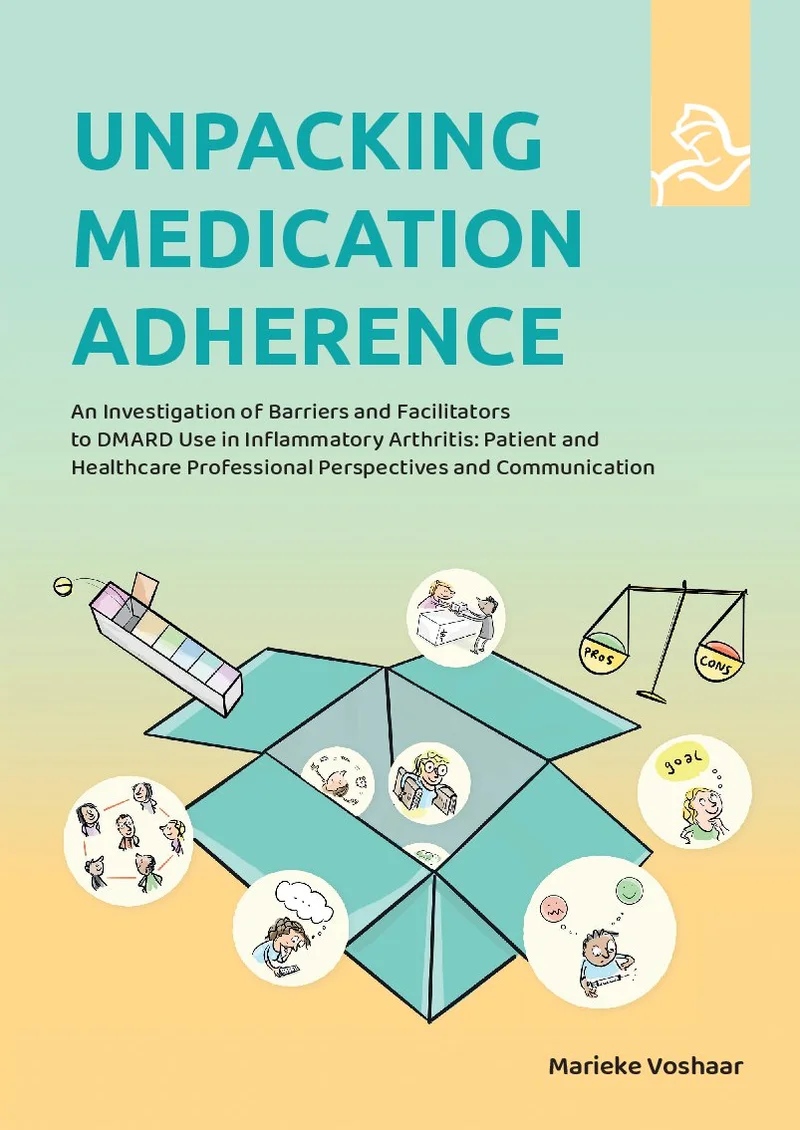


UNPACKING MEDICATION ADHERENCE
ENGLISH SUMMARY
Rheumatoid arthritis (RA) is a chronic condition for which long-term treatment with disease-modifying antirheumatic drugs (DMARDs) is essential to slow or even stop disease progression and preserve functioning. Although DMARDs are effective, their full clinical potential is often not realised in daily practice due to among others suboptimal medication adherence. To date, effective and sustainable interventions to structurally improve adherence in RA are lacking.
Traditional adherence research has primarily focused on demographic and disease-related factors, which have proven insufficient to distinguish patients at increased risk of non-adherence. Where HCPs are well educated and skilled to make the diagnosis and advice on (curative) treatment options, especially administration of medication is almost exclusively executed by the patient herself. This underscores that medication use in RA is a complex behavioural process, influenced by cognitive, emotional, social, and contextual factors.
Over the past decades, healthcare research and HCPs shifted towards acknowledgement of the importance of the interaction between patients and HCPs. Improving outcomes that matter to patients are the only reason to spend billions in healthcare. Healthcare is shifting towards patient-centred care (PCC), in which active patient involvement, shared decision-making, and self-management are central toward the best possible outcomes, that matter for her (him).
Nevertheless, knowledge remained limited and fragmented regarding which barriers and facilitators patients experience in relation to DMARD use, which of these factors are most relevant from the patient perspective, how healthcare professionals perceive these factors, and to what extent such barriers are actually discussed in routine clinical practice. These knowledge gaps hinder the development of targeted, patient-centred strategies to improve medication adherence.
The five studies included in this thesis were conducted to systematically address these gaps. By identifying barriers and facilitators from the patient perspective, exploring their relative importance, examining healthcare professionals’ perspectives, and analysing communication during routine consultations, this thesis aims to provide a coherent foundation for the development of more effective, patient-centred approaches to improving DMARD adherence in RA.
Chapter 2: Patient-Centred Care in Established Rheumatoid Arthritis
Patient-centred care (PCC) is highlighted in this review as a key approach to improving outcomes in established rheumatoid arthritis (RA). Medication adherence used as a key example illustrates how patients’ experiences, preferences, and everyday realities shape care outcomes. This narrative review showed that recognising patients as individuals with unique needs and preferences positively affects treatment safety, effectiveness, and costs, while strengthening collaboration between patients and healthcare professionals (HCPs).
Because RA requires ongoing management beyond limited clinical encounters, active patient involvement is essential. Effective PCC extends beyond information provision and requires support for patients to develop the knowledge, confidence, and skills needed for shared decisionmaking and self-management. Educational resources and decision aids can facilitate engagement, particularly when complementing meaningful patient–HCP interactions.
The implementation of PCC is a gradual process that depends on high-quality communication, appropriate professional competencies, interdisciplinary collaboration, and adequate access to care. When these conditions are embedded in routine practice, PCC supports improved health outcomes and quality of life for people with established RA through shared responsibility between patients and HCPs.
Chapter 3: Barriers and Facilitators to DMARD Use in Inflammatory Rheumatic Diseases
In this study, barriers and facilitators to disease-modifying antirheumatic drug (DMARD) use in patients with inflammatory rheumatic diseases (IRDs) were explored. Despite the proven effectiveness of DMARDs, suboptimal adherence remains common, indicating a need to better understand patients’ perspectives on medication use.
Using questionnaires (120 patients) and 2 focus group discussions (21 patients), patients’ experiences with DMARDs were examined and analysed using the Theoretical Domains Framework (TDF), with findings mapped onto the COM-B model. This approach enabled systematic identification of psychological, social, and contextual factors influencing adherence behaviour.
The results demonstrated substantial individual variation in barriers and facilitators, with factors spanning patients’ capability, opportunity, and motivation. Motivational influences—such as beliefs about treatment necessity, concerns about side effects, and preferences for autonomy—were particularly prominent, alongside practical and communicationrelated challenges.
These findings highlight the limitations of uniform adherence interventions and support the need for personalised, theory-informed strategies that address patients’ individual contexts and lived experiences.
Chapter 4: Ranking Facilitators and Barriers of Medication Adherence in Inflammatory Arthritis
In this study, patients with inflammatory arthritis prioritised facilitators and barriers to adherence to disease-modifying antirheumatic drugs (DMARDs). While many influencing factors have been identified in prior research, insight into their relative importance from the patient perspective has been limited.
Using a maximum difference scaling (MaxDiff) approach, 128 patients ranked 35 previously identified adherence-related factors. The analysis showed that perceived symptom relief was the most important facilitator of adherence, followed by maintaining independence and involvement in shared decision-making with healthcare professionals.
These priorities were consistent across patient subgroups and were not influenced by age, sex, or educational level. Together, the findings highlight a set of core values that underpin adherence behaviour across the inflammatory arthritis population.
The results emphasise the importance of adherence strategies that focus on tangible treatment benefits, support patients’ autonomy, and promote shared decision-making. Addressing these patient-prioritised factors may enhance the effectiveness of adherence interventions and strengthen patient-HCP communication in routine clinical care.
Chapter 5: Healthcare Professionals’ Perceptions of Barriers and Facilitators to DMARD Use in Rheumatoid Arthritis
In this study healthcare professionals’ (HCPs) perspectives on barriers and facilitators influencing adherence to disease-modifying antirheumatic drugs (DMARDs) in patients with rheumatoid arthritis (RA) were explored. While adherence challenges are well documented from the patient perspective, less is known about how HCPs understand and interpret these influences.
In-depth interviews were conducted with rheumatologists, specialised nurses, and pharmacists. Participants described a broad range of factors affecting adherence, including treatment-related issues such as side effects, delayed treatment effects, and regimen complexity. However, the most prominent influences were patient-related, particularly beliefs about medication necessity and harm, coping strategies, and selfmanagement skills.
HCPs also identified disease-related factors, healthcare system characteristics (including trust and continuity of care), and broader social and economic contexts as important determinants of adherence behaviour. Many of the identified factors were considered modifiable through improved communication and tailored support.
Overall, the findings underscore the central role of HCPs in addressing adherence through personalised, trust-based interactions that respond to patients’ beliefs, capabilities, and circumstances, thereby supporting more effective long-term management of RA.
Chapter 6: Talking About Barriers to DMARD Use in Routine Rheumatology Care
In this study, it was investigated if and how barriers and facilitators to disease-modifying antirheumatic drug (DMARD) use were discussed during routine consultations between patients with rheumatoid arthritis (RA) and their rheumatologists. Although effective communication is known to support adherence, little is understood about how medicationrelated issues are addressed in everyday clinical practice.
Analysis of 134 audio-recorded consultations showed that patients raised medication-related barriers or facilitators in fewer than half of visits, and explicit discussion of adherence or non-adherence occurred in less than a quarter of visits. When facilitators were mentioned, they were mainly practical in nature, such as treatment convenience and integration into daily routines. Barriers more often reflected concerns about side effects, effectiveness, and long-term use.
Rheumatologists typically responded using a combination of informational and empathic communication, addressing both practical questions and emotional concerns. However, many opportunities to proactively explore adherence were missed, with adherence mostly addressed through closed-ended questions by rheumatologists.
Overall, the findings highlight the need for more systematic and patientcentred communication about medication use. Proactively eliciting patients’ experiences and concerns may help normalise discussions about adherence, strengthen the therapeutic relationship, and better support sustained DMARD use in routine care.
Chapter 7: General Discussion
Medication adherence to disease-modifying antirheumatic drugs (DMARDs) in patients with inflammatory arthritis from a patient-centred and behavioural perspective, was the focus of this thesis. Across five complementary studies, the research aimed to deepen the understanding of the barriers and facilitators that shape patients’ medication use and to identify opportunities for improving medication adherence in clinical practice.
A central finding throughout the thesis was the pivotal role of motivation in DMARD adherence. When barriers and facilitators were mapped onto the COM-B framework, most patient-reported factors clustered within the motivation domain, encompassing both reflective processes (such as beliefs about medication necessity, perceived benefits, concerns about long-term use, and autonomy) and automatic processes (including emotional resistance and ambivalence). While traditional medication adherence interventions often focus on education or practical support, the findings of this thesis indicate that such approaches are unlikely to result in sustained adherence if patients’ motivational needs are not adequately addressed. Importantly, many motivational barriers are modifiable through patient-centred communication strategies, shared decision-making, and behaviour change techniques such as motivational interviewing and autonomy-supportive care.
Effective patient–healthcare professional (HCP) communication emerged as a second key theme. Despite evidence linking communication quality to medication adherence, the observational study in Chapter 6 demonstrated that barriers to DMARD use are discussed in only a minority of routine rheumatology consultations. When barriers are addressed, discussions tend to focus on side effects, even though patients rank other factors, such as symptom relief, independence, and shared decision-making, as more important. These findings point to a persistent gap between what patients find meaningful and what is addressed in clinical encounters. The thesis highlights that responsibility for initiating adherence-related conversations primarily lies with HCPs, who must proactively create a safe, empathetic environment in which patients feel able to disclose concerns. At the same time, empowering patients to actively participate and voice barriers is essential. Multidisciplinary collaboration, involving nurses and pharmacists, as well as structured communication tools, may help bridge this gap.
Finally, the thesis underscores the value of theoretical frameworks in understanding and improving medication adherence. By applying the Theoretical Domains Framework (TDF) and linking it to the COM-B model, this research provided a comprehensive and structured approach to identifying behavioural determinants of DMARD use. These frameworks enabled differentiation between modifiable and less modifiable barriers and offer practical guidance for the development of theory-informed, personalised adherence interventions. Together, the findings support a shift away from one-size-fits-all approaches toward patient-centred, motivation-focused strategies that integrate behavioural theory, effective communication, and supportive healthcare systems to improve longterm adherence in inflammatory arthritis.
| Publicatiedatum | 11 december 2026 |
| Universiteit | Radboud Universiteit |
| Auteur | Marieke Voshaar |
| ISBN nummer | 978-94-6534-668-7 |