Maarten van der Ven
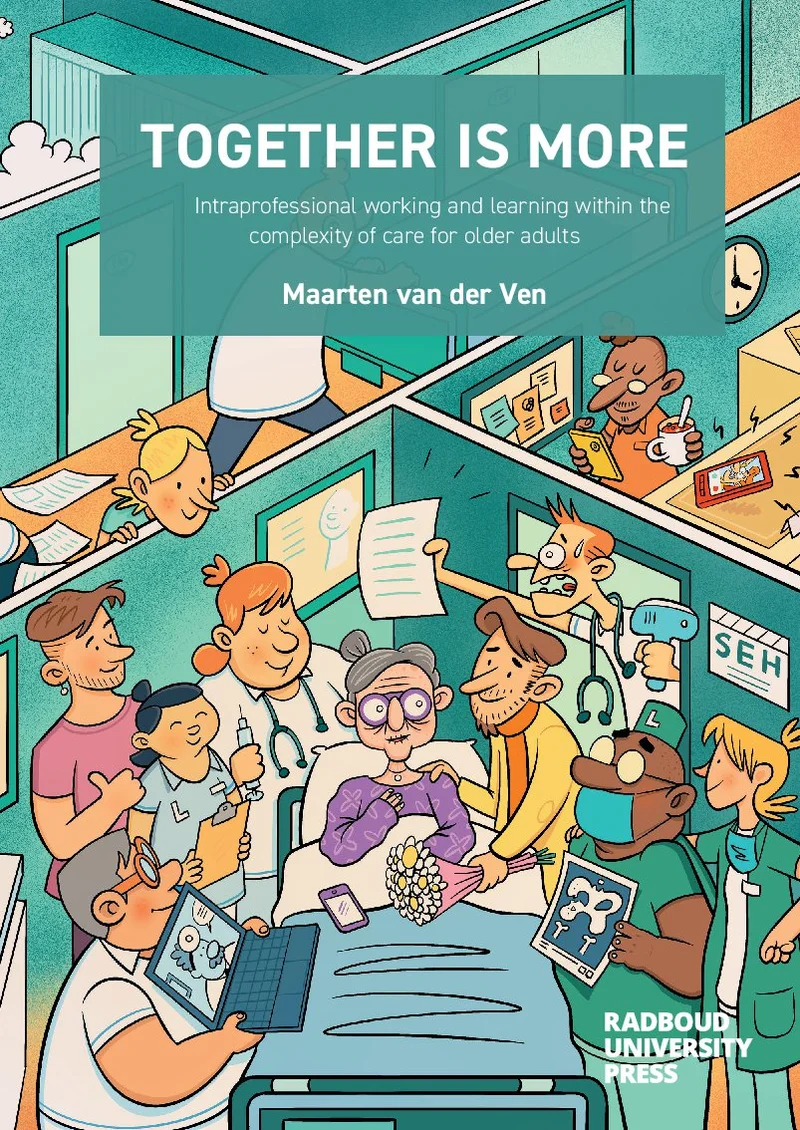


Together is more - intraprofessional working and learning within the complexity of care for older adults
Society is changing due to the 'double aging' of the population: the number of older adults is increasing and people are living longer. This group is characterized by increasing multimorbidity: the simultaneous occurrence of several chronic conditions. Our healthcare system has responded with extensive specialization, making specific health professionals available for each condition. This leads to a situation where a single older patient may involve a multitude of healthcare professionals. Good collaboration between the involved professionals is essential to achieve coordinated and integrated care. Research shows that inadequate collaboration leads to an increased risk of negative outcomes for both the patient and the healthcare professional. Therefore, promoting effective collaboration has been an important research area for some time.
In the literature, a distinction is made between:
- Interprofessional collaboration (IPC): healthcare professionals from different disciplines, such as nurses, physicians, and paramedics, work together within one person-centered treatment plan.
- Intraprofessional collaboration (IntraPC): healthcare professionals within one discipline but from different specialties, such as geriatricians, general practitioners, and surgeons, work together within one person-centered treatment plan.
Previous research shows that learning IPC and IntraPC does not happen automatically. Therefore, calls are made to pay explicit attention to this during training. While the literature on learning IPC has grown strongly in recent years, knowledge about learning IntraPC remains limited.
Practice shows that there are differences between IPC and IntraPC. In intraprofessional teams, roles and task distributions are often more implicit, and leadership is more often a subject of discussion than in interprofessional teams. This raises the question of to what extent insights from interprofessional collaborative learning are applicable to intraprofessional contexts. Therefore, this thesis focuses specifically on intraprofessional collaborative learning.
In Chapter 1, we introduce the central theme of this thesis and describe relevant insights from the literature regarding intraprofessional collaborative learning.
Learning IntraPC often takes place during workplace learning. Workplace learning is learning by participating in daily practice. It is characterized by strong context-dependency, where learning outcomes and learning mechanisms are influenced by the environment in which the learning occurs. This highlights that context-specific knowledge of how IntraPC learning occurs in the workplace can contribute to developing effective work processes that facilitate IntraPC learning.
During workplace learning, IntraPC learning occurs during interactions between a resident (AIOS) and a supervisor and/or between residents from different specialties.
- Learning during interactions between a resident and a supervisor. This is also called supervised workplace learning and can occur, for example, through supervised participation in practice, mutual observations, or conversations during participation in practice.
- Learning during direct interactions between residents. This describes how residents find themselves at the boundaries of clinical practices and that interactions around that boundary have strong learning potential. This is described in the theory of 'Boundary Crossing', which distinguishes four learning mechanisms: Identification, Coordination, Reflection, and Transformation.
In previous research, opportunities for learning IntraPC have been identified, competencies formulated, and design principles for IntraPC learning activities developed. However, how these opportunities, competencies, and design principles can be translated into concrete work processes and learning activities has not yet been investigated. In the studies described in Chapters 2 to 5, we sought ways to shape IntraPC learning in daily practice.
In Chapters 2 and 3, we describe the development, implementation, and evaluation of the workplace learning module 'Transmural Intraprofessional Collaborative Learning' (TILS, internationally known as SPICE). This module focuses on primary care and secondary care residents who are together doing a rotation in the geriatrics department of Radboudumc.
Chapter 2 contains design-based research in which TILS was developed in close collaboration with researchers, educationalists, and professionals from primary and secondary care. This resulted in two workplace learning activities and four formal learning activities. Through iterative design cycles, the feasibility, necessary adjustments, and learning outcomes of the activities were investigated.
The findings showed that for successful implementation, learning activities must align as much as possible with existing teaching moments, there must be sufficient attention to the patient's perspective, activities must be firmly embedded in daily practice, and supervisor involvement is essential. The latter two aspects in particular require extra attention.
In Chapter 3, we investigated the long-term effects of TILS on resident behavior and clinical practice using an innovative evaluation method called the 'Effects Forum' (Effectenplein). In this forum, all stakeholders are invited to jointly reflect on the effects of an intervention, combining focus group interviews with timeline analysis and knowledge co-construction.
The most important outcomes could be summarized in three themes: insight into the care continuum, improved mutual understanding, and a 'ripple effect' of IntraPC learning. Residents transferred their learning to new workplaces through reflection and dialogue.
Chapter 4 focuses on learning IntraPC within supervised workplace learning. An ethnographic study observed supervision dialogues to see how IntraPC learning occurred and what factors hindered or promoted it. We found that frequent opportunities for learning existed in everyday conversations between residents and supervisors, but these were not always utilized due to dynamics such as perceived time pressure, a monitoring focus, and feedback misalignment.
Chapter 5 describes an ethnographic study on learning IntraPC in the emergency department (ED). In acute care for multimorbid older patients with hip fractures, multiple medical specialists' expertise is needed simultaneously. We observed interactions and field interviews, identifying a complex ED context characterized by a 'swarm' of unacquainted professionals, a silo mentality, and a hierarchical feedback culture that impeded effective collaboration and learning.
Chapter 6 is the general discussion, where we critically reflect on our findings and formulate implications for further research and practice. Our results show that collaboration does not arise naturally but is strongly influenced by the organization of care. Fragmentation is not an individual failure but a logical consequence of how care and work are organized. This has consequences for learning: collaboration receives little explicit attention and is largely learned implicitly. A systems-based approach is needed to redefine the supervisor's role as a 'guide' in the healthcare landscape, contributing to more coordinated and integrated care for multimorbid older adults.
| Publicatiedatum | 19 januari 2027 |
| Universiteit | Radboud Universiteit |
| Auteur | Maarten van der Ven |
| ISBN nummer | 9789465153278 |
| DOI nummer | 10.54195/9789465153278 |