Lena Durocher Granger
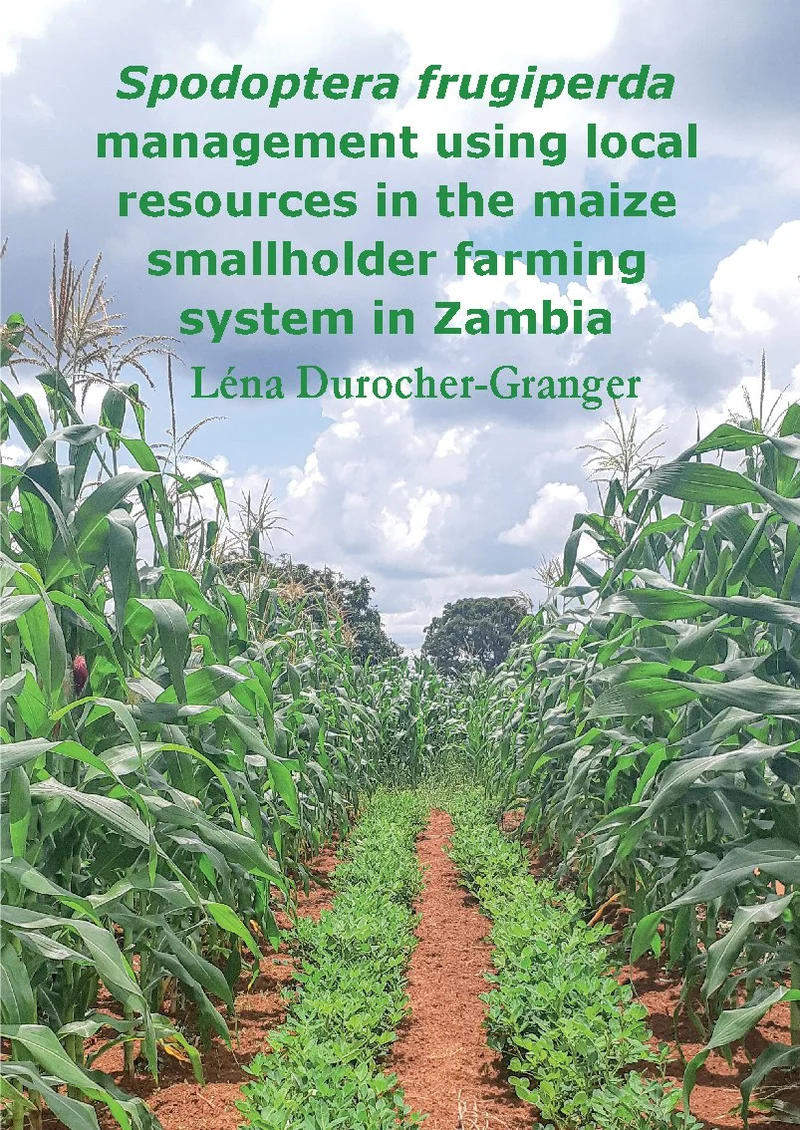


Spodoptera frugiperda management using local resources in the maize smallholder farming system in Zambia
Fall armyworm (FAW), Spodoptera frugiperda (J.E. Smith) (Lepidoptera: Noctuidae), an insect pest originating from the Americas, has become one of the main invasive alien species (IAS) worldwide since it was first detected in 2016 in Africa, where it causes considerable losses on cereals such as maize, sorghum, rice and sugarcane. IAS disproportionately affect livelihood and food security of smallholder farmers in low- and medium-income countries (LMIC), causing severe negative environmental, economic and social impacts. Following the invasion of FAW, the majority of African governments reacted to the outbreaks by purchasing and providing, for free, massive amounts of synthetic pesticides to smallholder farmers in the hope to mitigate crop losses, raising great concerns for health and environmental risks. These reactive measures resulted in a growing interest in research on biological control options for smallholder farmers. Additionally, when applied individually on a field-by-field basis, synthetic pesticides have little impact on highly mobile insect pests such as FAW, which can travel hundreds of kilometres to find a suitable maize field to oviposit. Integrated pest management (IPM), a comprehensive tool that can help farmers manage pests while reducing the need for synthetic pesticides, is still poorly adopted, especially in LMIC. Proper time of planting, which is part of an IPM approach, is a critical management decision for farmers, as planting too early or too late can lead to complete loss of the crop. Commonly, planting early to avoid peak infestation of FAW is recommended to farmers, however, no empirical data in Africa was available to sustain this advice. Biological control, a component of IPM, most often used as the last solution to turn to when all other options have failed, has been proven to be an efficient, cost effective and safe method for pest and disease management. Classical biocontrol, a very impactful tool in the management of IAS, can be a lengthy multi-year process when it comes to searching for exotic natural enemies to release in the newly invaded area. Augmentative and conservation biocontrol can be used to mitigate crop damage when local solutions are available, and, when adopted collectively, their effectiveness can increase. Over the past few decades, experts on invasive species and social scientists investigated the role of collective action for invasive species management and found that the principles can be applied and adapted to reduce the damage caused by IAS across a landscape. However, its application is still poorly studied in low- and middle-income countries (LMIC) where national plant health systems in place to prevent and manage biological invasions, are limited. “Collective pest management” can provide benefits over individual field-by-field management, especially for highly mobile pests when consistent and coordinated actions are implemented. Since its invasion in Africa, FAW has quickly established due to widely available small maize fields (< 2ha) individually managed by millions of smallholder farmers. As a highly mobile pest, FAW’s management is complicated and indicates the need for collective action. Conservation biocontrol such as intercropping can offer simple, low-cost and adaptable solutions to smallholder farmers as pest management alternatives to chemical insecticides, which can reduce pest pressure and chemical usage. The research presented in this thesis aimed at identifying which farming practices farmers can easily implement collectively to enhance local natural enemies, with the main goal of reducing pest pressure and need for synthetic pesticides. The geographic focus of my thesis was located in the maize belt of Central and Lusaka provinces of Zambia where FAW is a major pest problem. In chapter 2, I surveyed the local native parasitoid species successfully attacking FAW and evaluated the factors affecting the occurrence of local natural enemies. During the rainy season of 2018- 2019, I collected on a weekly basis FAW eggs and larvae throughout the maize crop cycle at four locations in the Lusaka and Central provinces in Zambia. To evaluate which factors affected parasitoids occurrence, I recorded on a weekly basis the maize growth stage, number of plants checked and level of damage. Egg masses and larvae were brought back to the laboratory and kept with artificial diet until parasitoids or FAW moths emerged. Overall, I identified 12 different egg-larval, larval and larval-pupal parasitoid species with parasitism rates varying between 8% and 33%. Factors influencing parasitoid species occurrence were location, maize growth stage and FAW larval stage. I conclude this first empirical chapter by indicating that there is potential for enhancing local populations of parasitoids that have adopted FAW as a host through conservation biological control programmes in order to develop safe and practical control methods for smallholder farmers. Chapter 3 studies the feasibility of creating a collective action to promote biological control of FAW among maize smallholder farmers in rural Zambia, and the social and institutional conditions needed for it to be successful and sustainable. I therefore developed a model combining both Ostrom’s eight Design Principles for a community-based management of common-pool resources and criteria of an agricultural innovation that meet the community’s requirements. The tools developed included questionnaires for focus group discussions and in-depth interviews with smallholder farmers of two maize growing districts. I found that some conditions are already in place to support a collective action to manage FAW, such as matching rules to local conditions, collective-choice arrangement, conflict resolution mechanism and minimal recognition of rights to organize, which are conditions supported by traditional leadership of the communities. I conclude that while some conditions would still need to be strengthened for a collective pest management to be sustainable, my study is a first step towards co-designing agricultural innovations based on social and ecological conditions. Chapter 4 reports preliminary effects of planting date and maize growth stages on FAW density and on its local parasitoids from a field study. Early, intermediate and late planting treatments were organized in a complete randomized block design and data on maize growth stage, number of egg masses and larvae were collected weekly in each replicate. Egg masses and larvae were brought back to the laboratory and were fed with artificial diet until parasitoids or FAW moths emerged. The common recommendation of early planting to avoid peak infestation was confirmed as results showed an increase in the number of egg masses over time from early to late planting. Parasitism probabilities were lower in the early planting treatment than for the intermediate and late planting treatments and decreased with increased maize maturity. Parasitoid biodiversity showed dominance by one or two species for early and late whorl stages while maize reproductive stages showed a more even distribution of four species. This preliminary research provided the first empirical evidence that planting early helps to avoid the peak activities of FAW moths. Additionally, these findings provided important information on parasitoid activities in a country with unimodal rainfalls, contributing to developing conservation strategies for the sustainable management of FAW in Zambia. Chapter 5 explores the influence of intercropping on natural pest control in agriculture. In this chapter, I focused on investigating the natural resources available for smallholder farmers to maximize pest control by intercropping maize with commonly grown crops. Fieldwork was carried out during the two consecutive rainy seasons of December to March 2019-2020 and 2020-2021, at two sites in the Lusaka province. The five companion crops tested alongside maize control were cowpeas, groundnuts, beans, sorghum and sunflower. To assess the influence of intercropping on FAW density and parasitoids’ attractiveness, I collected data in the field, on a weekly basis, on FAW egg masses and larvae numbers, and maize stages. Egg masses and larvae collected from the field were incubated in the laboratory until emergence of adult moths or parasitoids. Despite the lack of a clear trend in the data due to variability in the experimental field design across sites and years, I found associations of the parasitoid Chelonus curvimaculatus with sorghum plants, and of Pristomerus sp. with sunflower and maize control treatments. I conclude by suggesting that global collaboration is needed to further understand the various components underlying the tri-trophic interactions between maize, native crops, FAW and local native parasitoid species. Chapter 6 consolidates the entomology and social sciences by assessing the experiences of smallholder farmers with intercropping maize with local companion crops. Specifically, I assessed their experiences in terms of ecological knowledge, willingness and preferences to operationalize collective action principles, long-term pest management and evaluated their limiting factors. Farmers’ knowledge of the concept of biocontrol and natural enemies increased following the project intervention. Farmers showed a positive attitude towards a collective action to manage FAW and showed willingness to implement it at the community level. Boundaries, local conditions and leadership were found to be critical to support a collective action. The main factors limiting the implementation of a collective action for FAW management were a lack of knowledge, coordination and support. This study highlighted the knowledge needed and the limitations of the current extension system in promoting collective pest management and suggests a way forward in improving management approaches of highly mobile pests. Considering all the findings from the five empirical chapters, I consolidated and synthesized in Chapter 7 the new insights and perspectives created during this interdisciplinary research, integrating the viewpoints of farmers who participated in the co-design, implementation and testing of intercropping practices. I further discussed the implications and influence of my research on national policies and challenge the current agricultural extension system, which focuses on reactive and individual pest management approaches. I also discussed the limitations of my research and concluded by emphasizing the need for new collective pest management approaches to uplift biocontrol programmes.
| Publicatiedatum | 4 juni 2026 |
| Universiteit | Wageningen University |
| Auteur | Lena Durocher Granger |