Gerda Bruinsma
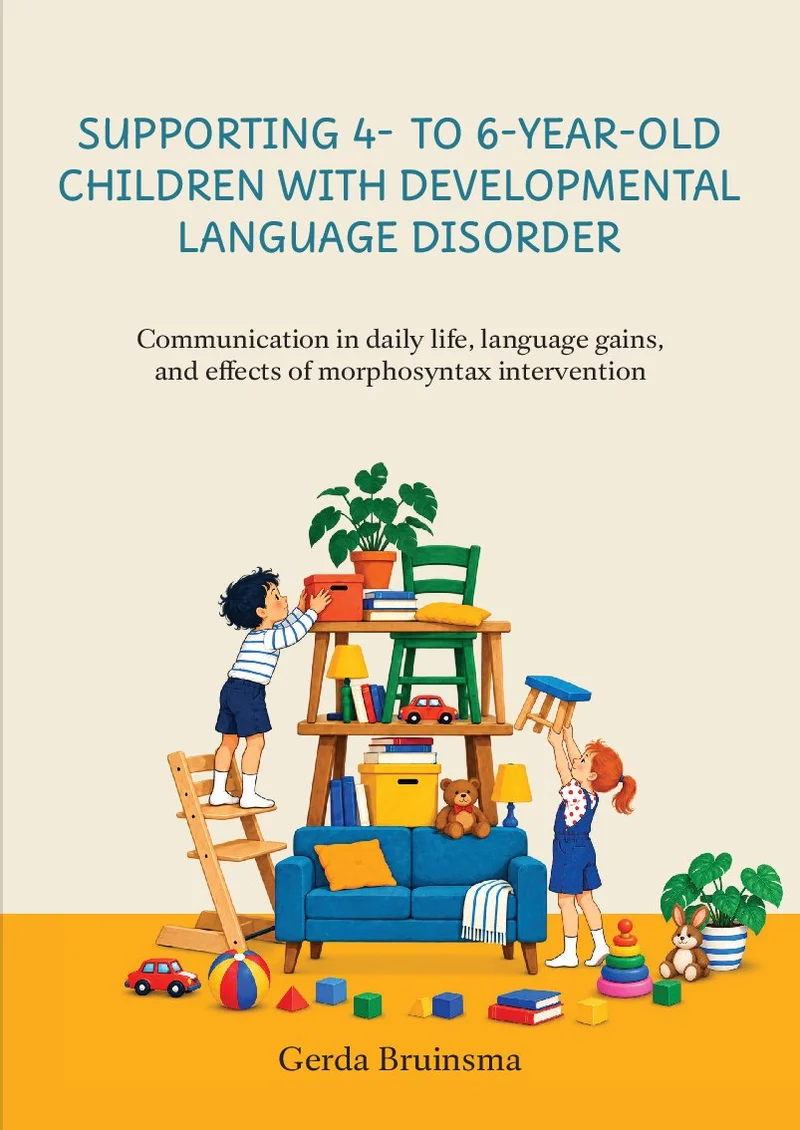


Supporting 4- to 6-year-old children with Developmental Language Disorder
Children with Developmental Language Disorder (DLD) have great difficulty acquiring and using language. As a result, they experience serious problems in daily communication and interaction. DLD is a neurobiological developmental disorder that occurs in 7-10% of children and has consequences for their social-emotional development, school performance, and quality of life (Bishop et al., 2017; Norbury et al., 2016). Language and communication problems often persist into adulthood. Timely, effective intervention is therefore important.
DLD is diagnosed when children show clear and lasting limitations in their language development that hinder communicative functioning at home and at school. Two language profiles are generally distinguished: 1. receptive-expressive DLD, with problems in both understanding and producing language; 2. expressive DLD, with problems primarily in language production (ICD-11, World Health Organization, 2021). Children with DLD may experience difficulties in phonology, morphosyntax, semantics and word finding, and pragmatics. Morphosyntactic problems are most common and are seen as the core issue (Leonard, 2014).
In the Netherlands, many children with DLD attend ‘cluster 2 education,’ special schools for children with DLD. This is because mainstream education places high demands on language proficiency. Limitations in language comprehension, morphosyntax, vocabulary, and verbal working memory make it difficult for children with DLD to follow instructions, understand assignments, and express their knowledge. Cluster 2 education aims to compensate for these barriers and strengthen educational participation through smaller classes, integrated speech therapy, and educational offerings explicitly aimed at strengthening communicative skills. Speech therapists, teachers, and other education and care professionals collaborate intensively in this setting.
Although all children with DLD experience communicative limitations, little is known about their nature and extent in young children. There is also limited knowledge about the potential for growth and catching up on delays in young children with DLD. Previous research indicates that some children show progress while others do not, but an explanation for this has been lacking until now.
Given the persistent difficulties in morphosyntax that children with DLD face and their influence on communication, effective interventions are vital. While interventions such as focused stimulation and recasting have proven effective in highly controlled studies, their effectiveness in clinical practice remains unclear.
This dissertation has three goals:
1. To gain insight into communication in the daily lives of young children with DLD.
2. To map their language development during one school year in cluster 2 education, including factors that influence this development.
3. To evaluate the effectiveness of Language in Interaction Therapy (LIT; Van den Dungen, 2007), an evidence-based, functional intervention in play situations aimed at stimulating morphosyntax.
To answer these questions, three sub-studies were conducted with two different groups of participants aged 4 to 6. One group consisted of 154 children from 18 special education schools (Studies 1 and 2), and the other of 28 children from 6 schools (Study 3).
Chapter 2 describes the limitations in daily communication for children with DLD. Parents reported that their children experienced limitations in various situations. The most frequently mentioned were limitations in the ability to express oneself, to be understood, and to speak intelligibly, especially in contact with unfamiliar people. Emotions and stress in the children appeared to have a major negative influence on communicative functioning. Teachers rated communicative skills as insufficient but found social skills and the quality of student-teacher relationships comparable to those of typically developing children. Children with receptive-expressive DLD experienced more and broader limitations than children with expressive DLD.
Chapter 3 examines progress in morphosyntax, vocabulary, and language comprehension during one school year using a cohort study of 154 children. The children showed progress in language comprehension, expressive vocabulary, and expressive morphosyntax, with some narrowing the gap compared to typically developing peers. In morphosyntax, scores were lowest at the start and progress was minimal, consistent with the persistent nature of problems in this domain. The rate of progress was not related to language profile, multilingualism, or non-verbal IQ. However, children with lower initial scores showed more progress than those with higher initial scores.
Chapters 4 and 5 evaluate the effects of the intervention ‘Language in Interaction Therapy’ (LIT) on morphosyntactic complexity.
Chapter 4 introduces LIT and describes its principles and techniques: defined therapy goals, structured play scripts, and therapeutic techniques such as modeling, focused stimulation, and recasting. The chapter describes how LIT supports speech therapists in implementing these elements in morphosyntax intervention. Additionally, the protocols designed for the study are described. Speech therapists could apply the intervention according to the protocols when provided with training and guidance. In a small initial study (n=5), two children showed greater progress during the LIT phase than during usual care (UC). Outcome measures were Mean Length of Utterance in words (MLU-w) and TARSP-P, a measure for morphosyntactic complexity developed for this research.
Chapter 5 describes a larger study with 14 children receiving LIT and UC and a non-equivalent control group of 14 children who received only UC. Progress was observed in all children during both UC and LIT, but with significant individual variation. About half of the children in the LIT group showed more progress during the LIT phase, primarily in storytelling. No clear differences were found in spontaneous language during play or sentence repetition. Differences between LIT and UC could not be explained by the respective periods of the school year, language profile, or multilingualism. Differences between speech therapists suggest that implementation quality is a key factor.
Chapter 6 describes methodological considerations for the cohort study and the study on the effects of LIT. In the cohort study, ethical considerations prevented the inclusion of a control group without intervention, so progress in language proficiency cannot be solely attributed to the special education setting. Methodological considerations for the LIT study relate to evaluating a complex intervention in a clinical setting. There was variation in implementation and uncontrollable influencing factors, such as language stimulation at home and in the classroom. Outcome measures for morphosyntactic growth, such as TARSP-P, require further refinement.
This dissertation shows that young children with DLD experience significant limitations in their daily communication, especially in unfamiliar situations or under stress. At the same time, many children show progress in language proficiency, regardless of language profile, multilingualism, or non-verbal IQ. Morphosyntax remains the most persistent domain and requires targeted, well-implemented interventions. LIT shows potential, but variation among children and therapists emphasizes the need for further development and professionalization.
For practice, this means all children with DLD should be able to receive support, regardless of language profile, non-verbal IQ, or multilingualism. That support should consist of integrated strategies to strengthen language skills and promote communicative participation, with development systematically monitored. Collaboration between speech therapists, teachers, and parents is crucial for this.
| Publicatiedatum | 2 december 2026 |
| Universiteit | Universiteit Utrecht |
| Auteur | Gerda Bruinsma |
| ISBN nummer | 978-94-6534-792-9 |
| DOI nummer | 10.33540/3792 |