Fangbin Hou
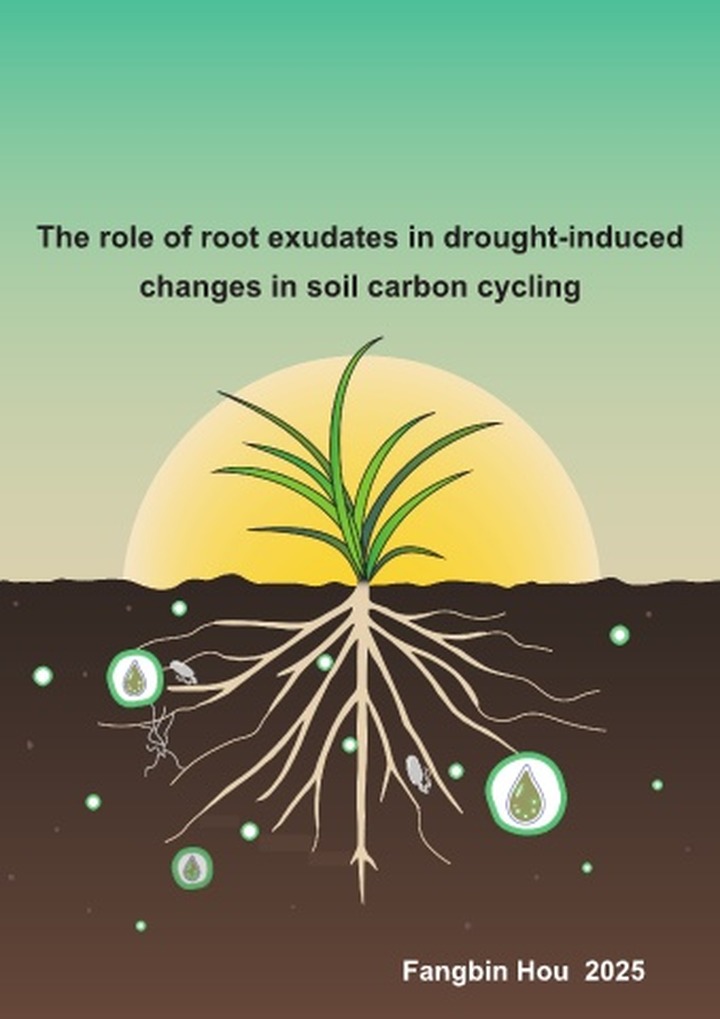


The role of root exudates in drought-induced changes in soil carbon cycling
Root exudates are complex labile carbon (C) compounds released from roots into the soil. They are mediators of plant-microbe interactions and important precursors for the formation of soil organic matter (SOM). Drought affects root exudation quantity and quality, thus potentially affecting soil microbial activities and the formation and loss of SOM. However, how drought affects root exudation and what the consequences are for C cycling remain unclear. This thesis, titled “The role of root exudates in drought-induced changes in soil carbon cycling”, aims to reveal the consequences of altered root exudation under drought for soil and ecosystem C cycling. I tested the overall hypothesis that drought increased specific root exudation rates, and that the legacy effect of drought on root exudation stimulates microbial respiration and enhances the formation of MAOM in four controlled experiments in which I subjected common grassland species to drought and assessed the consequences for various functions of the root exudates. In Chapter 2, I tested how root exudates from droughted plants affect the subsequent growth of a plant of the same species in a two-phase experiment. In the first phase, I subjected 12 common grassland species to a two-week drought compared to a well-watered control. In the second phase, we grew these same 12 plant species in the soil conditioned in phase one, which allowed us to assess how these plants affect their own future growth (plant-soil feedback, PSF), calculated by dividing the growth of a plant in its own soil compared to its growth in a soil conditioned by a different plant species). We found that legumes fed back positively to their own growth, while grasses and forbs affected their own future growth negatively. The effect of root exudates on plant-soil feedback were weak, but we found that total feedback could be predicted by high root diameter and high root nitrogen content. In Chapter 3, we used the root exudates collected in the first phase of the experiment in Chapter 2, to assess how root exudates from plants subjected to drought affected soil microbial respiration compared to those of control plants. I found that drought increased specific root exudation rates (i.e. the amount of root exudate C per unit root biomass) mainly in legumes and increased specific root exudate-induced respiration rates (i.e. the amount of respiration per unit of root exudate C added) more in forbs and legumes than in grasses. Both specific root exudation rates and specific root exudate-induced respiration rates were positively related to root diameter and root nitrogen content, indicating that root exudates are part of “outsourcing” and “fast” root strategies. These findings also suggest that increased respiration triggered by root exudates after drought is an active plant strategy to help plant recovery. Interestingly, the root traits related to specific root exudation rates were the same traits that best predicted positive plant-soil feedback in Chapter 2, potentially suggesting a role of root exudation in promoting plant growth. In Chapter 4, I tested the effect of the addition of root exudates from droughted plants on soil organic matter (SOM) fractions, the less stable particulate organic matter (POM) fraction, and the stable mineral-associated organic matter (MAOM) fraction. I repeatedly added root exudates collected from the grass Lolium perenne (L. perenne), the forb Ranunculus acris (R. acris), and the legume Trifolium pratense (T. pratense), to the same unconditioned soil. I found that R. acris and T. pratense root exudates decreased the POM pool but increased the stable MAOM pool. Drought did not affect the dynamics of POM and MAOM pools, but root exudates from droughted R. acris and T. pratense plants increased microbial respiration and the carbon/nitrogen (C/N) ratio of POM, indicating in increased microbial N demand which may potentially result in the decrease of POM on longer timescales. In contrast, L. perenne root exudates did not change POM and MAOM pools. These results indicate that plant species from different functional groups, through their root exudates, have contrasting effects on the stabilization of SOM, and that drought, via altering microbial communities and N demand, may result in alterations of POM and MAOM pools. In Chapter 5, I tested the effect of repeated drought on root exudation and the microbial respiration triggered by these root exudates across a grass, a forb, and a legume. L. perenne, R. acris and T. pratense were subjected to one, two, or three repetitive drought events, compared to a well-watered control, after which their root exudates were collected and used to assess total root exudate-induced respiration and specific root exudate-induced respiration rates. I found that repeated drought reduced total root exudation and the total respiration induced by root exudates of R. acris and T. pratense, but specific root exudation rates and specific root exudate-induced respiration rates were not affected by increasing number of droughts. L. perenne had the lowest and stable root exudate-related parameters except for an increase in specific respiration rates following repeated drought events. These results suggest that increased specific root exudate-induced respiration rates may not persist after repeated drought events. The findings in this thesis highlight the function of root exudation as an adaptive trait when plants face drought conditions. Drought-induced changes in root exudates stimulate microbial activity and enhance SOM mineralization while also promoting stable SOM formation and nutrient storage. These processes indicate a critical role of root exudation in regulating soil C cycling, supporting plant survival, and maintaining ecosystem functions.
| Publicatiedatum | 1 april 2026 |
| Universiteit | Universiteit van Amsterdam |
| Auteur | Fangbin Hou |
| ISBN nummer | 978-94-6510-499-7 |