Erne Blondeau


Greenhouse gas emissions from managed peat grasslands in the Netherlands
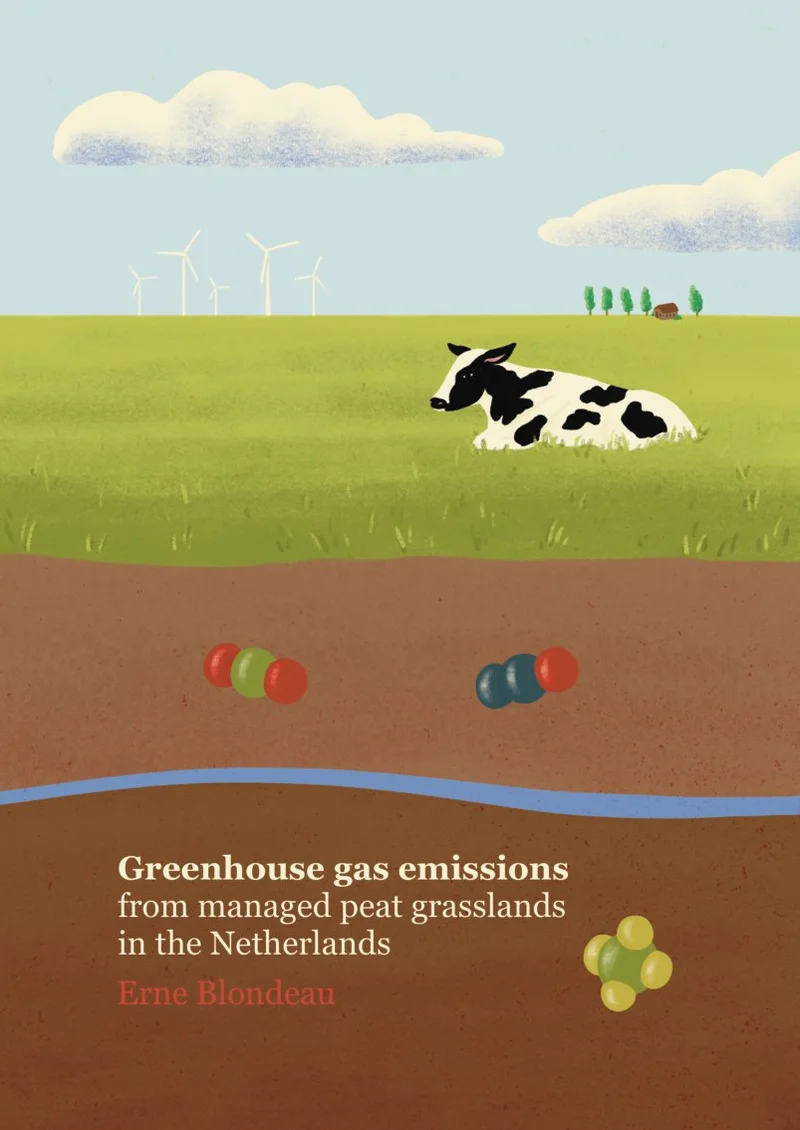
Peat soils store a large part of the global soil carbon stock, which can potentially be lost when they are drained for agricultural use, to improve the load-bearing capacity for cattle and machinery. This results in emissions of the greenhouse gases (GHG) carbon dioxide (CO2) and nitrous oxide (N2O), as well as land subsidence. In the Netherlands, CO2 and N2O emissions resulting from peat drainage account for 3% of the total national GHG emissions. These gases are formed during the oxidation of the soil organic matter mediated by microbes, a process that is enhanced when oxygen enters the soil.
The oxidation of peat during microbial oxidation is strongly affected by moisture and temperature conditions, yet the interaction between these effects is not fully clear. Improving the understanding of these mechanisms and the variation across different peat types will benefit modelling of mitigation measure effects. Raising the groundwater level (GWL) has been proposed to mitigate peat oxidation, but may lead to increased emissions of N2O and methane (CH4), creating a potential trade-off between different greenhouse gases. Installation of a water infiltration system (WIS) may reduce peat oxidation while enabling grass production and cattle grazing. However, their effects on N2O emissions and interaction with cattle excreta and fertilizer applications have not been studied yet.
In this PhD I aimed to:
1) Explore the effects of soil moisture, temperature and peat properties on peat oxidation;
2) Study the potential of water management to reduce CO2, N2O and CH4 emissions associated with peat oxidation and the possibility of a trade-off between these gases;
3) Study the effect of raised water levels, achieved by water infiltration systems on N2O emissions in fertilized or grazed peat grasslands;
4) Quantify N2O emissions and emission factors for different mineral fertilizers, manure and grazing.
I addressed objective 1 in Chapter 2, where I incubated soil samples (3 g) from three contrasting Dutch grassland peat sites and three depths (within the upper 50 cm of the soil). Temperature treatments of 4.6, 13.9, 23.2 or 34 °C (±1.5 °C) and water filled pore spaces (WFPS) of 50, 60, 80 or 95%, were applied in a full factorial design. Heterotrophic respiration rates (the oxidation of soil organic matter as energy source for microbial organisms) were measured and the Q10 (the relative respiration increase for a 10 °C temperature increase) was calculated for each treatment combination (WFPS, location and depth) over the whole studied temperature interval. Additionally, an Arrhenius function was fitted for each combination of WFPS and sampling depth and location for the calculation of temperature-specific Q10 values. Respiration ranged between 0 and 79 μg CO2-C g-1 C h-1 and increased both with temperature and with WFPS (up to 80% WFPS, after which respiration remained constant). Temperature and WFPS did not have a significant interaction effect on respiration rates. However, an interaction between temperature and moisture became apparent from the significant negative WFPS effect on Q10, which indicates a potential oxygen limitation on the temperature impact. The temperature-specific Q10 strongly decreased with temperature. These results suggested that heterotrophic respiration of peat soil is most susceptible to warming under both dry and cold conditions.
The second objective was studied in an incubation study (Chapter 3) on incubated soil cores of 1 m length and, 24 cm diameter. These undisturbed soil cores were sampled after removal of the grass layer, from the same sites as those described in Chapter 2, and incubated in a climate controlled room for 370 days at 16°C. The cores were subjected to two drying-wetting cycles, with the GWL varying between near the soil surface to 160 cm below the surface. I measured gas fluxes of CO2, N2O and CH4 from the soil surface, extracted pore water for DOC and mineral nitrogen analysis, and measured soil hydraulic and shrinkage characteristics. Emissions of CO2 increased after lowering the GWL, but showed different GWL-response curves during rewetting of the soil. On average, highest CO2 emissions of 1.5 g C m-2 day-1 were found at a GWL of 80 cm below the surface. However, the 0 cm GWL was the only treatment with significantly lower CO2 emissions than other GWLs. Cumulative CO2 emissions differed significantly between sampling sites. Emissions of N2O showed a different response, peaking at GWL heights above -20 cm, particularly after a recent GWL rise. Though not significantly different, the highest N2O emissions were measured at the 0 cm GWL treatment. I confirmed this pattern for N2O in un-replicated soil cores with grass sward, although emission values were lower in these cores due to the root uptake of mineral nitrogen. CH4 emissions or -uptake remained low under any GWL. From this experiment, I concluded that raising the GWL is a successful strategy to reduce CO2 emissions from peat oxidation. However, raising the GWL close to the soil surface could lead to N2O emissions that negate any gains in terms of global warming potential. These results suggest that raising the GWL in peat grasslands to -20 cm creates such a risk.
The mechanisms behind peat N2O emissions were further explored in two field experiments that addressed objectives 3 and 4.
In chapter 4, I studied the combined effects of a water infiltration system and simulated grazing on N2O emissions from a peat grassland. The experiment included two drainage intensities: conventional ditch drainage (CDD) and WIS aiming for a GWL of -40 cm. Additionally, grazing effects (urine application, dung application and trampling) were simulated in a full factorial design on each field in three measurement campaigns, during the summer of 2022, autumn 2022 and autumn 2023. Nitrous oxide emissions were measured weekly and the autumn campaigns included measurements of biochemical parameters in soil (pore water). Without nitrogen inputs, cumulative N2O emissions from peat oxidation were lower, but not significantly, under a water infiltration system compared to conventional drainage (1.2 ± 0.25 kg N ha-1 vs 8.8 ± 3.7 kg N ha-1). Urine, dung and trampling application all significantly increased cumulative N2O emissions in both drainage systems. There was a significant interaction effect between drainage type and urine application, indicating different effects of water infiltration systems in the absence or presence of urine application. Urine and dung emission factors were higher under a water infiltration system than conventional ditch drainage. The results from this experiment suggested that water infiltration system effects on N2O emissions from peat grasslands are not consistent, and interact with external nitrogen inputs through cattle grazing.
A second field experiment was conducted from early 2023 to early 2025. It included three drainage treatments: conventional ditch drainage (CDD) and water infiltration systems aimed for water levels of 20 cm (WIS20) and 40 cm (WIS40) below the surface. On each field, plots were fertilized with mineral (calcium ammonium nitrate and ammonium sulphate) or organic (cattle slurry, the liquid and solid fractions of cattle slurry, and farmyard manure) fertilizers, differing in nitrogen and carbon content. Nitrous oxide emissions were measured weekly, and the grass yield and N uptake were measured over multiple cuts per year. Cumulative N2O emissions were lower under WIS40 than under CDD, while highest emissions were observed for the most shallow drainage treatment (WIS20). Application of mineral fertilizers resulted in significantly higher emissions (14.8 to 16.7 kg N ha-1) than organic fertilizers (3.5 to 8.3 kg N ha-1), particularly under WIS20. These differences remained when expressed as yield-scaled emissions, despite a greater apparent nitrogen recovery for mineral than for organic fertilizers. These results suggest that maintaining a shallow groundwater level increases the risk for N2O emissions from peat grasslands, potentially due to increased denitrification rates in the topsoil. This is exacerbated when combined with mineral fertilizer application.
The findings in this thesis demonstrate that soil moisture as well as oxygen are limiting factors for peat soil respiration, and that reducing drainage may help to mitigate CO2 emissions from peat soils. The effect of a raised GWL on N2O emissions originating from peat oxidation is less clear, as a shallow GWL may actually exacerbate N2O emissions resulting from denitrification. This may particularly be the case in combination with urine excretion from grazing cattle and application of mineral fertilizers.
| Publicatiedatum | 29 oktober 2026 |
| Universiteit | Wageningen University |
| Auteur | Erne Blondeau |
| DOI nummer | 10.18174/681377 |