Chiara Bortoluzzi
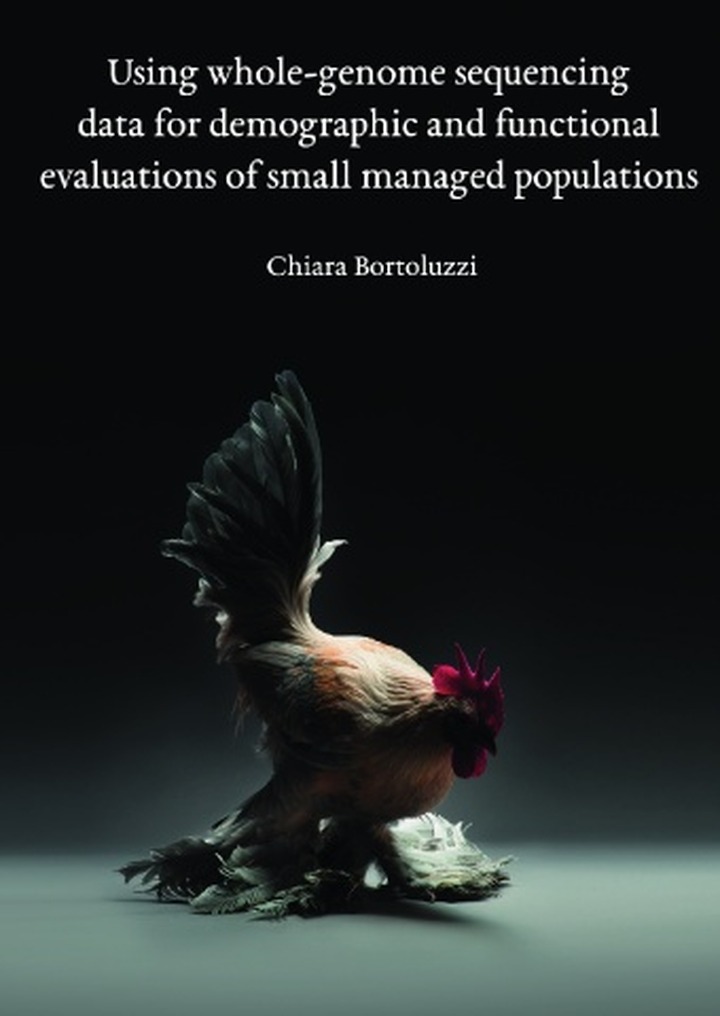


Using whole-genome sequencing data for demographic and functional evaluations of small managed populations
The genetic diversity harboured in a genome can have major phenotypic effects, both beneficial (e.g. adaptation) or detrimental (inbreeding depression). The work described in this thesis contributes to our understanding of the complex interplay between demography and selection in the chicken genome. I analysed genotype and sequence data from several local chicken breeds to answer questions about the underlying mechanisms that shape genomic and deleterious variation. Moreover, by means of population genomics, comparative genomics, and functional genomics I was able to unravel the genetic basis of ptilopody and develop a tool to rank variants based on their likelihood of being functional. With this thesis I provide a comprehensive overview on the importance of demographic and functional characterisation studies aiming to conserve diversity in a species genome. In Chapter 2 I characterise the genetic diversity, demographic history, and level of inbreeding of 37 traditional Dutch chicken breeds to guide conservation efforts and management strategies. I show that large fowls and true bantams were the source populations of recently created neo-bantam breeds, with which they share a high proportion of their alleles. I observe that neo-bantams display genetic signatures of back-crossing, often pursued for phenotype selection. By contrasting the genetic diversity and level of inbreeding of traditional breeds with that of commercial white egg layers, I highlight the importance of using markers to inform breeding programmes on potentially harmful homozygosity to prevent loss of genetic diversity. In Chapter 3 I examine the genomic consequences of the severe domestication bottleneck and the recent breed formation bottleneck. I show that, despite the rather similar genome-wide heterozygosity, recently bottlenecked populations have a higher proportion of deleterious variants relative to populations that have been small for longer time. In fact, in recently bottlenecked populations, genetic drift and recent inbreeding are mostly responsible for the observed genome-wide homozygosity. I also observe that deleterious variants tend to be found in long tracts of homozygous genotypes (ROHs), possibly suggesting a link with inbreeding depression. In Chapter 4 I use temporal sequencing data to quantify temporal genomic erosion in small populations under a recently established conservation programme. I show that, because of the relatively small number of founding individuals, a reduction in genetic diversity (∆π) and increase in inbreeding (∆F ROH) are expected at the start of the conservation programme. I also demonstrate that management can control genetic drift, allowing purging of deleterious alleles. In this chapter I reinforce the imperative to establish and incorporate genomic information into management practices that aim to keep local at-risk breeds from the brink of extinction. In Chapter 5 I provide evidence for a parallel genetic origin of ptilopody in chicken and pigeon. I show that ptilopody (or foot feathering) is determined in both species by two loci, in which similar mutations and regulatory pathways are involved. At one loci, I identify a 17 kb deletion affecting PITX1 expression, a gene known to encode a transcription regulator of hindlimb identity and development. At the second loci, I find a foot-feathered 4 kb haplotype upstream TBX5, a gene involved in forelimb identity and a key determinant of foot feather development. The haplotype and causal non-protein-coding mutations likely affect TBX5 ectopic expression in foot feathered birds during embryonic development. In Chapter 6 I examine the functional importance of variants found in conserved non-protein-coding elements (CNEs) of the chicken genome. To do that, I develop a ch(icken) Combined Annotation-Dependent Depletion (chCADD) model, a variant effect prediction tool that can score and rank variants based on their likelihood of being functional. I show that CNEs display SNP densities and allele frequency distributions characteristic of genomic regions constrained by purifying selection. Moreover, by annotating SNPs with the chCADD score, I was able to identify specific subregions of higher functional importance. In fact, SNPs found in these subregions are associated with known disease genes in human, mouse, and rat. I anticipate the chCADD score to be of great use to the scientific community and breeding companies in future functional studies in chicken.
| Publicatiedatum | 14 oktober 2020 |
| Universiteit | Wageningen University |
| Auteur | Chiara Bortoluzzi |
| ISBN nummer | 978-94-6395-482-2 |