Cathrien Hoijinck
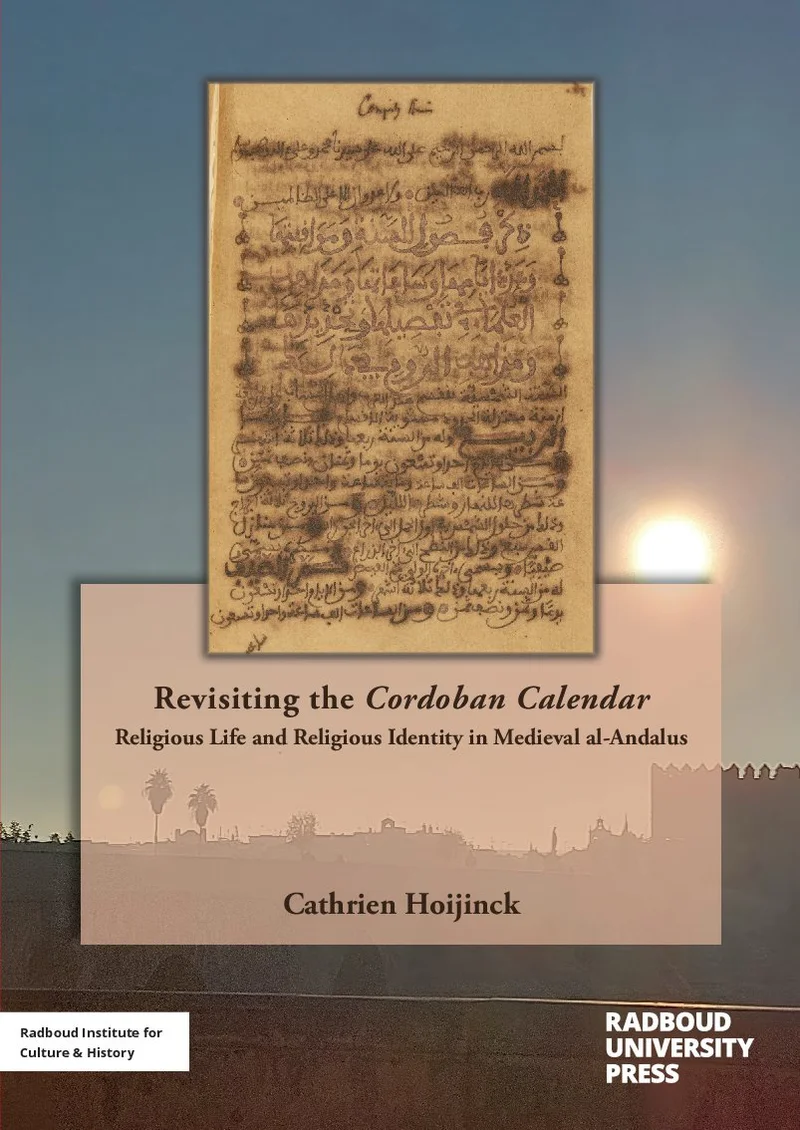


Revisiting the Cordoban Calendar
This dissertation offers a critical revision of several aspects of what is currently known as the Cordoban Calendar, namely its manuscript corpus, transmission, liturgical content, and the religious identity of its author. As an Arabic almanac probably composed in Córdoba in the tenth century, the Cordoban Calendar is of considerable interest to historians seeking to gain a better understanding of the realities of al-Andalus during this period. Thanks to the two manuscripts edited by Reinhart Dozy in 1873 and Charles Pellat in 1961, many scholars working on al-Andalus are familiar with the Cordoban Calendar, or at least have a general idea of its contents. Consequently, almost all conclusions drawn about the Cordoban Calendar have thus far been based on these two manuscripts. In recent decades, however, additional manuscripts have come to light, although they have not yet become widely known among scholars. These manuscripts correspond to a considerable extent to the text preserved in the two edited manuscripts, either in the form of Latin translations (6) or Arabic copies (4). In addition to these manuscripts, I identified seven further manuscripts containing versions of the Cordoban Calendar and incorporated them into the analysis. The text, therefore, is not witnessed by two manuscripts, as is commonly assumed, but by nineteen.
Corpus – The nineteen manuscripts correspond closely to one another, in most of the sections on an almost word-for-word basis. The main structure and building blocks of the text consist of an extensive introduction containing the title(s), two rubrics, and a paragraph on the Christian year. Each month contains a prologue and an epilogue, as well as daily entries providing information on weather conditions, the positions of the sun and moon, the feasts being celebrated, the length of the day, and agricultural activities. The text also contains several passages connected specifically to the Cordoban context. It is the combination of these building blocks that distinguishes the Cordoban Calendar from other Arabic almanacs. The greatest degree of variation is found in the liturgical entries, that is, entries concerning religious feasts and commemorations, as well as biblical and qurʾanic figures and events. On the basis of both the correspondences and the variations among the manuscripts, this study establishes a taxonomy that divides the manuscript corpus into several branches. This taxonomy is not intended to represent stemmatic relationships, that is, direct lines of descent between individual copies, but rather connections in a broader sense. It identifies text versions that share the greatest degree of textual similarity, allowing them to be discussed as manuscript branches.
The newly identified manuscripts shed new light on the context in which the text was produced and challenge widely held assumptions about the Cordoban Calendar. For instance, they strengthen the hypothesis that the text was most probably composed in 973 rather than 961. They also strongly suggest that the text was known from the outset under two titles: the Kitāb al-anwāʾ and the Kitāb tafṣīl al-azmān wa-maṣāliḥ al-abdān. Revisiting the Cordoban Calendar on the basis of the complete, currently identified manuscript corpus thus contributes to a more nuanced understanding of the circumstances of its production.
Transmission – One of the main conceptual tools for revisiting the Cordoban Calendar from a fresh perspective is the notion of living literature. This concept works particularly well in cases where there is no autograph preserved, where attempts to reconstruct such a version face significant obstacles, and where multiple textual variants circulate without clearly pointing to an Urtext—all features that apply to the textual tradition of the Cordoban Calendar. Viewing the Cordoban Calendar as living literature makes it possible to treat all manuscripts, in principle, as equally valid witnesses to the textual tradition. Accordingly, this research, framed by the concept of living literature, does not seek to establish definitively which of the nineteen manuscripts is closest to the original text. It nevertheless considers the possibility that the manuscripts belonging to branch B1 preserve an older text version from which other copies in the corpus derive, rather than being themselves the result of a merge of other manuscripts in the corpus, as is currently proposed.
Liturgical content – The absence of an original manuscript of a textual tradition raises the question of how such a source can be used for historical research. Rather than attempting to reconstruct an Urtext, this study distinguishes between liturgical categories that were more likely to have formed part of the Cordoban Calendar in its earliest recoverable form and those that were less likely to have done so. First, it must be noted that the Cordoban Calendar cannot be considered a stand-alone text. Parts of it draw on sources—almanacs and other calendrical works—that travelled from the Middle East and Egypt to al-Andalus. The Cordoban Calendar therefore stands in close relationship to other sources, whether they predate or postdate it. This dissertation has clarified the relationship between the Cordoban Calendar and the works of scholars from a range of backgrounds, including Ibn Māsawayh, al-Bīrūnī, al-Umawī, al-Jādirī, Ibn al-Bannāʾ, and the anonymous author of the Long Calendar. The analysis also reveals previously unnoticed correspondences with texts such as Ibn Bahlūl’s Kitāb al-dalāʾil, al-Ṭabarī’s Taʾrīkh, and an anonymous calendar preserved in the El Escorial manuscript 924. Situating the Cordoban Calendar within this wider Mediterranean tradition of Arabic almanacs demonstrates the extent to which this tradition flourished and circulated among scholars across political and religious boundaries.
Comparison with these other Arabic almanacs has made it possible to formulate hypotheses about the liturgical categories that originally formed part of the Cordoban Calendar. On the basis of this comparison, I argue that the Cordoban Calendar accommodated a diverse liturgical repertoire in its earliest recoverable form, including Iberian Christian feasts, Coptic feasts, Jewish and Persian feasts, and entries concerning prophets and scriptures. There are also good reasons to assume that Islamic historical events belonged to the Cordoban Calendar from an early stage of its transmission, although this cannot be argued with the same degree of confidence as for the other liturgical categories.
The identification of the most likely early liturgical categories provides the basis for interpreting the Cordoban Calendar’s liturgical content. The analysis focuses in particular on Christian Andalusi practice, given the availability of comparable Christian material from the kingdoms of northern Iberia. The evidence suggests a certain degree of liturgical uniformity across the Peninsula, despite regional and chronological differences. At the same time, a number of noteworthy deviations point to local Cordoban particularities. The case studies also revealed a number of entries that most likely did not refer to celebrations in Córdoba.
Entries referring to the Cordoban martyrs and associated figures are of particular interest because of their controversiality and their occurrence in only one of the manuscripts. These entries appear to have been added at a later stage of the textual transmission, which significantly weakens the claim that these individuals were ever commemorated by a Christian community in Córdoba. The case of the Cordoban martyrs thus illustrates the difficulty of treating this particular manuscript as a straightforward representation of tenth-century Cordoban Christian practice.
Religious identity – On the basis of philological arguments, this study identifies the author of the Cordoban Calendar as rooted in the Islamic tradition. The narrative function of key terms, the use of names, the author’s perspective as an outsider on communities such as Iberian Christians, Jews, Copts, and Persians, and the doctrinal perspective embedded in descriptions of biblical and qurʾanic events all point to a Muslim viewpoint. At the same time, the text contains a diverse range of liturgical and theological material, suggesting a relatively unpolemical engagement with ritual practices that did not belong to the author’s own religious tradition. Rather than setting these traditions against one another, the text constructs a shared historical framework that acknowledges and accommodates multiple religious traditions. It is conceivable that the author did not perceive these ‘different’ traditions simply as cultural expressions external to his own, but rather as elements of a shared cultural world. Despite the subtle presence of Islam as its prevailing religious framework, the Cordoban Calendar should therefore be understood as the testimony of an individual whose identity was not defined exclusively by religious affiliation, but who instead sought to bring into view the diversity of the realm in which he lived.
The author’s attitude towards these different traditions is significant for understanding tenth-century Andalusi identity more broadly, particularly in the context of individuals working at court, as was most likely the case with the author of the Cordoban Calendar. Court scholars and secretaries may be expected, particularly in this period, to have been well informed about—and often interested in—traditions beyond their own, while remaining rooted in a particular religious tradition, whether Jewish, Christian, or Muslim. Caliph al-Ḥakam II’s wide-ranging interest in religion and scholarly inquiry may have encouraged the author’s creativity and freedom to incorporate diverse traditions, whether or not this was motivated by pragmatic considerations. The concept of cultural hybridity, as formulated by Peter Burke, and more particularly his discussion of hybrid people and hybrid texts, provides a useful framework for understanding this attitude and its possible underlying causes.
Throughout this study, I have demonstrated how a textual tradition with a complex transmission history—particularly one lacking an autograph—can be approached more critically by incorporating all identified text versions through philological analysis. Such an approach has the potential to challenge deeply entrenched assumptions about both the nature of the text and the context of its production. It also opens up a fresh perspective on how such texts can be used to draw more nuanced conclusions about the wider historical context in which they were produced. In the case of the Cordoban Calendar, the evidence of cultural hybridity through this approach challenges not only our understanding of this particular text, but also broader conceptions of identity itself, suggesting that religious and cultural boundaries in tenth-century al-Andalus could be more fluid and multilayered than conventional categories allow.
| Publicatiedatum | 1 december 2026 |
| Universiteit | Radboud Universiteit |
| Auteur | Cathrien Hoijinck |
| ISBN nummer | 9789465153254 |
| DOI nummer | 10.54195/9789465153254 |