Carin Dietz
Solvent development for recovery of furfural and hydroxymethylfurfural from aqueous biorefinery solutions
28 juni 2019
Overig
Open Ebook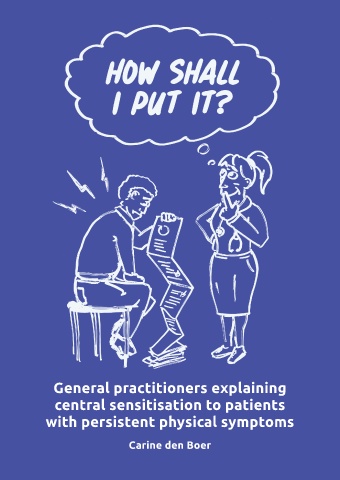
Share this project
Summary
In the general introduction in chapter 1, we describe the background of the research and the research questions we have studied.
Persistent physical symptoms (PPS) are one or more physical symptoms that last at least weeks and cause dysfunction or significant distress. The physical symptoms may occur in the context of an (adequately treated) medical condition or in the absence of a medical condition. Biological, psychological and social factors may play a role the perpetuation of symptoms.
Over the years, various terms have been used to describe symptoms that often puzzle both patients and physicians. Since 2010, the term ‘Medically Unexplained Symptoms’ (MUS) has been used. Recently, an increasing number of patients, researchers, and practitioners prefer to use the term ‘persistent physical symptoms’ (PPS), which is considered more neutral and therefore more acceptable than MUS. With PPS, the emphasis is on the recognition that the symptoms persist and the consequences this has for patients' functioning.
Patients with PPS often pose a challenge for physicians. Achieving a favourable treatment outcome for the patient necessitates successful collaboration, respectful communication, and trust in the doctor-patient relationship. Patients may benefit from receiving an acceptable and understandable explanation.
When patients present their symptoms to the general practitioner, a thorough medical history taking, physical examination, and possibly additional investigations, are important to rule out or to determine (treatable) diseases. When the GP considers PPS it is important to start as soon as possible with a broad exploration of the symptoms. The symptoms and the thoughts, emotions, behaviour and reactions of the social system which are related to the symptoms, are explored.
Once the GP and the patient agree that sufficient investigation has been conducted, the GP can proceed to a more comprehensive exploration of the symptoms. The symptoms will be explored, including thoughts, emotions, behaviour and the reaction of the social environment. If a shared problem definition is reached, the GP can explain why the symptoms do not resolve. Various explanatory models are available, e.g. somatosensory amplification, immune system disfunction, dysregulation of the stress hormone system, dysregulation of the autonomic nervous system, and central sensitization (CS). Subsequently, the GP can discuss the factors influencing the symptoms and collaboratively develop a treatment plan with the patient. We chose to further investigate the use of CS as explanatory model because it aligns well with the conceptual framework of both GPs and patients.
Central sensitization (CS) is a hypersensitivity of the central nervous system to sensory stimuli. In CS, these stimuli are amplified due to an increase in receptors and neurotransmitters in the dorsal horn of the spinal cord. When these stimuli are interpreted as threatening, they are further amplified in the brain. Conversely, when no danger is perceived, they are inhibited. This heightened sensitivity can be caused by clear tissue damage, leading to persistent or even worsening symptoms. CS can also arise following physical or mental overexertion. In some cases, the triggering factors for CS remain unclear.
The concept of CS also demonstrates the interconnectedness of the mind and body: the brain processes all sensory stimuli from the body and amplifies or inhibits them based on interpretation. Various brain regions are involved in this process, including the brainstem and hypothalamus (responsible for responses such as fight, flight, and freeze), the limbic system (regulating emotions and social behaviour), and the neocortex (our rational brain).
We investigated whether CS can serve as a useful explanatory model for GPs and patients with PPS, and whether the addition of a test makes the explanation more acceptable and clear.
We formulated four research aims:
1. To compile an overview of definitions and operationalisations of CS, compare them, and to make an inventory of measurement instruments for CS in PPS.
2. To investigate the availability of valid and reliable measurement instruments for assessing CS that are feasible and potentially valuable for use in primary care.
3. To identify factors that facilitate or hinder providing an explanation based on CS for PPS by GPs.
4. To assess whether patients with PPS understand and accept CS as an explanatory model for their symptoms.
In Chapter 2 we report on our systematic review of the literature regarding definitions, operationalisations and mechanisms of CS in chronic pain and persistent physical symptoms research. We applied broad search terms for CS in combination with mechanisms, operationalisations and tests and only included publications focusing on chronic pain or MUS. We screened the titles and abstracts of 2692 records, read 268 articles in full text and included 126 publications in our review. We performed a thematic analysis of definitions and operationalisations and listed the measurement instruments.
The most mentioned theme in the definitions of CS was the hyperexcitability of the central nervous system. Additional themes were: 1. locations in the central nervous system, such as nociceptive neurons, spinal and supraspinal structures, and the dorsal horn of the spinal cord; 2. the nature of sensory input, which can be normal, noxious or subthreshold input; 3. reduced inhibition of signals in the brain; and 4: the activation and modulation of the N-methyl-d-aspartate (NDMA) receptors.
We found eight different operationalisations. Most frequently mentioned were hyperalgesia (i.e., increased sensitivity to painful stimuli), allodynia (i.e., painful perception of non-painful stimuli) and temporal summation (increased pain perception in response to repetitive noxious stimuli over time).
CS is most frequently measured with various forms of quantitative sensory testing (QST), (f)MRI, laboratory evaluation of neurotransmitters and questionnaires. QST measures hyperalgesia, allodynia and temporal summation and can be tested by applying thermal, tactile, vibratory, electrical or ischemic stimuli. Various questionnaires are available to assess CS-related symptoms, e.g. the Central Sensitisation Inventory.
In conclusion, there is consensus that central nervous system hyperexcitability is the primary mechanism of CS. Furthermore, structures and mechanisms in the spinal cord, such as nerve pathways, NMDA receptors, and non-harmful stimuli, are consistently mentioned. Additionally, the processing of stimuli in the brain, particularly the reduced inhibition of stimuli, is frequently identified as a component of CS. The operationalizations of CS differed, we found eight different ones. Furthermore, we found a wide range of measurement instruments.
In chapter 3 we report the results of our Delphi study for tests for CS in general practice. In this study we aimed to assess which tests might have added value compared with providing only an explanation and which might be feasible and thus be suitable for use in general practice.
We conducted a Delphi study of two e-mail rounds to reach a consensus among experts who were clinicians and researchers in chronic pain and PPS. We invited 40 national and international experts on chronic pain and PPS, and 27 agreed to participate. We selected 12 tests which might be feasible in general practice from our systematic review and additional searches; panellists added three more tests in the first round. We asked the panellists to rate these in total 15 tests on technical feasibility for use in general practice, added value and to provide an overall judgement for suitability in general practice. We set the threshold for consensus at 70%.
In two rounds, the panellists reached a consensus on 14 of the 15 tests: 3 were in principle included, and 11 were excluded. In the first round we included the Central Sensitisation Inventory (CSI) and in the second round the algometer to measure pressure pain thresholds (PPTs). In the second round we also selected the monofilament to measure temporal summation, because the score of the panellists of 69% was close to the threshold value of 70%.
In Chapter 4 we describe our focus group study of the experiences of GPs explaining CS to patients with PPS. Previously, we had instructed 33 GPs on how to explain CS to their patients with PPS and provided them with a toolbox containing information about PPS and the biopsychosocial model, about CS and how to explain it and links to instruction movies. After 0.5-1.5 years 26 GPs participated in focus groups and interviews to report and discuss their experiences with explaining the CS model. We conducted two focus groups with in total 15 GPs and 11 interviews by telephone. For both, we used a topic list with four main themes.
Theme 1 concerned GPs’ previous experiences with (explaining to) PPS patients. GPs reported that they have to be convinced that they are dealing with PPS to provide a persuading explanation to the patient. They stressed that it is essential to show empathy and to coach the patient. In the relationship with patients with PPS, GPs acknowledged that their empathy for patients with PPS differed from patient to patient and from day to day, more often than with patients with other symptoms.
Theme 2 focussed on GPs’ experiences with the explanation of the CS model. GPs tried to tailor the CS model to the individual patient, taking time to explain it to them using several appointments. Some GPs found the term central sensitisation too difficult for patients and used terminology like ‘hypersensitivity’ instead. GPs believed that to understand the explanation some health literacy of the patient was required and they used metaphors to make the explanation clearer.
Theme 3 presented the patients’ responses to explaining the CS model. Most patients understood the CS model, according to GPs, and accepted that it might explain their symptoms’ persistence. The model’s scientific foundation contributed to convincing the patient of its validity. GPs mentioned that the results of the explanation for the patient could only be judged over a more extended period; symptoms might be accepted by the explanation and be reduced with treatment at first but could return after some time.
Theme 4 summarised the benefits and drawbacks of the CS model. Most GPs were satisfied with the CS model; they reported that it provided more insight into the mechanism underlying PPS and valuable tools for explaining the persistence of their symptoms to patients. GPs mentioned that you always have to be alert not to overlook somatic pathology. They reported that the disadvantages of the model were its complexity and the time it took to explain the model; some GPs reported to need more training.
We concluded that our short training in explaining CS seemed to be sufficient; most GPs could explain CS after the training and using the toolbox. The effects on the patient should be studied using an appropriate design and follow-up period.
In chapter 5, we present the findings of the part of our study in which we investigated the experiences of GPs and patients with explaining and testing CS. The GPs used the Central Sensitisation Inventory (CSI), an algometer for testing pressure pain thresholds (PPTs), and a monofilament for testing temporal summation. 25 GPs and 80 patients completed a short questionnaire after the application of one or more of the tests and 15 GPs and 17 patients participated in focus groups and individual interviews, respectively.
The GPs reported that all tests were feasible during consultations, taking less than 5 minutes in 25% of the cases and between 5 and 10 minutes in 60%. In about 50% of the cases an additional consultation was needed to perform the test. The results of the CSI confirmed CS-related symptoms more often (74%) than the algometer (46%) and monofilament (43%), and many GPs preferred the CSI. Patients did not have a preference for a particular test, but found the tests meaningful and the CS explanation clearer when a test was used.
The analysis of the focus groups and interviews with the GPs revealed that explaining CS in combination with the provided tests boosted their confidence in consultations with patients with PPS. The tests helped to discuss PPS and the mechanism of CS as an explanation for the symptoms, and GPs reported that patients were more likely to accept CS as a possible explanation. They did not require additional diagnostic examinations. However, some GPs struggled to explain CS to patients with a negative test result, while others adressed this by relativising the results of the test in advance.
The patient interviews showed that some patients had alternative explanations for their symptoms. However, most patients understood the mechanism of CS and some had already received this explanation from other healthcare workers.
Chapter 6 synthesises our main findings and compares these with the existing