Ben Wang
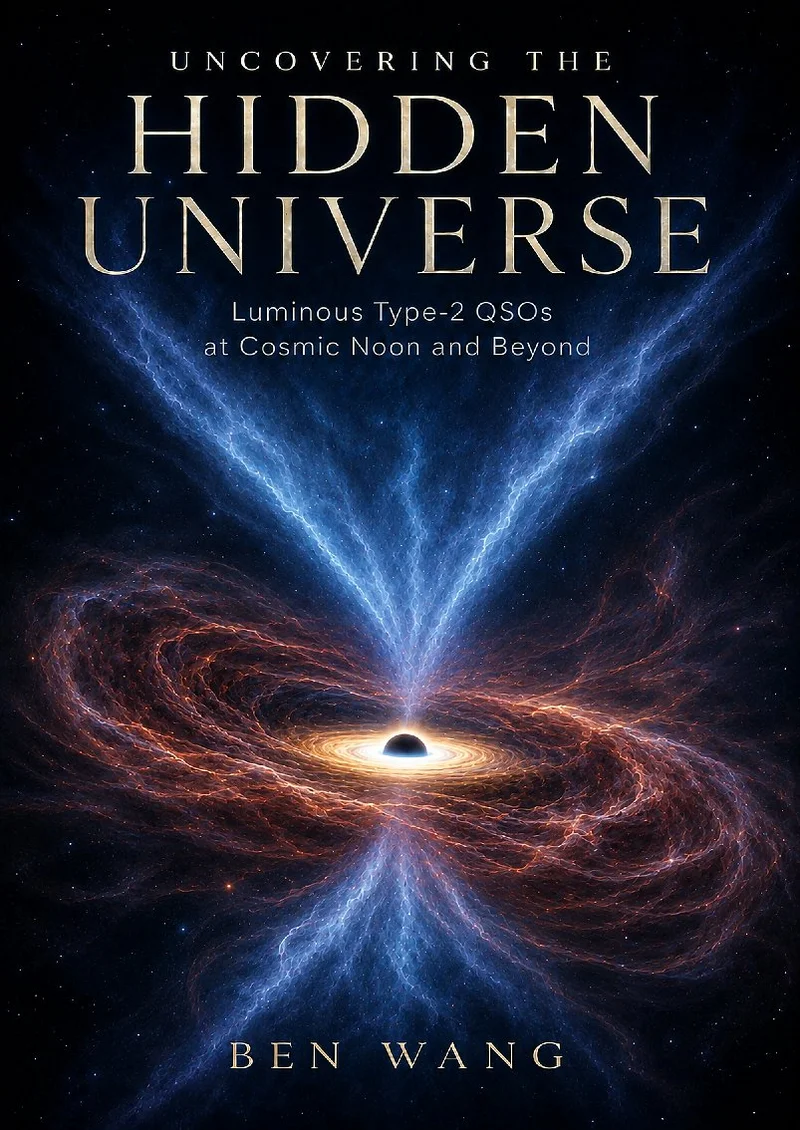


Uncovering the Hidden Universe: Luminous Type-2 QSOs at Cosmic Noon and Beyond
Decades of multi-wavelength surveys (such as SDSS), primarily focusing on low-luminosity objects at low redshift (𝑧 < 1), where the obscured fraction is comparable to that of the Type-1 population and generally decreases with increasing luminosity (e.g., Zakamska et al. 2003a; Reyes et al. 2008a; Lawrence & Elvis 2010a). However, recent JWST discoveries of an abundance of obscured active populations—such as the ‘Little Red Dots’ (LRDs) at 𝑧 ≈ 4 − 9—point to a drastically higher obscured fraction in the early universe (Type-2:Type-1 ≈ 103−4 : 1) (e.g., Matthee et al. 2023; Greene et al. 2023; Kocevski et al. 2023). According to the Soltan argument, this implies that significant SMBH growth occurred at 𝑧 ≳ 4. Nevertheless, it remains unclear whether an equally massive obscured population is missing from counts during cosmic noon (2 < 𝑧 < 4), creating considerable uncertainty in mapping the full history of SMBH accretion.
To bridge this gap and track the brightest Type-2 QSOs during cosmic noon and beyond, we have developed a new mid-IR selection technique based on photometry from SDSS, DESI, and WISE. By focusing on IR-bright (fluxW4 > 5 mJy), optically faint (𝑟 > 23), and extremely red (𝑟 − 𝑊 4 > 8.38) sources, we conducted a pilot study in SDSS Stripe 82, which was later expanded to a ∼14,000 deg2 sky survey. Spectroscopic follow-up with Gemini/GNIRS, Keck/LRIS, and Keck/KCWI yielded an exceptionally high success rate of 83%, confirming 53 new Type-2 QSOs. Crucially, in contrast to earlier surveys that primarily found objects at low 𝑧, 75% of our newly discovered obscured QSOs are located at 𝑧 > 2.
Analysis of their spectral energy distributions (SEDs) reveals bolometric luminosities of 𝐿bol = 1046.3 − 1048.1 erg s−1 and SMBH masses of 108.2 − 1010.0 𝑀 ⊙ (assuming the Eddington limit). Compared to previously known Type-2 AGN, our sample exhibits brighter dust tori, redder optical-IR colors, and SED shapes remarkably similar to those of JWST LRDs. Their spectra show striking diversity: while most exhibit characteristic narrow lines (FWHM < 2000 km s−1 ), approximately one-third of the sample reveals broad H𝛼 emission despite their optical Type-2 classifications.
To investigate the circumgalactic medium (CGM) of these extreme sources, we performed integral-field spectroscopy with Keck/KCWI and submillimeter observations with ALMA. We determined that 80% (12/14) of the studied Type-2 QSOs possess enormous Ly𝛼 nebulae extending over > 20′′ (∼ 160 kpc), with some showing extended CIV and HeII emission, indicating exceptionally gas-rich environments. Supplementary ALMA observations of [CI] and CO(4-3) for six objects at 𝑧 ∼ 2 demonstrate that these obscured QSOs reside in massive halos, including one extreme system surrounded by three companion galaxies.
Ultimately, this research yields three important conclusions regarding the evolution of QSOs: (1) The significant spectral diversity within our sample—in particular, the presence of broad H𝛼 in apparently obscured sources—indicates that the Type-1/Type-2 dichotomy cannot be solely explained by a simple, orientation-based unification; evolutionary and intrinsic physical variations must play a role. (2) Although the obscured fraction at low redshift strictly decreases with increasing luminosity, our survey successfully uncovered a population of the brightest QSOs that remain heavily obscured during cosmic noon, blurring traditional classification boundaries and demonstrating a continuous population of QSOs with mixed properties at high redshift. (3) Our robust multi-wavelength approach proves that mid-IR selection is a highly efficient method for systematically discovering and studying the brightest obscured black holes in the distant universe.
The rapid evolution of artificial intelligence (AI)—from traditional neural networks to modern Large Language Models (LLMs)—has fundamentally reshaped our scientific methodology. Simultaneously, the exponential growth of astronomical data from modern sky surveys has transformed the field, bringing both unprecedented opportunities and formidable analytical challenges. In this new, data-driven era, the question of how AI technologies can be best integrated with scientific research, not just to process data but to truly discover and formulate new science, has emerged as a defining issue of our generation. To address this, we have developed a convolutional neural network (CNN) to automatically identify Damped Ly𝛼 systems (DLAs) within the Dark Energy Spectroscopic Instrument (DESI) survey, demonstrating the extraordinary efficiency of machine learning for extracting weak signals from vast astronomical datasets. Furthermore, we designed a new benchmark to evaluate the physical reasoning and visual-dynamic capabilities of state-of-the-art large multimodal models (LMMs) using simulated billiard scenarios, exploring the limits of machine understanding of natural laws. Looking ahead, the next frontier lies in the transition of AI from a passive analytical tool to an active collaborative partner capable of autonomous hypothesis generation and complex physical reasoning. Ultimately, these advanced foundational models will serve as the crucial bridge between heterogeneous multi-wavelength datasets and theoretical astrophysics, unlocking entirely new paradigms of cosmic discovery.
| Publicatiedatum | 7 oktober 2026 |
| Universiteit | Universiteit Leiden |
| Auteur | Ben Wang |