Bart Liebrand
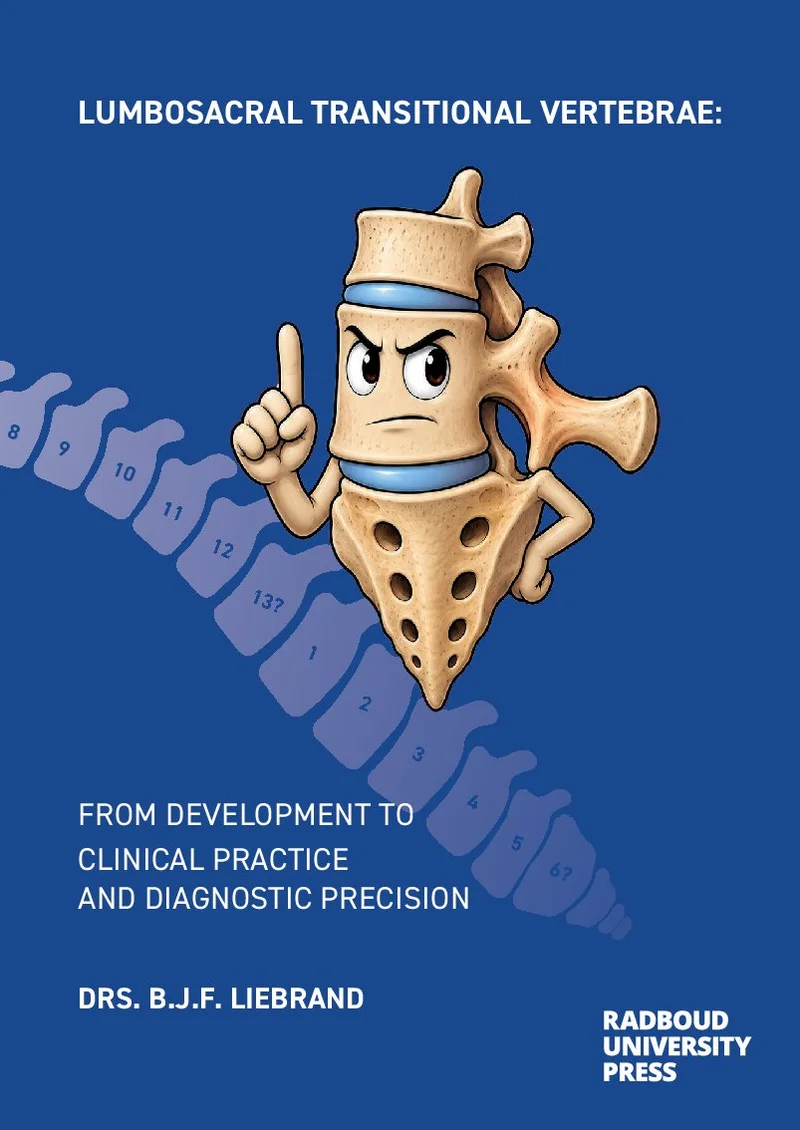


Lumbosacral Transitional Vertebrae
Low back pain is one of the leading causes of disability worldwide. A substantial proportion of patients develop lumbosacral radicular pain and, when conservative treatment like physiotherapy or medication fails, are referred for specialist diagnostics. Interventional pain procedures in the pain management department are frequently the next treatment method. During these treatments discrepancies in determining the correct spinal level frequently arise in patients with lumbosacral transitional vertebrae (LSTV). These congenital anatomical variants, present in approximately 10% of the population, may result in four or six lumbar vertebrae instate of the standard five. LSTV remain often undetected due to limitations in standard MRI protocols, increasing the risk of incorrect level identification and treatment. This thesis investigates the nature and extent of these discrepancies, their clinical consequences, and the accuracy of existing level-determination methods.
After an introduction on LSTV and its’ clinical context in the first chapter of this thesis, Chapter 2 presents a case-based review showing that differences in diagnostic approaches, varieties in fluoroscopic techniques, and limitations of MRI protocols frequently lead to ambiguous identification of the symptomatic level. The article demonstrates that no standardized, evidence-based method exists for level determination in the presence of anatomical variants. Improved communication between radiologists, neurologists, surgeons, and interventional pain specialists, along with higher quality intraprocedural imaging and standardized counting protocols, is essential to prevent wrong-level interventions.
Chapter 3 describes a retrospective study of 114 patients with an anomalous number of lumbar vertebrae in which discrepancies between referral, MRI, and treatment levels were examined. These discrepancies were common: 40% between referral and treatment, and 46% between MRI and treatment. Interobserver agreement between radiologist and pain specialist was fair for classifying transitional vertebrae and substantial for vertebral counting.
Chapter 4 explores the clinical consequences of incorrect level identification in a cohort of 214 patients. Unclear level determination, for instance the nomination of possible two affected levels in an MRI report, was associated with more consultations, more interventional procedures, increased imaging, longer treatment trajectories, and more frequent referrals to other hospitals. Furthermore, this research demonstrated that discrepancies between MRI and treatment levels significantly increased the likelihood of incorrect level interventions.
Chapter 5 presents a systematic review evaluating the accuracy of conventional and advanced methods for spinal level determination. Conventional techniques (fluoroscopy, MRI, CT, ultrasound) showed variable accuracy and never achieved 100% accuracy in the presence of LSTV’s. Advanced methods, including intraoperative navigation and algorithm-based approaches, frequently reached near-perfect accuracy but remain costly and insufficiently validated for routine clinical use. Artificial intelligence methods have achieved near-perfect accuracy but are not yet applicable to routine clinical use.
Chapter 6 describes a study on level identification accuracy in the lumbar spine by pain specialists and demonstrates that even experienced specialists struggle with level identification in patients with LSTV. Incorrect level identification occurred in 43% of LSTV cases, compared with 8% in standard lumbar anatomy.
Chapter 7 outlines the embryonic origins of transitional vertebrae and discusses their implications for clinical practice. True LSTV involve real structural changes at the lumbosacral junction, while numerical vertebral variations are simple count differences without transitional anatomy. Spines with 25 or 23 vertebrae might represent numerical anomalies when no transitional morphology is present. Lumbarization and sacralization should be strictly defined in the literature and related to the sacral and lumbar counts.
In the general discussion of Chapter 8 I conclude that concludes that transitional vertebrae in the lumbar spine constitute a significant source of diagnostic disagreement due to limitations and differences in clinical approaches to these patients. Improvement is achievable through multidisciplinary collaboration, full-spine imaging, uniformed counting protocols, and future AI models trained on anatomical variation.
| Publicatiedatum | 3 december 2026 |
| Universiteit | Radboud Universiteit |
| Auteur | Bart Liebrand |
| ISBN nummer | 9789465153292 |
| DOI nummer | 10.54195/9789465153292 |