Amy Van Der List
T Cell Alloreactivity to the Kidney Transplant
13 februari 2024
Erasmus Universiteit Rotterdam
Open Ebook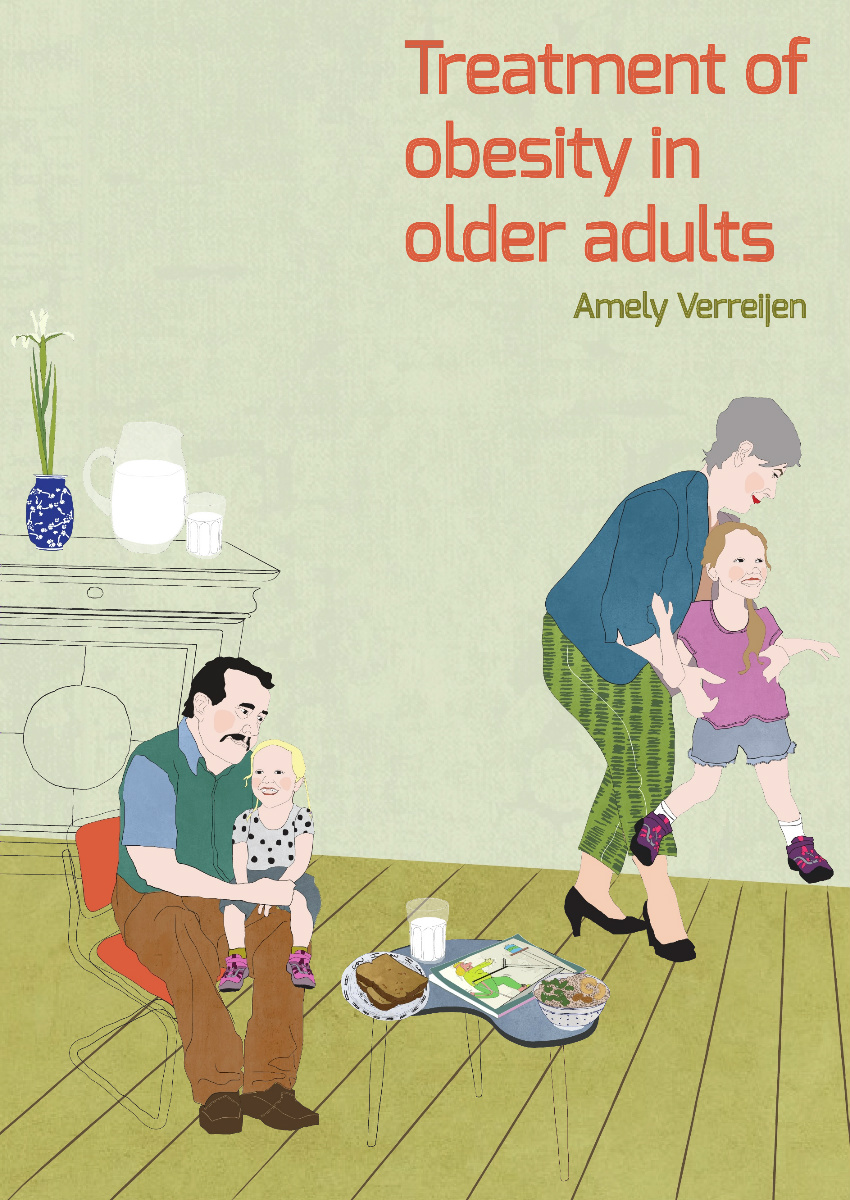
Share this project
Summary
The pace at which Western populations are aging is increasing and coincides with an increased prevalence of obesity, resulting in large numbers of obese older adults in the future. Obesity at older age is related to many health risks. Although prevention of obesity should be prioritized, obesity among older adults is still a reality. Described benefits of weight loss for obese older adults are a reduced risk of chronic disease, an improvement in physical functioning and quality of life, and a decreased mortality. Despite the described health risks of obesity, and the benefits of voluntary weight loss, clinicians often are reluctant to recommend weight loss interventions for older adults because of the potential risks of weight loss. These risks include the loss of muscle mass and strength, the reduction of bone mineral density and increased fracture risk. More knowledge is needed to optimize treatment options for weight loss in older adults with obesity in which these risks are minimized.
This thesis covers several relevant aspects of the treatment of obesity in obese older adults and addresses these four questions, which are covered in the four parts of this thesis:
1. What are the caloric needs of older obese adults before and during weight loss?
2. What is an optimal protein intake for older adults?
3. What is the effect of a higher amount of protein (in combination with exercise) during a weight loss intervention on preservation of muscle mass?
4. What are optimal treatment options for obese older adults?
Part 1: Estimating caloric needs
With respect to research question 1 we evaluated the validity of 41 existing resting energy expenditure (REE) equations in an older population with obesity. We included data of 341 obese older adults from the Netherlands, Belgium and the USA and compared the estimated REE from 41 predictive equations to the measured REE with indirect calorimetry. These analyses were performed in the total study sample, and in the Dutch, Belgian, American black, and American white subgroups. The results, which are presented in chapter 2 demonstrate that not one single equation was accurate for the total study sample, but up to 70-80% of the individuals could be predicted accurately within the subgroups. Cautious suggestions are provided for REE equations per subgroup. For the caloric needs during weight loss, we studied the presence of adaptive thermogenesis during weight loss in older overweight and obese adults compared to younger adults in chapter 3. Adaptive thermogenesis is the decrease in energy expenditure beyond what would be expected from the changes in fat free mass (FFM) and fat mass (FM) during weight loss. This study included 122 younger and 132 obese older adults. Before and after weight loss body composition and REE were measured. Baseline values of FFM and FM were used to generate a prediction equation for REE. This equation is also used to predict REE after a period of weight loss. Predicted values of REE were compared with measured REE after a period of weight loss, and revealed the presence of adaptive thermogenesis in our older population of 64 kcal per day. Dietitians need to be aware of the role adaptive thermogenesis might play during weight loss.
Part 2: Optimal protein intake
Regarding research question 2 we performed two observational studies. In chapter 4 we investigated whether the amount and type of protein (animal or vegetable) intake were associated with the 5-year change in mid-thigh muscle cross-sectional area (CSA) assessed by computed tomography in older adults (n = 1561). Overall the mean (95% CI) loss in muscle CSA over the 5 year period was −9.8 (−10.6, −8.9) cm2. No association of higher total, animal, or vegetable protein intake with 5-year change in mid-thigh muscle CSA was observed. In chapter 5 we explored the association between the amount of protein intake at breakfast and lunch and total daily protein intake in older adults, since protein may have higher satiating properties compared to fat and carbohydrates. Protein intake was assessed by a 3-day food record in 498 community dwelling older adults. A higher protein intake at breakfast and lunch was associated with a higher total daily protein intake. Stimulating a higher protein intake at breakfast and lunch might represent a promising nutritional strategy for optimizing the amount of protein per meal without compromising total daily protein intake.
Part 3: Muscle mass preservation during weight loss
Chapter 6 and 7 present two weight loss intervention studies in overweight and obese older adults to address research question 3. In our randomized controlled trial (RCT) in chapter 6 we studied the effect of a high-whey (leucine and vitamin D enriched) protein supplement, combined with resistance exercise during a 3 month weight loss period with caloric restriction, on muscle mass preservation. We included 80 overweight or obese older adults (55 years and older). All subjects followed a hypocaloric diet and performed resistance training 3 times per week. Subjects were randomly allocated to a high-whey (leucine and vitamin D enriched) protein supplement or to an iso-caloric control supplement with no protein. The primary outcome, appendicular lean mass, was measured by dual-X-ray absorptiometry. A high whey (leucine and vitamin D enriched) protein supplement preserved 0.95 (95% CI: 0.09, 1.81) kg appendicular muscle mass compared to the isocaloric control supplement. In the second RCT (chapter 7) we studied the effect of a high protein diet and/or resistance exercise on FFM preservation during weight loss. We included 100 overweight and obese older adults. All subjects followed a 10-week weight loss program with a hypocaloric diet. Subjects were randomly allocated to either a high protein (1.3 g/kg/d) or normal protein diet (0.8 g/kg/d), with or without a resistance exercise program 3 times/week (2-by-2 factorial design). FFM was assessed by air displacement plethysmography. We observed no significant effect of the higher protein diet and resistance exercise on FFM preservation. Also, no statistically significant interaction between high protein and resistance exercise was observed. However, the difference in protein intake between the high protein and the normal protein group was only 0.15 g/kg or 16 g/d, which was lower than targeted. Based on these results (chapter 6 and 7) a high-whey (leucine and vitamin D enriched) protein supplement helped to preserve muscle mass during a period of weight loss with resistance exercise. Whether a high protein diet (no supplement) combined with resistance exercise could be beneficial for FFM preservation during weight loss in older adults, should be confirmed by future studies using a larger protein contrast.
Part 4: Towards optimal treatment
Chapter 8 covers research question 4 and provides a narrative review of the literature. The main aim of this review was to provide a current update of the various exercise and nutritional strategies to prevent and/or counteract sarcopenic obesity in older adults. This review concludes that a combination of a moderate weight loss diet, with resistance exercise in combination with aerobic training, and a higher protein intake of minimal 1.0-1.2 g/kg/d, which is relatively high in animal protein and a spread of protein intake over the main meals, has the highest potential in improving different parameters of sarcopenic obesity.
Chapter 9 discusses the main findings of the studies presented in this thesis in the light of the existing literature. The following recommendations, based on this thesis and related