Alexandra Cristobal Huerta
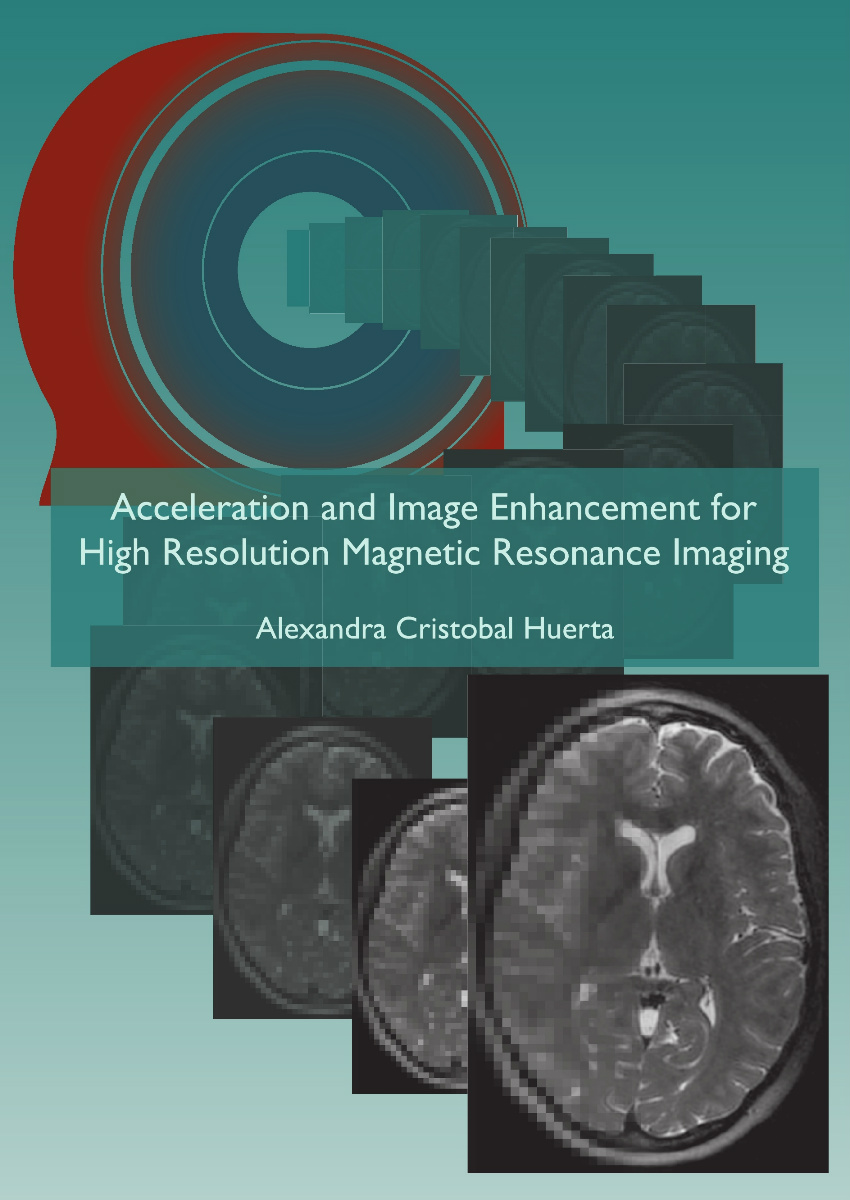


Acceleration and Image Enhancement for High Resolution Magnetic Resonance Imaging
his thesis proposes and investigates novel techniques to shorten the acquisition of three- T dimensional high-resolution brain and knee MR images, without deteriorating image quality. The Three-dimensional Fast Spin Echo (3D-FSE) pulse sequence was chosen as sequence to investigate since it allows depicting small structures of the body isotropically in the three orthogonal planes of acquisition, and is especially relevant in clinical settings for acquiring Proton Density (PD)-weighted and T 2 -weighted images from knee and brain. However, its long acquisition time and its high Specific Absorption Rate (SAR) limit its wider acceptance as standard sequence within clinical protocols. An introduction to Magnetic Resonance (MR) physics is provided in Chapter 1. We introduced the general physical concepts, the two main sequences on which most of the current sequences are based on and the two advanced sequences investigated in this thesis, with its advantages and disadvantages. We also explain the three most popular reconstruction techniques currently available in most of the sequences and clinical scanners. We finalize this chapter by introducing the concept of Deep Learning (DL) and its advantages. In Chapter 2 we provided insights and guidance about the most suitable acceleration technique among the ones available in clinical scanners to acquire faster high-resolution PD-weighted knee images with a 3D-FSE sequence. We compared Half Fourier (HF), Parallel Imaging (PI) and Compressed Sensing (CS) quantitatively in terms of Signal to Noise Ratio (SNR), Contrast to Noise Ratio (CNR) and scanning time in a phantom and in-vivo experiments. From our results we concluded that PI obtains the highest image quality among the techniques but has in the longest acquisition time. When comparing HF versus CS, the latest obtains more blurry images between tissues than HF for the same acquisition time. Therefore, HF is proposed as the most suitable acceleration technique to use for PD-weighted knee images with 3D-FSE in clinical scanners. To further accelerate the acquisition of 3D-FSE sequences and reduce SAR, in Chapter 3 and Chapter 4 the Three-dimensional Gradient and Spin Echo (3D-GRASE) sequence was implemented and investigated together with PI and CS for high resolution imaging. In these chapters, several suitable cartesian k-space trajectories and k-space grids were proposed and evaluated. Specifically, Chapter 3 evaluates four different k-space trajectories for obtaining knee PD-weighted images and two k-space trajectories for brain T 2 -weighted images. These trajectories were based on the SORT phase-encoding strategy combined with linear or radial modulation. The performance of each trajectory was evaluated in simulation, in phantom and in-vivo experiments by measuring the Point Spread Function (PSF) and Signal to Noise Ratio his thesis proposes and investigates novel techniques to shorten the acquisition of three- T dimensional high-resolution brain and knee MR images, without deteriorating image quality. The Three-dimensional Fast Spin Echo (3D-FSE) pulse sequence was chosen as sequence to investigate since it allows depicting small structures of the body isotropically in the three orthogonal planes of acquisition, and is especially relevant in clinical settings for acquiring Proton Density (PD)-weighted and T 2 -weighted images from knee and brain. However, its long acquisition time and its high Specific Absorption Rate (SAR) limit its wider acceptance as standard sequence within clinical protocols. An introduction to Magnetic Resonance (MR) physics is provided in Chapter 1. We introduced the general physical concepts, the two main sequences on which most of the current sequences are based on and the two advanced sequences investigated in this thesis, with its advantages and disadvantages. We also explain the three most popular reconstruction techniques currently available in most of the sequences and clinical scanners. We finalize this chapter by introducing the concept of Deep Learning (DL) and its advantages. In Chapter 2 we provided insights and guidance about the most suitable acceleration technique among the ones available in clinical scanners to acquire faster high-resolution PD-weighted knee images with a 3D-FSE sequence. We compared Half Fourier (HF), Parallel Imaging (PI) and Compressed Sensing (CS) quantitatively in terms of Signal to Noise Ratio (SNR), Contrast to Noise Ratio (CNR) and scanning time in a phantom and in-vivo experiments. From our results we concluded that PI obtains the highest image quality among the techniques but has in the longest acquisition time. When comparing HF versus CS, the latest obtains more blurry images between tissues than HF for the same acquisition time. Therefore, HF is proposed as the most suitable acceleration technique to use for PD-weighted knee images with 3D-FSE in clinical scanners. To further accelerate the acquisition of 3D-FSE sequences and reduce SAR, in Chapter 3 and Chapter 4 the Three-dimensional Gradient and Spin Echo (3D-GRASE) sequence was implemented and investigated together with PI and CS for high resolution imaging. In these chapters, several suitable cartesian k-space trajectories and k-space grids were proposed and evaluated. Specifically, Chapter 3 evaluates four different k-space trajectories for obtaining knee PD-weighted images and two k-space trajectories for brain T 2 -weighted images. These trajectories were based on the SORT phase-encoding strategy combined with linear or radial modulation. The performance of each trajectory was evaluated in simulation, in phantom and in-vivo experiments by measuring the Point Spread Function (PSF) and Signal to Noise Ratio (SNR), and compared with similar 3D-FSE acquisitions. From this work it was concluded that SORT Linear modulation encoding for T 2 -weighted images and SORT Radial modulation encoding with M=0 for PD-weighted images obtain image quality comparable to 3D-FSE, while reducing SAR by more than 40% and shortening acquisition time by 20%. On the other hand, Chapter 4 investigates the effects of the different k-space trajectories proposed in Chapter 3 together with two common k-space undersampling grids for CS combined with PI (CSPI) in PD-weighted and T 2 -weighted 3D-GRASE acquisitions. CSPI requires an incoherent undersampling, a variable density k-space grid and a fully sampled k-space center in order to achieve an artefact-free reconstruction. Two undersampled grids proposed in the literature for different sequences and applications fulfill these requirements: Variable Density (VD) pseudo-random Gaussian grid and VD Poisson-disc grid. The incoherence of the different combinations of k-space trajectories and undersampled k-space grids was evaluated in simulation, phantom and in-vivo experiments, concluding that i) sampling patterns combining a VD Poisson-disc k-space grid in both PD-weighted and T 2 -weighted contrasts obtained the highest incoherence and ii) the trajectory has low influence on the results. Chapter 3 and Chapter 4 shown that the quality of 3D-GRASE images highly depends on the trajectory applied during the acquisition. Moreover, the image contrast can slightly change with respect to Fast Spin Echo (FSE) if the acquisition parameters are not carefully chosen, due to the T -weighted contrast introduced by the Gradient Recalled Echos (GREs). ∗ In order to propose a solution to this problem, in Chapter 5 a Deep Learning (DL) method that brings the appearance of 3D-GRASE closer to 3D-FSE images, removing artefacts and achieving a more similar FSE image contrast, was investigated. Three different DL models were developed based on a Three-dimensional (3D) U-Net in combination with three loss functions previously proposed in the literature for regression problems: i) the voxel-wise metric l 2 -norm, ii) Destructural Similarity Index (DSSIM) and iii) the perceptual loss. The results from this work showed that the overall image quality in the axial plane is improved when a 3D U-Net with a perceptual loss is applied to 3D-GRASE images, since noise is removed, image details are mostly preserved and image contrast is more similar to that of 3D-FSE images. The quantitative metrics used to evaluate the quality of the images corroborated the higher image quality and similarity between the images enhanced by the 3D U-Net and 3D-FSE in the axial plane. However, the radiologist assessment indicated that further developments need to be performed to improve the interface of the tissues in the images from the networks to apply this work in the assessment of cartilage. Finally, the contributions and conclusions of this thesis are discussed in Chapter 6. Although further assessments need to be performed to adopt the technical developments of this thesis in clinical settings, we have shown the benefits of 3D-GRASE with accelerated reconstructed techniques over 3D-FSE and the promising capabilities of DL to enhance the quality of 3D-GRASE images. (SNR), and compared with similar 3D-FSE acquisitions. From this work it was concluded that SORT Linear modulation encoding for T 2 -weighted images and SORT Radial modulation encoding with M=0 for PD-weighted images obtain image quality comparable to 3D-FSE, while reducing SAR by more than 40% and shortening acquisition time by 20%. On the other hand, Chapter 4 investigates the effects of the different k-space trajectories proposed in Chapter 3 together with two common k-space undersampling grids for CS combined with PI (CSPI) in PD-weighted and T 2 -weighted 3D-GRASE acquisitions. CSPI requires an incoherent undersampling, a variable density k-space grid and a fully sampled k-space center in order to achieve an artefact-free reconstruction. Two undersampled grids proposed in the literature for different sequences and applications fulfill these requirements: Variable Density (VD) pseudo-random Gaussian grid and VD Poisson-disc grid. The incoherence of the different combinations of k-space trajectories and undersampled k-space grids was evaluated in simulation, phantom and in-vivo experiments, concluding that i) sampling patterns combining a VD Poisson-disc k-space grid in both PD-weighted and T 2 -weighted contrasts obtained the highest incoherence and ii) the trajectory has low influence on the results. Chapter 3 and Chapter 4 shown that the quality of 3D-GRASE images highly depends on the trajectory applied during the acquisition. Moreover, the image contrast can slightly change with respect to Fast Spin Echo (FSE) if the acquisition parameters are not carefully chosen, due to the T -weighted contrast introduced by the Gradient Recalled Echos (GREs). ∗ In order to propose a solution to this problem, in Chapter 5 a Deep Learning (DL) method that brings the appearance of 3D-GRASE closer to 3D-FSE images, removing artefacts and achieving a more similar FSE image contrast, was investigated. Three different DL models were developed based on a Three-dimensional (3D) U-Net in combination with three loss functions previously proposed in the literature for regression problems: i) the voxel-wise metric l 2 -norm, ii) Destructural Similarity Index (DSSIM) and iii) the perceptual loss. The results from this work showed that the overall image quality in the axial plane is improved when a 3D U-Net with a perceptual loss is applied to 3D-GRASE images, since noise is removed, image details are mostly preserved and image contrast is more similar to that of 3D-FSE images. The quantitative metrics used to evaluate the quality of the images corroborated the higher image quality and similarity between the images enhanced by the 3D U-Net and 3D-FSE in the axial plane. However, the radiologist assessment indicated that further developments need to be performed to improve the interface of the tissues in the images from the networks to apply this work in the assessment of cartilage. Finally, the contributions and conclusions of this thesis are discussed in Chapter 6. Although further assessments need to be performed to adopt the technical developments of this thesis in clinical settings, we have shown the benefits of 3D-GRASE with accelerated reconstructed techniques over 3D-FSE and the promising capabilities of DL to enhance the quality of 3D-GRASE images.
| Publicatiedatum | 26 januari 2022 |
| Universiteit | Erasmus Universiteit Rotterdam |
| Auteur | Alexandra Cristobal Huerta |
| Order nummer | FTP-202603171252 |
| ISBN nummer | 978-94-6423-599-9 |