Amy Van Der List
T Cell Alloreactivity to the Kidney Transplant
13 februari 2024
Erasmus Universiteit Rotterdam
Open Ebook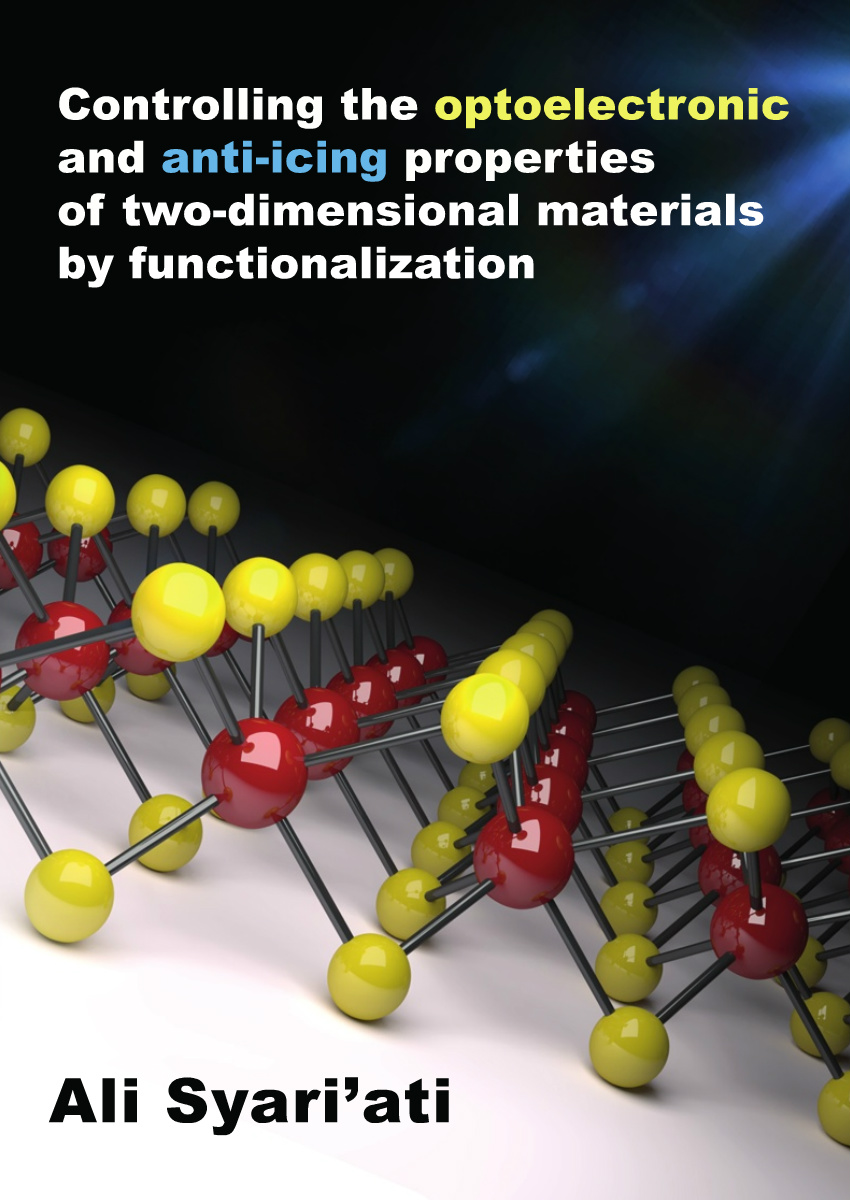
Share this project
Summary
Research on two-dimensional (2D) materials has exploded since 2004, when A. Geim and K. Novoselov demonstrated the remarkable properties graphene, which they had successfully isolated by using scotch tape. Subsequently, the research community has shown great interest to explore others 2D materials, namely transition metal dichalcogenides (TMDs), hexagonal boron nitride (h-BN), black phosphorus (BP), germanene and MXenes. Their physical and chemical properties identify them as promising candidates for application in electronic devices, sensors, catalytists, and coatings. Many researchers from different fields such as device physics, surface chemistry, biochemistry, biology and polymer chemistry have investigated 2D materials in order to learn how to control their properties. For example, semiconducting 2D materials can be stacked together to form heterostructures. On the other hand, the surface to volume ratio of 2D materials makes them suitable for sensor and catalytic applications. Moreover, atomically thin and transparent 2D material offers great benefit for coating purposes.
Despite the plethora of applications that can be realized with 2D materials, obtaining high quality and large size nanosheets remains a challenge. This thesis summarizes our contribution to the development of preparation methods for 2D materials. In addition, we also highlight our efforts in controlling their properties. We start in Chapter 1 by providing a general introduction to the field and explain the primary objective of this Ph.D. research project. We describe the two 2D materials discussed in this thesis, graphene and MoS2, and detail the electronic and optical properties of MoS2.
Chapter 2 outlines the experimental details relative to the projects we report on in this thesis. Chemical vapour deposition is explained and the basic theoretical background as well as the instrumental details is given for all employed characterization techniques, namely X-ray photoelectron, Raman, infrared and photoluminescence spectroscopy; atomic force, scanning electron, and transmission electron microscopy; X-ray diffraction as well as contact angle and electrical transport measurements.
Chapter 3 focuses on the growth of MoS2 by chemical vapour deposition. We optimized the geometry of the deposition set up by using a quartz cup for the Mo source material and placing it several mm upstream of the substrate. The quartz cup generates a gradient of MoO3 vapour concentration during the growth stage that gives rise to a MoS2 film that fully covers the substrate in the region closest to the Mo source, and to separate MoS2 flakes further away from the Mo source. The step height of the film edge and of the flakes were measured by atomic force microscopy and found to be that of single layer MoS2, 0.7 nm. The high quality of MoS2 grown using our approach was verified by Raman spectroscopy and transmission electron microscopy; a mobility of 12.8 ± 0.3 cm 2 V s and a 10 on/off ratio were determined when the material was inserted in -1 -1 4 a field-effect transistor.
In Chapter 4, we describe how to identify the intrinsic defects of MoS2 grown by chemical vapour deposition with the help of X-ray photoelectron spectroscopy. In the Mo3d core level photoemission spectrum monosulfur vacancies and complex defects, which had only been revealed by scanning tunneling microscopy, give rise to distinct peaks at higher binding energy than the peak originating from Mo in a perfect bonding environment. In addition, we demonstrate that surface functionalization with thiol-terminated molecules can fill sulfur vacancies while preserving the semiconducting properties of MoS2.
In Chapter 5 we expand our study on surface functionalization of MoS2 grown by chemical vapour deposition. We demonstrate how the photoluminescence intensity of MoS2 can be enhanced via functionalization with p-doping TCNAQ. The seven times intensity results from the suppression of the non-radiative trion recombination. As the control experiment we also functionalized our MoS2 with n-doping ATTF and found that that photoluminescence intensity decreased. The surface functionalization described in this chapter preserves the MoS2 crystalline quality but is robust at the same time, which is crucial for optoelectronic applications.
In Chapter 6, we shift our focus on another 2D material namely graphene and report on the wetting properties of a coating based on graphene oxide layer for anti-icing applications. We employed Langmuir-Schaefer deposition as an up-scalable method to deposit graphene oxide on an arbitrary substrate and obtain full-coverage. The functional groups of graphene oxide were shown to reduce the ice formation temperature by influencing the amount of hydrogen bonding in the wetting layer.