Share this project
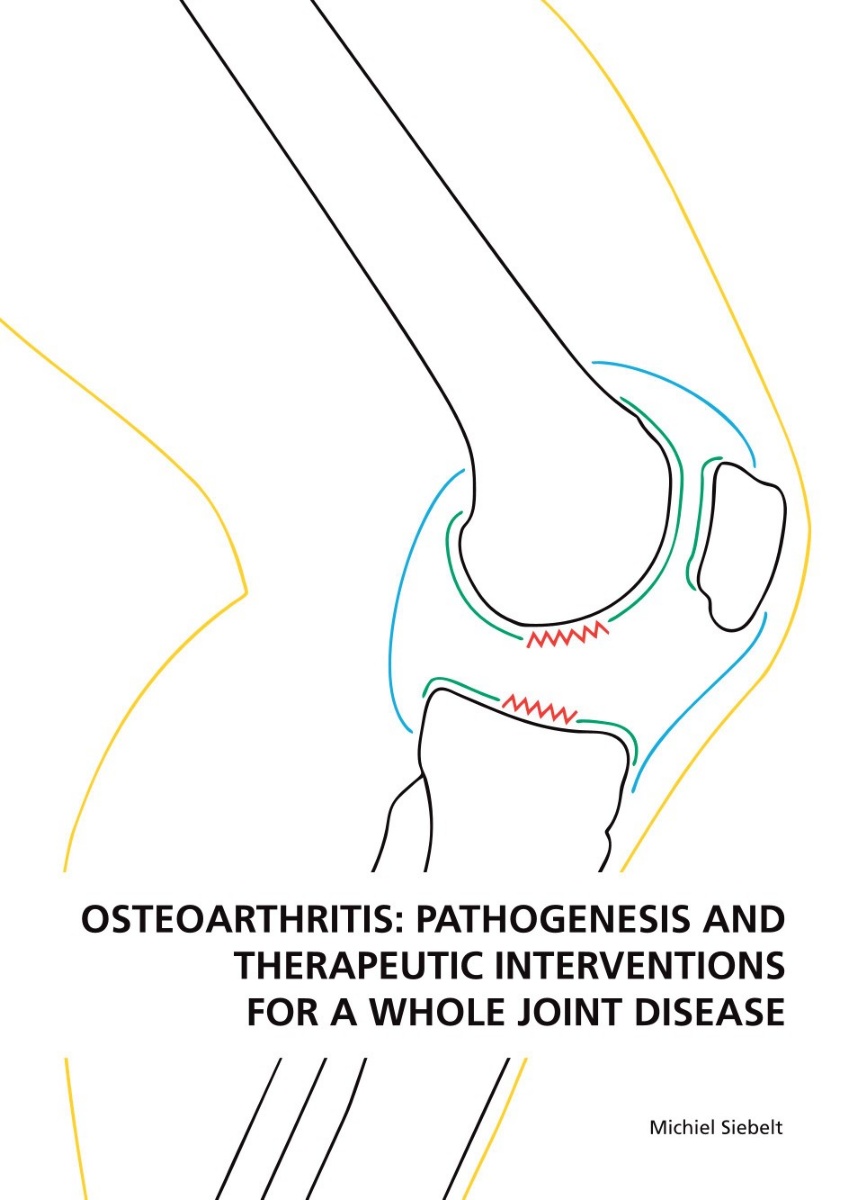
Michiel Siebelt
Erasmus Universiteit Rotterdam
Publication date: 3 juni 2015
University: Erasmus Universiteit Rotterdam
ISBN: 978-94-91487-22-4
OSTEOARTHRITIS: PATHOGENESIS AND THERAPEUTIC INTERVENTIONS FOR A WHOLE JOINT DISEASE
Summary
The articular joint is a complex structure in the human body that allows movement under high mechanical loading during daily activities. Osteoarthritis (OA) is a degenerative disease of articular joints that involves pathologic changes in articular cartilage, subchondral bone, synovium, menisci, ligaments, and probably even other structures as well. In this thesis, we studied different aspect of progressing OA pathology in different animal models using multi-modality imaging techniques (like µCT and µSPECT/CT) dedicated for small laboratory animal research. Furthermore, we investigated several therapeutic strategies that might be beneficial for OA management.
First, we longitudinally analyzed OA progression in different OA models using µCT-arthrography (µCTa) scans. In Chapter 2, we describe a new approach to more accurately segment cartilage from µCTa scans, enabling more detailed analysis of cartilage degradation in time. When applied for analysis of OA progression during a 24 week follow-up time in three different OA models, each model showed distinct patterns of disease progression. In particular, the strenuous running model showed a marked loss of sulphated glycosaminoglycans (sGAG) from articular cartilage during treadmill running. Unexpectedly, when rats did not run anymore, this sGAG loss progressed during follow-up. This finding suggests that increased biomechanical exposure through strenuous running initiates an ongoing cascade of OA processes that likely exceeds the ability for spontaneous cartilage repair.
In contrast to our finding in Chapter 2, from literature it is known that physiological joint loading through exercise can stimulate cartilage quality and enhance cartilage sGAG content in healthy joints. In Chapter 3, we investigated whether physical exercise exerts a similar effect on sGAG depleted cartilage. In this chapter we show that moderate exercise is harmless for healthy cartilage, but is detrimental for articular joints in rats with severely sGAG depleted cartilage. Not only cartilage degraded to a far more severe extent, there was also more formation of subchondral sclerosis, fulminant activation of macrophages, and increased osteophytosis.
Next, we performed experiments that target chondrocytes in order to intervene with OA progression. The canonical Wnt/β-catenin signaling pathway is a critical regulator of cartilage homeostasis and development and influences cell death through apoptosis mechanisms. In this pathway, glycogen synthase kinase-3β (GSK3β) down-regulates transduction of the canonical Wnt signal by promoting degradation of β-catenin. In Chapter 4, we show that inhibition of GSK3β leads to chondrocyte apoptosis and induces OA.
Another interesting regulator of cartilage homeostatis are heat shock proteins (Hsp). Hsp70 can be upregulated in chondrocytes through exercise, which protects chondrocytes against apoptotic cell death. However, this effect is limited due to suspected upregulation of Hsp90, which has an antagonistic function on Hsp70. In Chapter 5, we tested whether Hsp90 inhibition might prevent degenerative effects from strenuous running on articular cartilage. We found that Hsp90 inhibition upregulated Hsp70 in articular chondrocytes and stimulated sGAG production, which ultimately prevented cartilage ECM damage in the rat running model.
A loss of chondrogenic phenotype due to OA induced chondrocyte hypertrophy is associated with calcineurin (Cn) activity. In Chapter 6 we studied whether Cn inhibition through FK506 treatment improves chondrocyte phenotype in vitro and whether FK506 might prevent OA in vivo. In vitro monolayer and 3D pellet cultures of chondrocytes treated with FK506 showed both induced anabolic and reduced catabolic extracellular matrix (ECM) marker expression. When FK506 was applied in vivo, it prevented degradation of ECM, reduced subchondral sclerosis, and synovial macrophage activation. Our data suggest that FK506 induces an anabolic response in articular chondrocytes that protects cartilage ECM.
The cartilage-bone interface is long suspected to be the key-region in OA development. It has been hypothesized that a functional coupling between osteoclasts and osteoblasts exists that eventually will lead to sclerosis formation during OA progression. In Chapter 7, we investigated whether inhibited osteoclastic bone resorption through alendronate treatment intervened with formation of subchondral sclerosis formation and its effect on OA progression. Alendronate treatment functionally inhibited osteoclastic bone resorption, but the formation of sclerosis was not prevented. This suggests that other cells, like osteocytes, might play an important role in the formation of sclerosis. However, alendronate treatments did (somewhat) protect against ECM degradation, indicating that increased osteoclastic activity does contribute to during OA progression.
Within the synovium reside macrophages that become activated during OA progression. It is known that these activated macrophages produce transforming growth factor (TGF) β. Due to enhanced TGFβ production, the synoviocytes enhance bone morphogenetic protein (BMP) production. Consequently, these BMPs stimulate development of osteophytes. It is also known, that intra-articular use of corticosteroids inhibits osteophytosis. However, the mechanisms through which this effect is generated are still unknown. In Chapter 8 we studied what effect intra-articular injections of triamcinolone have on synovial macrophage activation. Triamcinolone was able to prevent osteophyte formation in a severe model for OA. Interestingly, triamcinolone injections severely enhanced macrophage activation. Unfortunately, we did not find an effect on cartilage quality or quantity. In fact, triamcinolone proved to enhance subchondral sclerosis in this model for OA.
Mesenchymal stem cells (MSCs) are promising candidates for cartilage regeneration. MSCs also have immunomodulatory and trophic capacities by secreting anti-inflammatory factors and growth factors. Cell tracking experiments showed that MSCs are able to survive up to two weeks after injection into the knee joint (Chapter 9). Although we found that MSCs exerted a favorable effect on pain in the mono-iodoacetate (MIA) model for OA, both MSC and freshly isolated bone marrow mononuclear cells (BMMNCs) did not modify any of the MIA induced OA changes in bone, cartilage and synovium. Further evaluation on multiple pain aspects is needed to assess the efficacy of MSC as a therapy to alleviate pain in clinical OA.
Current imaging modalities used in clinical practice (e.g. radiographs, MRI), are not likely to give us the necessary knowledge about OA pathogenesis. µCT-arthrography is a pre-clinical technique that enables us to detect early OA events before our laboratory animals develop any clinical symptoms of disease progression. Therefore, we conducted experiments in order to translate this technique towards a clinical setting. In Chapter 10, CT-arthography (CTa) scans made using a clinical CT system and compared to outcomes from EPIC-µCT scans. CTa had an excellent correlation with cartilage sGAG content. This correlation even further improved when we combined information on sGAG content with data that reflected the cartilage ECM composition. This indicates that cartilage analysis using CTa serves as an accurate measure for cartilage quality.
In order to use a radiation based technique (like CT) in clinical practice, it is necessary to investigate whether CTa scan protocols using a lower radiation dose are still able to measure cartilage quality. In Chapter 11 we report that CTa scans made with radiation doses ranging from 8.13 mGy to 81.33mGy, were all able to measure overall cartilage quality. CTa is therefore suitable for quantitative analysis of cartilage in clinical research. However, spatial analysis of cartilage quality on a single CT slice was highly affected by lowering the radiation dose. So, for new studies that require a high spatial resolution, will need to use a higher radiation dose.
To conclude, the results of this thesis support that OA is a ‘whole joint disease’. Our data suggest that there is a dedicated balance within joint tissues to cope with the daily biomechanical demands it faces. Physiological joint functioning is impaired through loss of tissue quality, increased biomechanical demands, or a combination of both. When physiological functioning is disturbed, OA is likely to develop. We have shown that targeted interventions at different cells in the joint enable preservation of tissue quality, through which OA might be prevented. New imaging techniques for quantitative cartilage analysis (e.g. CT-arthrography) and emerging techniques that visualize cellular and molecular aspects of OA (e.g. SPECT/CT) will enhance our knowledge of OA. With these techniques, we will be able to more accurately select patients all suffering from a similar etiology of OA. The fewer the variables within OA study populations, the higher the chances in developing disease modifying agents that successfully target OA can be identified.
See also these dissertations


Mengxiao Sun
The role of service plants in promoting biological pest control and pollination in Xinjiang pear
3 juni 2026
Wageningen University
Open Ebook
Sherril Phyllis
Wild meat in the city, health risks and implications
1 juni 2026
Wageningen University
Open Ebook
Wisenave Arulvasan
Developing Breathomics for Clinical Application
29 mei 2026
Universiteit Maastricht
Open Ebook


Evi Koene
Pharmacological inhibition of ketohexokinase in inborn and acquired metabolic disorders
4 juni 2026
Universiteit Maastricht
Open Ebook
Isaura Wayop
Enhancing antimicrobial stewardship in veterinary medicine
4 juli 2025
Universiteit Utrecht
Open Ebook
Lidongsheng Xing
Identifying Sound Features from Brain Activity
6 mei 2026
Universiteit Maastricht
Open Ebook
Hongchen Li
Microbubble Oscillations and Microstreaming
21 mei 2026
Erasmus Universiteit Rotterdam
Open EbookWe print for the following universities