Isaura Wayop
Enhancing antimicrobial stewardship in veterinary medicine
4 juli 2025
Universiteit Utrecht
Open Ebook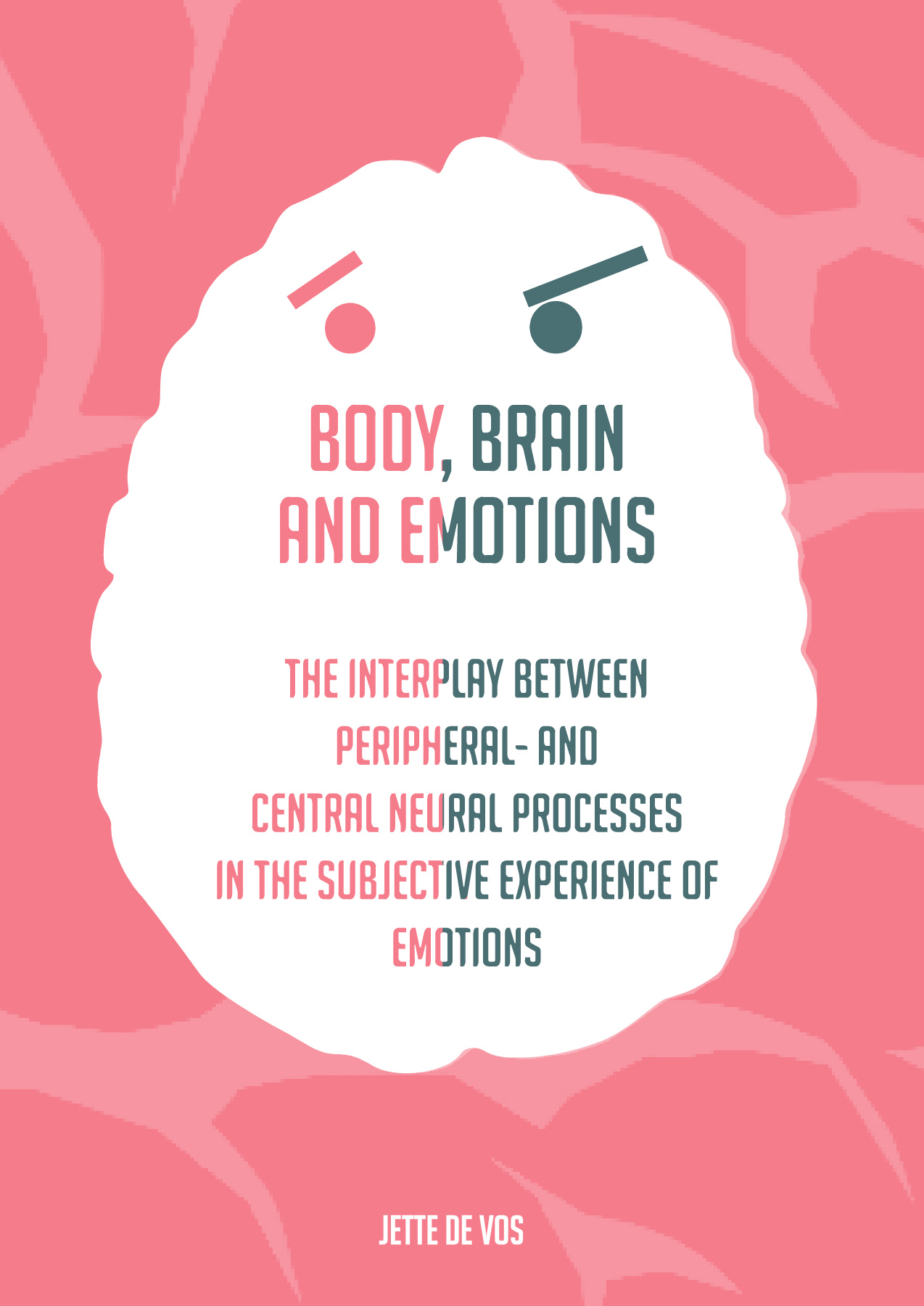
Share this project
Summary
Jette de Vos
Body, Brain and Emotions: The interplay between peripheral- and central neural processes in the subjective experience of emotions
Despite years of research on the fundamental mechanisms of emotions, much is still unknown about the physiological processes of emotional experiences. By employing a variety of experimental emotion induction methods, manipulations and measurements, the aim of this thesis was to further unravel the interplay between peripheral (‘the body’)- and central neural (‘the brain’) processes in the subjective experience of emotions.
In chapter 2 we summarized the published results of studies that used a pharmacological intervention prior to 35% CO2 panic induction in a meta-analysis. By combining the results of 35 publications we could draw several conclusions. First, studies that applied a pharmacological intervention designed to inhibit the induced panic response, successfully achieved such inhibition. Second, no differences between the effects of interventions targeting different biological systems were found. However, when comparing inhibitors with enhancers of the serotonergic systems specifically, only enhancers were found to reduce the panic response. Lastly, studies that applied a pharmacological intervention to enhance the induced panic response, did not achieve such enhancement. These results highlight the possibility of using the 35% CO2 panic induction as a screening tool for pharmacological interventions for panic.
In chapter 3 we used the 35% CO2 panic induction in order to determine the effects of two pharmacological interventions. Specifically, we compared the effects of a hydrophilic agent that blocks β1 adrenergic receptors exclusively in the peripheral nervous system, a lipophilic agent that blocks β1 adrenergic receptors in the peripheral- and central nervous system, and a placebo. Although both compounds effectively inhibited physiological activity, as shown by a decrease in cardiovascular parameters, no effects on the subjective experience of panic were observed. These results do not support the common view that peripheral parameters of emotions play a causal role in the construction of the subjective experience of emotions. In fact, the observed dissociation between the peripheral physiological and subjective components of emotions highlights that alternative explanations should be tested in future research.
In chapter 4 we analysed the temporal dynamics of three large-scale networks that have been linked to emotional processing, in an experimental model of the development of clinical anxiety. We found that during the acquisition phase of a classical fear-conditioning paradigm, the connectivity within the default mode network (DMN) showed a different temporal dynamic for a stimulus that is learned to predict an aversive outcome (CS+) compared to a stimulus that is learned to be safe (CS-). At the end of the acquisition, the connectivity within the DMN was disrupted in response to the CS+, while the connectivity was increased in response to the CS-. This was the case in a group of healthy volunteers, but not in a group with high levels of anxiety traits. These results underline the importance of the DMN when studying the behavior of large-scale networks in relation to emotional processes.
In chapter 5 we analysed the effects of exposure therapy, and whether individual differences in extinction learning (both on neural and behavioral level) could predict therapy success in the long-term. We found that even after a year, individuals with a specific phobia for spiders who received one exposure therapy session reported a sustained decreased fear of spiders. The fear of spiders in this group was lower compared to individuals with a specific phobia for spiders who received an active control intervention, namely one progressive muscle relaxation session. Furthermore, we did not find an association between extinction learning indices and long-term therapy outcome. These results highlight the need to continue the search for reliable predictors of long-term (exposure) therapy outcomes, as these potential predictors could contribute to optimal individualized therapy selections.
In chapter 6 we analysed the feasibility of a new insula-targeted neurofeedback paradigm. We showed the feasibility of using an interoceptive task, namely a heartbeat counting task, to activate the insula and make a functional selection of activated voxels as target for subsequent neurofeedback training. In this subsequent neurofeedback training, the participants successfully upregulated the insula activity, however, they were not able to differentially activate the insula to a medium compared to a high level. Lastly, we explored the feasibility of estimating someone’s own level of activation before receiving feedback. We did not observe improvements in the estimation accuracy over time. In sum, this new paradigm proved to feasible to some extent, and offers a potential neurofeedback paradigm to study the effects of insula self-regulation on interoceptive and emotional processes.
Finally, chapter 7 discusses the main findings of the different chapters and how they contribute to unravelling the interplay between peripheral (‘the body’)- and central neural (‘the brain’) processes in the subjective experience of emotions. Furthermore, methodological considerations and suggestions for future research are discussed in this chapter.