Deel dit project
Jette De Vos
Universiteit Maastricht
Publicatiedatum: 15 april 2025
Universiteit: Universiteit Maastricht
ISBN: 978-94-6510-494-2
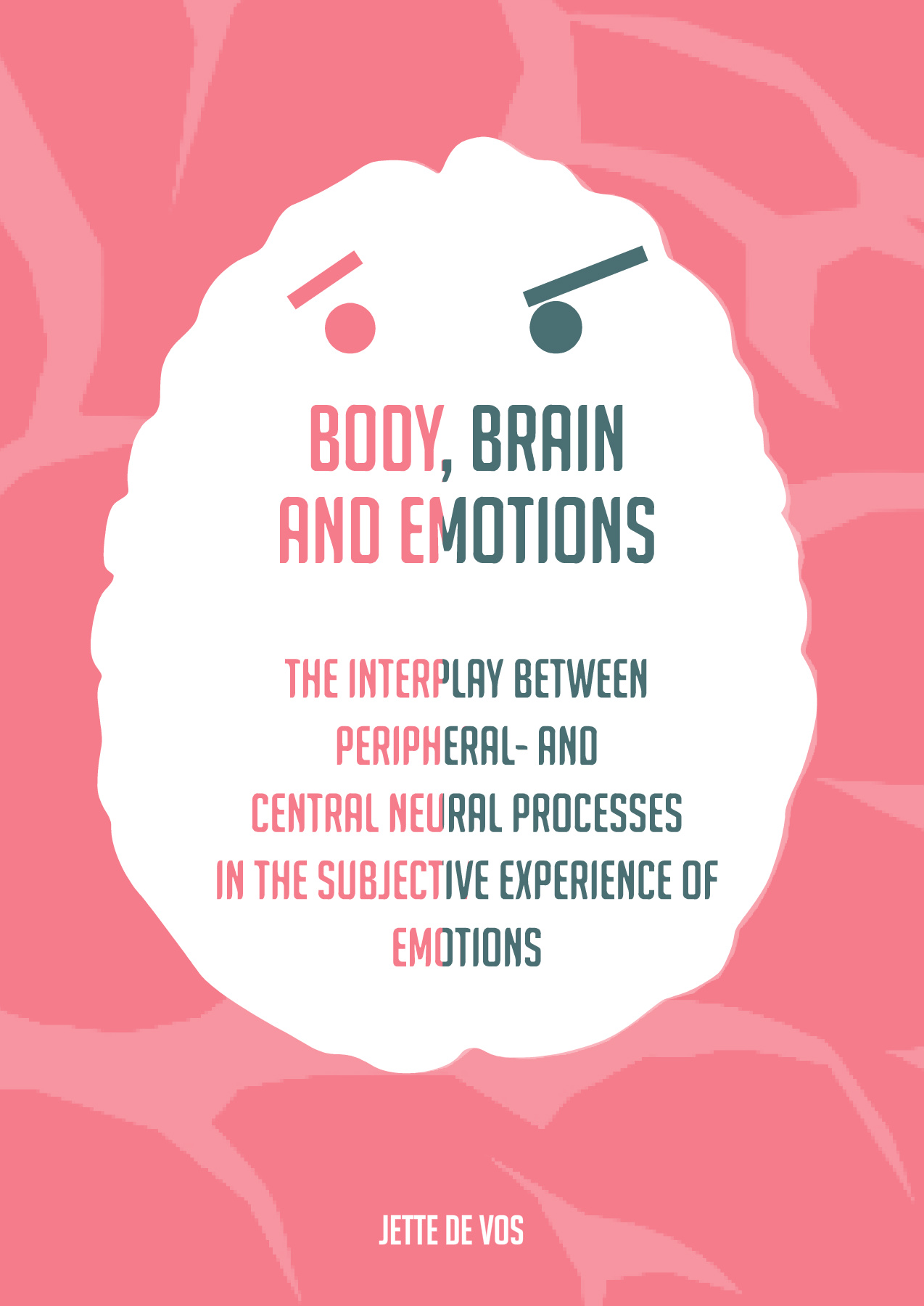
Body, Brain and Emotions
Samenvatting
Jette de Vos
Body, Brain and Emotions
The interplay between peripheral- and central neural processes in the subjective experience of emotions
jette de vos
Ondanks jaren van onderzoek naar de fundamentele mechanismen van emoties, is er nog veel onbekend over de fysiologische processen van emotionele ervaringen. Door gebruik te maken van verschillende experimentele methoden voor het opwekken, manipuleren en meten van emoties, was het doel van dit proefschrift om meer inzicht te krijgen in de wisselwerking tussen perifere ('het lichaam') en centrale neurale ('de hersenen') processen in de subjectieve ervaring van emoties.
In hoofdstuk 2 worden de gepubliceerde resultaten samengevat van studies die een farmacologische interventie toepasten voorafgaand aan een paniekinductie met 35% CO2, middels een meta-analyse. Door de resultaten van 35 publicaties te combineren, konden verschillende conclusies worden getrokken. Ten eerste bleken studies waarin een farmacologische interventie werd toegepast om de opgewekte paniekrespons te remmen, hier succesvol in te zijn. Ten tweede werden er geen verschillen gevonden tussen de effecten van interventies die op verschillende biologische systemen gericht waren. Echter, wanneer remmers werden vergeleken met versterkers van het serotonergische systeem, bleek alleen de inzet van versterkers de paniekrespons te verminderen. Tot slot bleken farmacologische interventies die gericht waren op het versterken van de paniekrespons, niet effectief. Deze resultaten benadrukken de mogelijkheid om de 35% CO2-paniekinductie te gebruiken als screeningsinstrument voor farmacologische interventies bij paniek.
In hoofdstuk 3 wordt de 35% CO2-paniekinductie gebruikt om de effecten van twee farmacologische interventies te bepalen. Concreet werden de effecten vergeleken van een hydrofiel middel dat alleen β1-adrenerge receptoren in het perifere zenuwstelsel blokkeert, een lipofiel middel dat β1-adrenerge receptoren blokkeert in zowel het perifere als centrale zenuwstelsel, en een placebo. Hoewel beide middelen effectief de fysiologische activiteit verminderden, zoals bleek uit een afname in cardiovasculaire parameters, werden er geen effecten waargenomen op de subjectieve ervaring van paniek. Deze resultaten ondersteunen niet de gangbare theorie dat perifere parameters van emoties een causale rol spelen in de constructie van de subjectieve emotionele ervaring. De waargenomen dissociatie tussen perifere fysiologische en subjectieve componenten van emoties benadrukt dat alternatieve verklaringen in toekomstig onderzoek moeten worden getest.
In hoofdstuk 4 wordt de temporele dynamiek van drie grootschalige neurale netwerken beschreven die betrokken zijn bij emotionele processen, binnen een experimenteel model voor de ontwikkeling van klinische angst. Tijdens de acquisitiefase van een klassieke conditioneringstaak vonden we dat de connectiviteit binnen het default mode-netwerk (DMN) een ander tijdsverloop liet zien voor een stimulus die een aversieve uitkomst voorspelt (CS+) vergeleken met een stimulus die veilig is (CS-). Aan het einde van de acquisitie was de connectiviteit binnen het DMN verstoord in reactie op de CS+, terwijl de connectiviteit verhoogd was in reactie op de CS-. Dit patroon werd waargenomen bij een groep gezonde vrijwilligers, maar niet bij een groep met hoge angsttrekken. Deze resultaten benadrukken het belang van het DMN bij het bestuderen van het gedrag van grootschalige neurale netwerken in relatie tot emotionele processen.
In hoofdstuk 5 worden de lange termijn effecten van exposuretherapie onderzocht en wordt gekeken of individuele verschillen in extinctieleren (zowel op neuronaal als gedragsniveau) de lange termijn effecten van exposuretherapie kunnen voorspellen. We vonden dat individuen met een specifieke spinnenfobie die één sessie exposuretherapie kregen, zelfs na een jaar een afname van spinnenangst rapporteerden. Hun angstniveau was lager dan dat van een controle groep die een actieve controle-interventie ontving, namelijk een training sessie progressieve spierrelaxatie. Verder vonden we geen associatie tussen kenmerken van extinctieleren en de lange termijn effecten van de exposure therapie. Deze resultaten benadrukken de noodzaak om verder te zoeken naar betrouwbare voorspellers van de lange termijn effecten van (exposure)therapieën, omdat deze voorspellers zouden kunnen bijdragen aan een optimale gepersonaliseerde therapiekeuze.
In hoofdstuk 6 wordt de haalbaarheid van een nieuw neurofeedback paradigma, gericht op de insula, onderzocht. We toonden aan dat het mogelijk is om een interoceptieve taak, namelijk een hartslag-teltaak, te gebruiken om de insula te activeren en een functionele selectie van geactiveerde voxels te maken voor daaropvolgende neurofeedbacktraining. Tijdens deze training slaagden deelnemers erin de insula-activiteit te verhogen, maar ze waren niet in staat om de insula-activiteit te verhogen naar een specifiek niveau (middelhoog of hoog). Tot slot onderzochten we of proefpersonen het activatieniveau zelf in konden schatten, voordat ze feedback kregen. Er werd geen verbetering in de nauwkeurigheid van deze schatting waargenomen. Samenvattend bleek dit nieuwe paradigma tot op zekere hoogte haalbaar te zijn en biedt het een potentieel neurofeedbackparadigma om de effecten van zelfregulatie van de insula op interoceptieve en emotionele processen te bestuderen.
Tot slot worden in hoofdstuk 7 de belangrijkste bevindingen van de verschillende hoofdstukken besproken en hoe deze bevindingen bijdragen aan het ontrafelen van de wisselwerking tussen perifere ('het lichaam') en centrale neurale ('de hersenen') processen in de subjectieve ervaring van emoties. Daarnaast worden in dit hoofdstuk methodologische overwegingen en suggesties voor toekomstig onderzoek besproken.
III. Impact Paragraph
Jette de Vos
Body, Brain and Emotions
The interplay between peripheral- and central neural processes in the subjective experience of emotions
jette de vos
Affective disorders are among the most prevalent mental health conditions, with anxiety disorders affecting approximately 300 million people and depressive disorders affecting approximately 280 million people globally [1]. These disorders have an immense detrimental effect on a patient’s well-being, and of all mental disorders, contribute the most to the burden of mental illness, as measured by disability-adjusted life-years (DALYs), years lived with disability (YLD), and years of life lost (YLL) [1]. The economic impact of mental disorders is significant, comprising both direct costs, such as medical care, outpatient visits, and hospitalizations, and indirect costs, such as loss of income and reduced productivity [2]. First-line treatments for affective disorders typically involve a combination of pharmacological interventions and psychotherapy, such as cognitive behavioral therapy (CBT) [3-5]. However, these treatments are often insufficient, leading to limited success in reducing the prevalence and societal costs of affective disorders [6].
Understanding the mechanisms underlying emotions — and distinguishing between non-pathological and pathological emotional processes that drive affective disorders — has important implications for improving treatment outcomes. Insights into the (neuro)physiology of emotions can support the development of more effective therapeutic strategies for affective disorders. The aim of this thesis was to deepen our understanding of emotions by exploring the interaction between peripheral (bodily) and central neural (brain) processes in the subjective experience of emotions. The findings from this research not only enhance our knowledge of emotional mechanisms but also offer methodological advancements with potential to inform the development of new treatments for affective disorders.
Part I of the thesis focuses on an experimental model for panic. Inhalation of 35% CO2 has been shown to induce symptoms similar to naturally occurring panic attacks, even in healthy individuals [7-9]. Panic attacks, a key feature of panic disorder and an indicator of the severity of other mental health conditions [10], are commonly treated with pharmacological interventions, though these are not always effective [11]. One challenge in studying new treatments for panic attacks is their spontaneous nature. This challenge can be overcome by using the 35% CO2 model. The 35% CO2 model provides a controlled environment to study panic symptoms and offers a tool for screening the therapeutic effects of potential pharmacological treatments. Chapter 2 demonstrates the capacity of certain pharmacological interventions to inhibit CO2-induced panic responses. By evaluating the effects of these treatments in the CO2 model and first in healthy individuals, researchers can identify the most promising candidates for further testing in large-scale randomized controlled trials (RCTs) and before moving on to testing in patients, streamlining research efforts and reducing unnecessary participation in trials with low clinical potential. Chapter 3 contributed to our understanding of the relationship between peripheral nervous system activity and the subjective experience of panic (as induced by the CO2 inhalation). Based on the results from chapter 3 new hypotheses could be formed about the relationship between ‘the body’ and subjective emotions, which are suggested to be tested in future research.
Functional magnetic resonance imaging (fMRI) techniques have surged in use over recent decades, greatly advancing our understanding of brain functioning and the underlying causes of mental disorders. In chapters 4 and 5, we contribute to this body of work by examining the neural mechanisms involved in fear learning and extinction. These findings offer new insights into the neural processes that occur during classical fear conditioning, which are believed to mirror those involved in the onset of anxiety disorders (the acquisition phase of fear conditioning) and a key component of CBT, i.e., exposure therapy (the extinction phase) [12]. By identifying deviations in neural mechanisms between healthy individuals and those with mental disorders, these findings can guide the development of more targeted and effective treatments in the future.
Moreover, chapter 5 contributed to the search for predictors of treatment success. Although CBT, and the exposure therapy component specifically, are effective treatments in general, not all patients benefit (sufficiently) from it [13, 14]. Aiming to identify predictors of treatment success aligns with the goals of precision medicine, which focuses on providing more individualized care to enhance treatment outcomes. Identifying the characteristics that predict success of exposure therapy, particularly in the long term, would be beneficial to help guiding treatment decisions, ensuring patients receive the most suitable intervention. Although no definitive predictors were found in this chapter, the findings contribute valuable insights that will inform and refine future efforts in this area.
One promising approach to addressing the deviant neural mechanisms observed in mental disorders is neurofeedback [15]. Real-time fMRI (rt-fMRI) neurofeedback is a non-invasive technique to train individuals to self-regulate specific neural signals. In chapter 6, we investigate a novel neurofeedback paradigm targeting brain regions associated with interoception — the brain’s representation of bodily signals — which is critical for understanding the connection between peripheral and central processes in the experience of emotions. In addition to advancing our understanding of emotional mechanisms, this paradigm has therapeutic potential, as deviations in interoceptive processes have been identified in the context of affective disorders and could thus be targeted.
Neurofeedback offers several advantages over traditional treatments. For example, as noted by Krause and colleagues [16], neurofeedback directly modifies neural activity, whereas psychotherapy may only indirectly achieve this. Furthermore, neurofeedback is individualized, non-invasive, and endogenous, making it less prone to side effects compared to other neuromodulation techniques. Its effects are also more sustainable, as once individuals learned a strategy to alter brain activity during training they can continue applying this strategy outside the fMRI scanner, i.e. in their daily life, without further training, unlike pharmacological interventions that require ongoing medication to maintain their effects. Additionally, patients may view neurofeedback more favorably than more invasive neuromodulation techniques, such as deep brain stimulation (DBS) that require implanting electrodes into the brain. Because of the clinical potential interest in neurofeedback is growing, which is reflected in the increasing number of RCTs published on the topic, with the first PubMed record dating back to 2005, and 33 trials published since 2020.
In
Bekijk ook deze proefschriften




Sam Neppelenbroek
Dysregulation of autoreactive B cell responses in autoimmune diseases
9 juli 2026
Universiteit Leiden
Open Ebook



Karlijn Doorenspleet
Improving North Sea biodiversity monitoring using novel molecular approaches
25 juni 2026
Wageningen University
Open EbookWij drukken voor de volgende universiteiten