Share this project

Cora Van Oosten
Wageningen University
Publication date: 20 april 2021
University: Wageningen University
ISBN: 978-94-6395-697-
Landscape governance
Summary
Research question 1: How is landscape governance manifested in various modes?
Responding to the first research question, the research outcomes indicate that landscape governance can be manifested in multiple modes of governance, depending on its spatial context, the drivers of degradation and the way in which public, private and civic actors collaborate in order to restore. Within landscapes, different modes of governance may co-exist and overlap, as a response to different environmental issues at stake. Moreover, landscape governance is not static, but dynamic, characterised by different modes of governance which continuously shift. The modifiers of these shifts are to be found in the wider societal trends of democratisation and decentralisation, international commodity chains, and societal discourses on nature conservation and landscape restoration. Within such changing contexts, landscape governance provides new institutional space for stakeholders to interact and find more collaborative modes of governance fitting the specific socio-spatial conditions of their landscape.
Research question 2: What are the major challenges that hamper landscape governance, and what are the deeper causes of these?
In many cases, landscape governance implies two types of challenges: substantive challenges which relate to the landscape itself, and process challenges which relate to its governance process. The substantive challenges are reflected in competing claims and conflict over land use, enforced by sectoral policy frameworks or silos which hardly interact. Process challenges relate to the level of participation in spatial decision making, and the legitimacy of decisions taken. Both challenges have deeper institutional causes related to mismatches between the jurisdictional, spatial and historical scales on which society is built. As landscape boundaries rarely tally with jurisdictional boundaries, legitimate stakeholder processes tend to involve stakeholders who do not have a clear stake in landscape issues, while those having a stake are underrepresented, leading to politically steered landscape agendas which are not supported by those living and working in landscapes.
Research question 3: How do landscape actors deal with these challenges, and what explains their strategies chosen and outcomes achieved?
Different stakeholders have different strategies at their disposal, depending on the livelihood objectives and the policy options that they have. In all cases, landscape actors overcome substantive challenges through different forms of integrated land use, sometimes based on traditional knowledge, sometimes based on novel business insights. Their strategies are either unconscious and intuitive, or more deliberate and strategically stretching the boundaries of sectoral policies on food production, nature conservation and economic growth. Actors overcome process challenges by following horizontal pathways of engaging in place-based dialogue, social interaction and collaborative learning. With this, they create social support for more integrated land use, and strengthen their landscape’s position within centrally steered policy frameworks which are poorly connected to landscape practice. More strategically positioned actors follow vertical pathways of engaging in multi-level policy networks and multi-scalar policy dialogue, in an attempt to negotiate alternative policy options and build bridges between the jurisdictional, spatial and temporal scales in which their landscape is enmeshed. The transformative power does not lie in the individual strategies but in the ensemble of strategies, as it is the ensemble of social interactions at multiple levels and scales that drives policy change.
Research question 4: Which capabilities do landscape actors have or need to have in order to employ the strategies to overcome substantive and process challenges?
The choice for a particular strategy or combination of strategies partly depends on the substantive, process and institutional capabilities that landscape actors have, but also on the wider institutional context and the social, sectoral and hierarchical position of actors within. In general terms, the capabilities of landscape professionals to tackle substantive challenges are relatively high, as they have sufficient technical skills and combine these with the particular landscape knowledge and experience that they have. Their capabilities to tackle process challenges and institutional challenges, however, often fall short. Process capabilities are rarely learned at school and therefore depend on the personal motivation and interest of individuals. Institutional capabilities not only fall short but are hardly recognised as such and rarely addressed in professional capacity development programmes. These seem to depend on the professionals’ networking skills and their ability to move beyond their mandate, which is influenced by the institutional environment in which they operate and the hierarchical positions that they have.
The overall conclusion as presented in chapter seven is that despite high hopes, landscape governance is not the silver bullet to reconcile environmental, social and economic concerns, as its challenges should not be underestimated. Landscape governance cannot be captured in just one mode of governance, as in reality, multiple modes co-exist, overlap and constantly shift, due to changing roles and behaviours of the public, private and civic actors involved. In all the cases studied, landscape governance arrangements provide space for these actors to interact, but too often the results remain informal. The reason for this is that landscapes do not necessarily represent a formal level of governance, meaning that decisions taken are not based on formally agreed democratic rules and therefore remain ‘in the shadow of hierarchy’. The deeper causes lie in the mismatch between jurisdictional, spatial and temporal scales, leading to substantive and process challenges which are not easily overcome. Typical are the interrelated challenges of asynchronous jurisdictional and sectoral boundaries and the lack of legitimacy of decisions taken, which frustrates decision-making processes and makes these prone to power imbalances and conflict. Despite these challenges, landscape actors have multiple strategies to advance, based on their productive and institutional behaviour. These strategies are either informal and intuitively employed to stretch rules and regulations, or more deliberate and strategically employed, to transform the rules into more flexible ones that better suit their spatial context. Usually, actors are capable of combining productive practices at field, farm or landscape level and create multifunctional land use systems that combine production, consumption and protection. However, more strategic capabilities of tackling multi-level policy conflicts and finding alternative sources of legitimacy through place-based governance arrangements often fall short. Strengthening the capabilities of individual actors through capacity development interventions is not enough to arrive at the desired transformation from jurisdictional to landscape governance. Rather than developing individual capabilities, a more systemic institutional change is needed, which requires a total ensemble of capable actors to reorganise systems, including the roles, responsibilities, hierarchies and power positions of all actors within. The landscape governance arrangements studied in this thesis have the potential to contribute to such systemic change, provided their internal and external dynamics lead to new legitimising institutions that bring decisions back to their spatial context. If so, landscape governance may provide a new entry point for more sustainable forms of landscape restoration which are better tailored to the socio-spatial context of their landscapes.
See also these dissertations

Anastasia Galkina
Dear Diary: Advances in Experience Sampling Methodology Studies
16 april 2026
Universiteit Maastricht
Open Ebook
Shereen Osman
Plant-Derived and Inspired Synthetic Molecules with Dual-Spectrum Activity
7 mei 2026
Erasmus Universiteit Rotterdam
Open Ebook



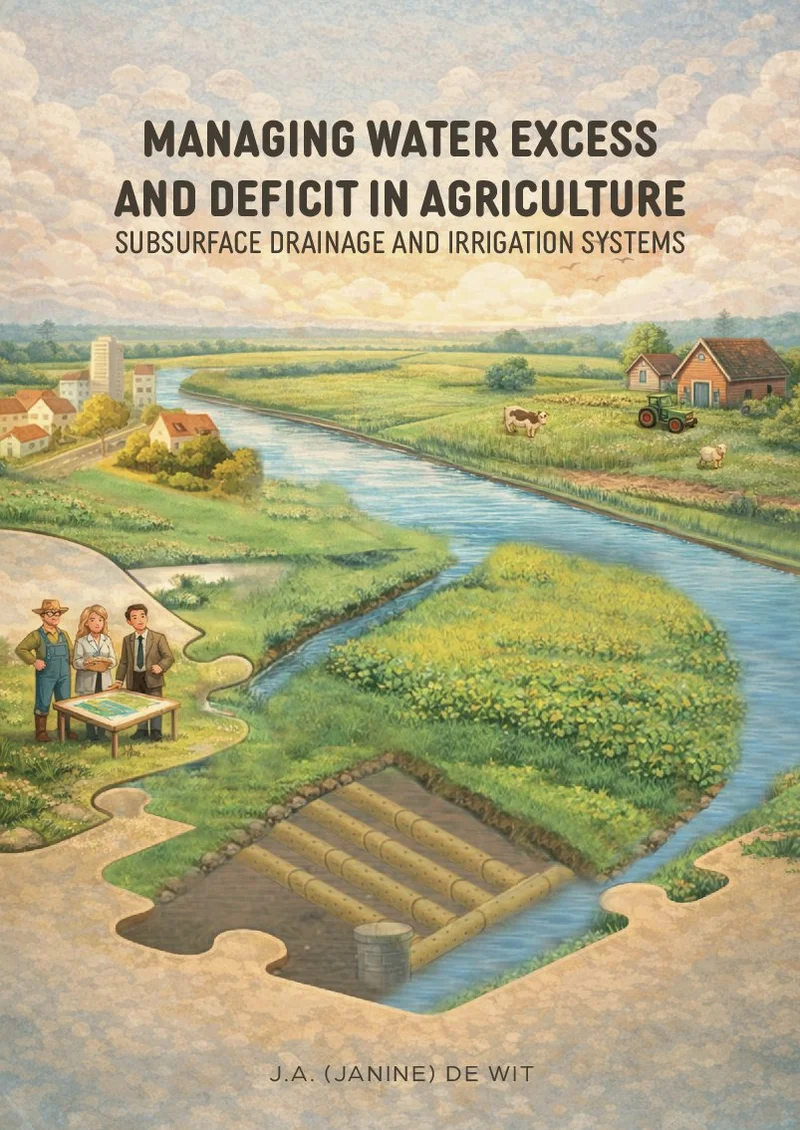
Janine de Wit
Managing water excess and deficit in agriculture
29 mei 2026
Wageningen University
Open Ebook
We print for the following universities