Share this project
Maria Victoria Iriarte Barbosa
Wageningen University
Publication date: 9 juli 2026
University: Wageningen University
ISBN: 978-94-6534-455-3
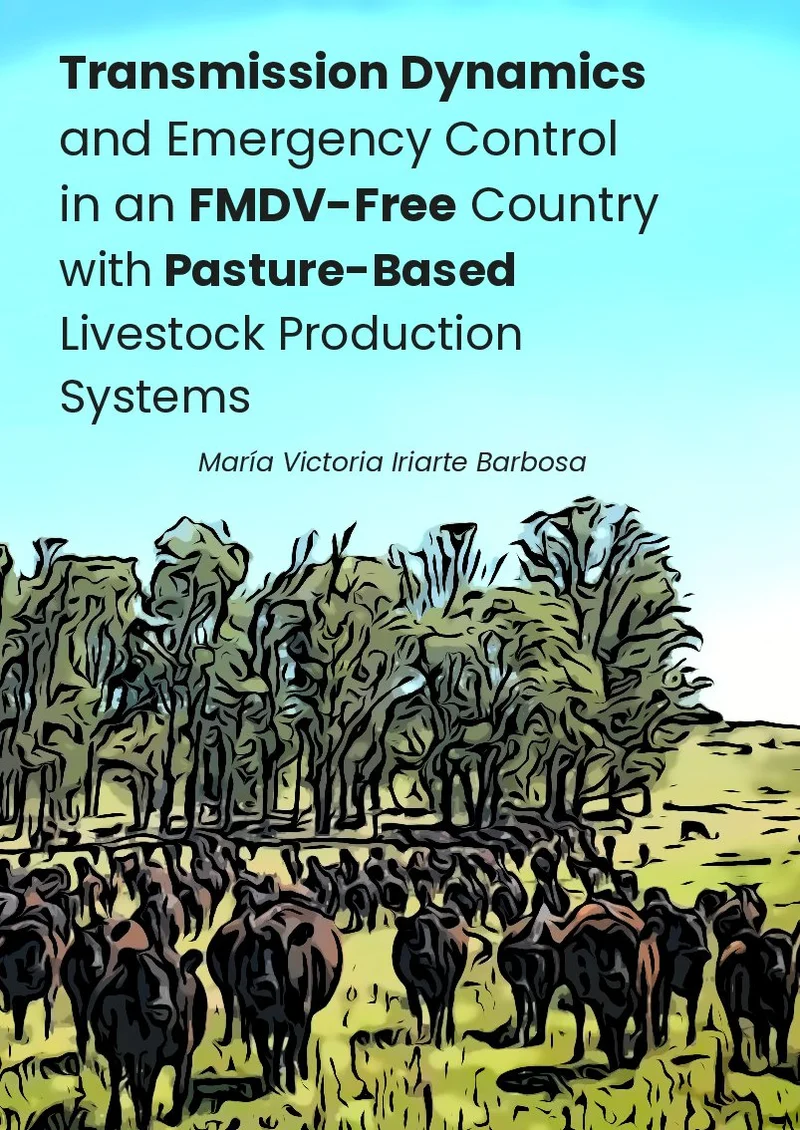
Transmission Dynamics and Emergency Control in an FMDV-Free Country with Pasture-Based Livestock Production Systems
Summary
Foot-and-mouth disease (FMD) remains one of the most economically damaging livestock diseases globally, constraining trade and imposing major control costs. Despite long-standing control efforts and the achievement of FMDV-free status in many regions, recent incursions into previously free countries demonstrate that the risk of introduction persists and that preparedness remains essential. Although extensively studied, important gaps persist in how transmission unfolds in different production systems and how control measures perform under field conditions.
This thesis advanced understanding of foot-and-mouth disease virus (FMDV) transmission following introduction into a previously FMDV-free country, with a focus on between-farm spread in pasture-based livestock systems. Using Uruguay’s 2001 epidemic as a case study, key drivers of transmission were quantified, the contribution of livestock movements during the high-risk period (HRP) was evaluated, between-farm transmission parameters were estimated, and the effectiveness of emergency mass vaccination was assessed when implemented alongside movement restrictions and enhanced biosecurity measures. The resulting estimates support outbreak preparedness modelling and contingency planning in Uruguay and in other regions with similar livestock production systems, and are likely to become increasingly relevant as livestock sustainability goals drive a shift from intensive toward more extensive production systems.
The 2001 Uruguay epidemic occurred when the country was FMDV-free without vaccination. By the time the index case was detected, infection had already spread widely. Because accurate infection timing is central to transmission inference, farm-level infection dates were reconstructed using a within-herd SEIR framework, enabling analyses based on likely introduction dates. Results indicate that when the first outbreak was confirmed, infection had likely already reached over 200 farms distributed nationwide. The spatial pattern of early infections is consistent with a detection delay of at least two weeks and suggests that multiple introductions from Argentina via indirect pathways cannot be excluded. During the HRP, livestock movements, especially through highly connected premises such as markets, enabled long-distance dissemination, limiting the impact of early local control measures.
Between-farm transmission was then quantified using complementary approaches. First, network analysis of animal movements during the HRP showed that movement-mediated transmission alone could sustain spread, estimated at RH = 1.48 for a two-week HRP and RH = 2.16 for a three-week HRP. Second, a spatially explicit kernel-based modelling framework was developed to estimate phase-specific transmission kernels. A pre-vaccination phase capturing the HRP and early response (culling, ban of animal movements), and a post-vaccination phase representing transmission after detection and the establishment of vaccine-derived immunity. Incorporating herd size and species composition into the kernel allowed separation of distance effects from farm-level heterogeneity in infectiousness and susceptibility. In Uruguay’s pasture-based livestock production system, where farms may be farther apart and herd sizes vary markedly, cattle density emerged as a key determinant of transmission potential, and the estimated kernels exhibited a broader spatial scale than those reported for intensive systems.
Farm heterogeneity strongly shaped transmission. Larger farms were more likely to become infected and contributed to onward spread, with herd size showing a stronger effect on infectiousness than on susceptibility, consistent with biological expectations. Species composition also mattered. Transmission during the epidemic was overwhelmingly driven by cattle holdings. Sheep and pig farms were rarely infected, and species-specific kernel terms suggested that sheep and pigs were less infectious and less susceptible than cattle and in this field context, though these estimates are imprecise due to small numbers and should be interpreted cautiously. Together, these findings identify large, cattle farms and highly connected through animal movement as priorities for risk-based surveillance and early detection.
The thesis also evaluates how control measures reduced transmission over time. Uruguay implemented movement restrictions, biosecurity enhancement, initial culling and ring vaccination, followed by emergency mass vaccination of cattle nationwide. Estimation of time-varying Re(t) showed a clear decline after detection and a drop below the epidemic threshold roughly two weeks after mass vaccination began (depending on the assumed generation interval), consistent with control taking effect once vaccination was added to movement bans and biosecurity. Vaccine effectiveness was quantified using field data by estimating the reduction in the between-farm transmission rate (β) after vaccination with commercial bivalent vaccines (A24 cruzeiro y O1 campos). Substantial reductions in transmission were evident within the first week post-vaccination across zones, providing population-level evidence that good quality commercial vaccines, combined with complementary measures, can interrupt between-farm transmission even when high potency vaccines may not be available.
Finally, the estimated kernels were used to compute farm-specific reproduction numbers Rh,i and generate risk maps, and to parameterize a stochastic individual-farm simulation model to compare alternative control strategies. Fourteen scenarios were evaluated, including culling of detected farms only, pre-emptive culling, emergency ring vaccination at different radii with comparisons between cattle-only versus multi-species application, and preventive cattle vaccination targeted by transmission risk (Rh ≥ 0.8) or herd size (farms with >300 and >100 heads of cattle). Results showed that reactive small-radius interventions had limited impact and poor operational efficiency under constrained culling capacity. In contrast, preventive targeted vaccination, especially risk-based targeting of farms with high transmission potential, consistently achieved the largest reductions in epidemic size with much lower operational effort.
Overall, this thesis demonstrates how quantitative epidemiology and the modelling of field data can translate lessons from a major epidemic into evidence-based insights that directly inform outbreak preparedness and response planning. It shows that delayed detection and HRP movements can drive widespread dissemination before control begins. Transmission in pasture-based production systems is shaped by cattle density and by farm-size heterogeneity, with larger cattle farms contributing more to onward spread. Furthermore, emergency vaccination with commercial vaccines can rapidly reduce between-farm transmission when integrated with movement bans and biosecurity measures.
By providing phase-specific transmission estimates, evidence on movement-mediated spread, and field-based estimates of vaccine effectiveness, this work strengthens the empirical basis for risk-based surveillance, outbreak-response modelling, and contingency planning for future FMD incursions in Uruguay and comparable settings.
See also these dissertations

Luan Moreira Grilo
From Furan-Based Cyclobutane to Diels–Alder Networks
30 juni 2026
Rijksuniversiteit Groningen
Open Ebook
Morwarid Mayar
Bridging the gap between in vitro and in vivo
14 mei 2024
Wageningen University
Open Ebook

We print for the following universities