Morwarid Mayar
Bridging the gap between in vitro and in vivo
14 mei 2024
Wageningen University
Open Ebook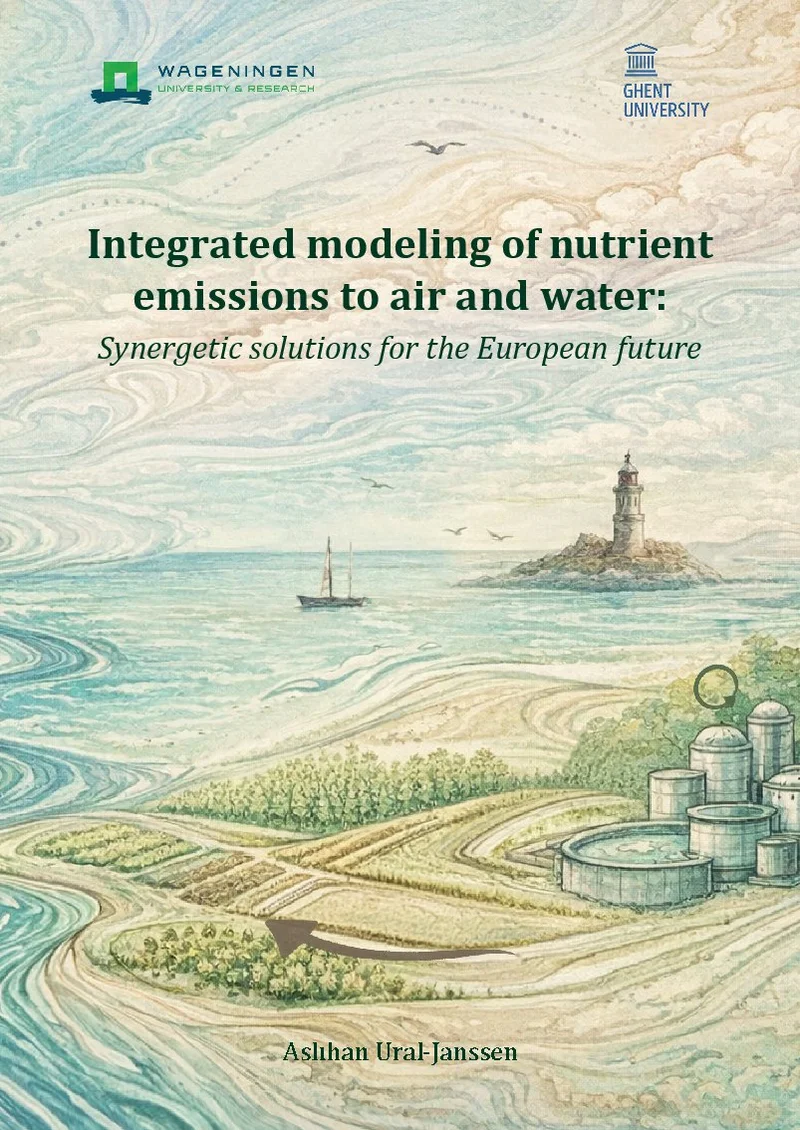
Share this project
Summary
Intensive agriculture and urbanization are important sources of nutrient emissions to the air and surface waters (rivers and coastal waters) in Europe. Elevated levels of nitrogen (N) and phosphorus (P) emissions can cause impacts on human health and the environment. Integrated nutrient assessments of both air and surface waters are, so far, limited, especially on the basin scale for the European Union (EU) and the United Kingdom (UK). This hinders a better understanding of air and water pollution hotspots, their causes and future trends. As a result, it is not easy to identify basin-specific required reductions to avoid future pollution. Integrated models are needed to fulfill these knowledge gaps, but hardly exist for both air and surface water pollution assessments for the EU basins and the UK.
Despite the progress of the EU policies, nutrient management strategies to reduce both air and water pollution simultaneously are needed. However, their effects have not been explored for European basins and future years while considering socioeconomic developments and climate change (global change drivers). Increasing population and demand for agricultural productivity urge the renewable alternatives such as bio-based fertilizers (BBFs) to replace nonrenewable synthetic fertilizers. BBFs could potentially reduce nutrient pollution through nutrient recovery from animal manure and municipal sewage sludge. However, the environmental effects of BBFs are often analyzed at small scales and for either air or water pollution. Additionally, the combination of BBFs with other nutrient management strategies to reduce air and water pollution is poorly understood at the EU level under global change. Consequently, there is a lack of a comprehensive policy for the adoption and implementation of these BBF products in the EU and the UK.
The main objective of this PhD thesis is, therefore, to enhance our understanding of basin-specific nutrient emissions to the air and surface waters, and explore the role of BBFs and other nutrient management strategies to reduce future nutrient pollution under global change across the EU and the UK.
To this end, three research sub-objectives (SO) are achieved:
• SO1: To quantify the contribution of agricultural activities to air, river and coastal water pollution simultaneously with a focus on nutrients in European basins (Chapter 2);
• SO2: To assess the future river exports of N and P, and identify required reductions to avoid coastal eutrophication in Europe under global change (Chapter 3);
• SO3: To quantify the effects of using recovered N from manure processing and recovered P from treated sewage sludge, increasing N and P use efficiencies in agriculture, and improving sewage treatments on reducing future nutrient emissions to the air, and losses to rivers and coastal waters of Europe (Chapter 4).
This PhD thesis contains five chapters. Chapter 1 justifies the research objectives. Chapter 2 provides model development for the recent past (SO1). Chapters 3 and 4 focus on model applications for future under socioeconomic developments and climate change (SO2) and under different scenarios including BBFs and other nutrient management strategies (SO3). Chapter 5 provides the synthesis of research outcomes and their discussion, followed by a future outlook. Below, I summarize the research carried out for Chapters 2-4.
Chapter 2 (SO1) presents the newly developed MARINA-Nutrients model for Europe, which is short for Models to Assess River Inputs of pollutaNts to seAs for Nutrients. The model quantifies the annual N emissions to the air from agricultural activities, inputs of N and P to rivers, and their exports to coastal waters from point and diffuse sources. Diffuse sources include the application of synthetic fertilizers and animal manure on agricultural land, biological N2 fixation by vegetation and atmospheric N deposition on land, leaching of organic matter and weathering of P-contained minerals. Point sources are sewage systems. The model is applied for 601 (sub)basins in 2017-2020. New modeling insights reveal that almost two-fifths of reactive N emissions to the air from agriculture are from animal housing and storage. Agriculture –mainly the application of synthetic fertilizers and manure– and sewage systems are responsible for 55% of N and 67% of P in rivers, respectively, at the EU level. Nearly a third of the European basin area is pollution hotspots (air, water, or both), producing over half of N emissions to the air and nutrient pollution in rivers. Moreover, 59% of the total population in the study area lives in those hotspots. Such hotspots are basins where total N emission to the air and nutrient inputs to rivers exceed the 80th percentile (the top 20%).
Chapter 3 (SO2) provides the required reductions for future river exports of nutrients to avoid coastal eutrophication in 2050. To this end, a future baseline scenario is developed and a backcasting approach is applied. A future baseline scenario combines the storylines of the existing Shared Socio-economic Pathway 5 (fossil-fuel-based) and Representative Concentrative Pathways 8.6 (high-end climate change) and is executed by the MARINA-Nutrients model from Chapter 2. A backcasting approach establishes a target for low eutrophication using an Indicator for Coastal Eutrophication Potential (ICEP). New insights reveal that nutrient export to European seas is expected to increase by 13-28% in 2050 relative to the period of 2017-2020. Manure and fertilizers are projected to contribute to future N export by rivers by 35%, while the remainder is mainly from sewage systems (22%), atmospheric N deposition over agricultural areas (14%), and leaching of organic matter (10%) from agricultural areas. Sewage systems are projected to be responsible for 70% of future P export by rivers. Avoiding future coastal eutrophication requires over 47% less N and up to 77% less P exports individually by the top ten polluted rivers in 2050 relative to the period of 2017-2020. The basins of these polluted rivers are expected to host 42% of the population in 2050, which potentially might be affected by coastal eutrophication.
Chapter 4 (SO3) provides novel insights into the effects of BBFs on reducing future nutrient emissions to the air and surface waters across the EU and the UK in combination with other nutrient management strategies. The BBFs considered are REcovered Nitrogen from manURE (ReNuRe) and Recovered P from treated Sewage Sludge (RPSS). Six scenarios are developed for 2050 and include the use of BBFs alone and in combination with increased nutrient use efficiencies in agriculture and improved sewage treatments. These new scenarios are executed by the updated MARINA-Nutrients for Europe for the year 2050. New insights reveal that adopting ReNuRe products with increased N use efficiency is found to be a synergistic option to reduce N emissions to the air (30%), and N inputs to rivers (23%) and N export by rivers to coastal waters (20%) of Europe in 2050 compared to the future baseline scenario (taken from Chapter 3). By combining the use of RPSS, increased P use efficiency and enhanced sewage treatment, 68% less P inputs to rivers and 62% less P export by rivers to coastal waters are projected relative to the future baseline in 2050. Results show that the RPSS alone can fulfill the P fertilizer needs of the EU and the UK by 2050.
Chapter 5 provides the synthesis of the research outcomes and discusses them in terms of the strengths (S), weaknesses (W), opportunities (O) and threats (T) using the SWOT approach. Strengths include a novel integrated nutrient model for both air and surface waters, building trust approaches, and different scenario types (predictive, explorative, and normative). The main weaknesses of this research are related to the hotspot definition, a steady-state modeling approach and missing (local) sources, and missing other BBF types. Despite these weaknesses, the thesis offers opportunities for more in-depth analysis of future trends in air and water pollution. These opportunities lie in a soft-coupling design of the MARINA-Nutrients to facilitate model development, its uncalibrated approach that offers the flexibility for scenario development, and interactions between BBFs and other nutrient management strategies to support future pollution control. The thesis has threats that are related to uncertainty along the modeling chain, potential trade-offs, and policy associated barriers for implementing BBFs. Building on these reflections, the main perspectives on BBFs and their role in air and water pollution (reduction) are discussed by synthesizing the existing knowledge and the results of this thesis. These perspectives are associated with the environmental, agronomic, technological, policy and socioeconomic aspects. Additionally, effective implementation and adoption of BBFs across scales requires the integration of the aforementioned aspects. Thus, a future outlook should build on the modeling tool, scientific insights, and solutions of this thesis to further explore not only BBFs but also other strategies to reduce air and water pollution simultaneously.
To conclude, this PhD thesis shows that nutrient pollution in the EU and the UK basins is expected to increase in the future. As a result, considerable amounts of N and P emissions should be reduced. However, synergetic solutions exist for reducing nutrient emissions to both air and surface waters and avoiding future coastal eutrophication in EU seas. BBFs offer a promising strategy and their reduction potential is often undervalued. The thesis highlights that BBFs are effective in pollution reduction when they are combined with higher nutrient use efficiencies and improved wastewater treatment. This all opens opportunities to support the EU environmental ambitions as well as the sustainable development goals for good air quality and clean water.