Katja Hol
Holistic Integration of Desktop Virtual Reality Technology in Higher Education
18 juni 2026
Open Universiteit
Open Ebook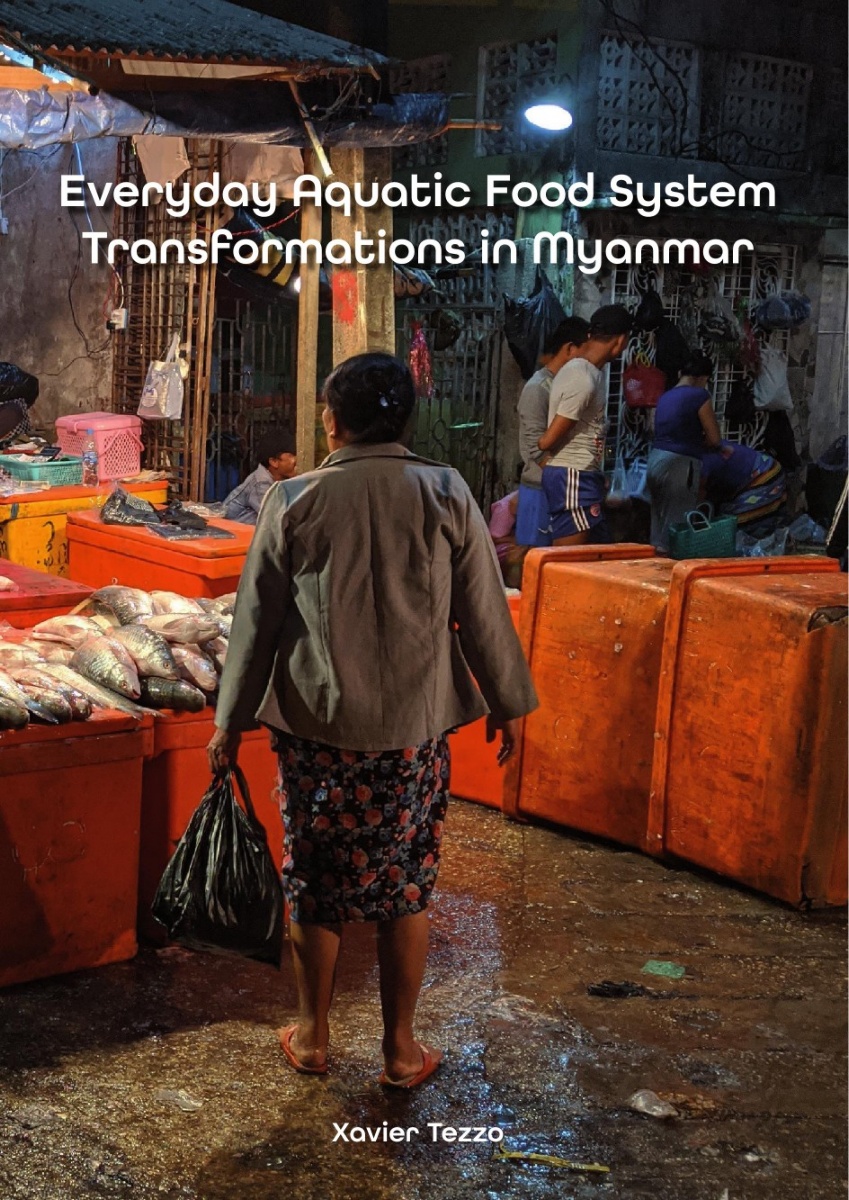
Share this project
Summary
Current approaches to understanding transformations in food systems have generally focused on particular processes or actors within food systems – so for instance, the role of traders, suppliers, or competitive processes of innovation – rather than understanding how system change is structured and ultimately changed through the everyday routinised practices and relations between those that constitute food systems. When it comes to aquatic food systems, most of the emphasis has been on the technological shift in production, that is, the intensification and expansion of aquaculture. In view of these limitations, this thesis set out to advance a sociological understanding of food system transformations by considering and interrelating routinized practices through which aquatic foods are consumed, distributed, and produced in everyday Myanmar.
This geography, I argue, offers two significant advantages for this endeavour. First, aquatic foods are ubiquitous with routinized doing and saying associated with consuming, trading, and producing them. And second, the country is subject to major societal transformations, making it an ideal geography to study food system transformations in relation to these. The research question that guides this thesis is as follows: What is the contribution of a social practices perspective on consumption, trade and production to a systemic understanding of aquatic food transformations? This research question is further broken down into two sub questions that are addressed across the four core Chapters of this thesis (i.e. Chapters 2, 3, 4, and 5). These two sub questions are as follows: (1) How are transformative processes in aquatic food systems both characterised and affected by the everyday realities of their social actors? and (2) In what ways do fish consumption and trade practices affect systemic transformations of aquatic food production? In addressing these questions, the combined results of these Chapters show a fundamentally new way of apprehending food system transformations as fundamentally social – that is, related to the meanings, competences and materialities that shape routinised ways of being, doing and saying in everyday life. In doing so, these Chapters challenge the conventional wisdoms associated with the aquaculture transition, the productivist transition that has largely influenced the ways in which aquatic food systems are imagined, understood, and ultimately governed.
Chapter 2 sets the stage by introducing the aquatic food system conceptual framework that effectively structures the whole thesis. This Chapter reviews development research and policies surrounding Southeast Asian freshwaters to identify and reflect on the main assumptions underpinning the governance of aquatic food systems in the region. This analysis -and notably unpacking the productivist wild-farmed binary- lays important foundations for the remainder of this research. It analyses the interrelationships between the production, provisioning, and consumption of wild and farmed fish, making visible gaps and weakness while at the same time demonstrating the emergence of a systemic thinking in this literature. Drawing from the aquatic food system framework introduced in this Chapter, the subsequent core Chapters each deal with a constitutive part of Myanmar aquatic food system.
Chapter 3 starts with a reassessment of fish consumption against the backdrop of the aquaculture transition by looking at the case of urban migrants in Yangon, the economic capital of Myanmar. Drawing on a social practices lens, this Chapter analyses how everyday fish consumption practices change as people move from the rural Ayeyarwady Delta to Yangon city. In doing so, it demonstrates how the reconfigurations of fish consumption practices are shaped by new routines in urban areas and the transition from capture fisheries to aquaculture. The analysis illustrates the value of using a social practices lens to integrate micro- and meso-scale transformative processes to understand dietary change by examining how rural-urban migration influence the sourcing, cooking, and eating of wild and farmed fish.
In the same vein, Chapter 4 then explores the aquaculture transition from the perspective of trade, by investigating the case of San Pya, the largest fish wholesale market in Myanmar. This Chapter also draws from a practice-based analysis to explore how wholesale markets, wholesalers, and processors effectively shape aquatic food systems transformations. In this Chapter, the social practices perspective is contrasted with conventional approaches where food provisioning is mostly understood under the prism of value chains. The comparison demonstrates the more complex and nuanced understandings that is allowed by the recognition of integrative practices relating to quality, trust, and risk. These, it is argued, make it possible to appreciate not only how fish trade is shaped by but also how it does shape aquatic food system transformations.
Chapter 5 then brings back the reflection onto production. It builds on a critical analysis of development interventions implemented in the Ayeyarwady Delta, the most important fish production landscape in Myanmar. By elaborating the key processes shaping and linking fish production, distribution, and consumption, this Chapter critically reflects on fisheries and aquaculture development projects in that geography. Based on this reflection, it is argued that dropping the wild-farmed binary from development thinking and replacing it with a singular understanding of food fish can fundamentally change the way we understand and govern aquatic food production landscapes.
Finally, the concluding Chapter of this thesis draws conclusions related to the core and sub questions of this thesis. It presents and reflects on the main research findings on Myanmar aquatic food system before proposing a conceptual framework capable of grasping socially mediated processes of change in food systems. The latter draws from a combination of food systems and social practices theories and brings the analytical emphasis onto three co-constitutive and sociological dimensions of food system change, namely: (1) Food practices as the foundational unit of food systems; (2) The systemic relations between food system practices; and (3) The dynamic embedding of food system practices. Based on the analysis of aquatic food systems transformations in Myanmar and the proposed conceptual framework, the thesis concludes by discussing its main implications for governance and future research.
Overall, this thesis argues that (aquatic) food systems are in fact dynamic, interconnected social systems, and that their transformative processes are best understood by characterizing the effective relations among consumption trade, and production practices and their embeddedness in everyday life. Such theorisation, it is argued, open up new ways not only for understanding food systems transformations, but also for steering them towards the realization of wider normative ambitions such as food and nutrition security, social equity, and environmental sustainability.
About the author
Xavier was born in 1985 in Abidjan, Ivory Coast from a Belgian mother and a Congolese father. With both of his parents working in development cooperation, Xavier spent his entire childhood in Africa, alternating between the Democratic Republic of Congo, Rwanda, Benin and Ivory Coast. After these formative years, Xavier went back to Belgium where he completed a MSc in Bioengineering from Université Libre de Bruxelles (ULB) during which he specialized in aquatic ecosystem modelling, followed by a MSc in Microfinance from Solvay Brussels Schools of Economics and Management (SBS-EM) where he studied the empowerment of fisheries communities through cooperatives in Senegal.
After his studies, Xavier worked for over 10 years in the field of fisheries and aquaculture development projects across Africa (Belgian Development Agency) and Southeast Asia (Food and Agricultural Organization, and then WorldFish). It is in 2016, during his experience as a Research Program Coordinator for WorldFish Myanmar that he started this thesis with the Environmental Policy Group (ENP) at Wageningen University as a sandwich candidate. As such, his research took as its starting point and drew on his development work with fisheries and aquaculture in Myanmar.
Xavier continued working throughout his PhD, first with WorldFish where it all began. In 2021, he joined the ENP as a researcher where he assisted the cross-country learning of the CGIAR-funded ‘Food Systems for Healthier Diets’ (FSHD/A4NH) research program and supported the completion of the NWO-funded ‘Supermarket supported area-based management and certification of aquaculture in Southeast Asia’ (SUPERSEAS) project. As of 2023, Xavier is employed as an Agriculture and Food Systems Expert by the Belgian Development Agency (Enabel) where he formulates and coordinates development interventions over sub-Saharan Africa, with a particular focus on the African Great Lakes Region.
The research described in this thesis was financially supported by Netherlands Organisation for Scientific Research (NWO). Financial support from Wageningen University for printing this thesis is gratefully acknowledged. Cover: A retailer browses through the stalls of San Pya fish wholesale market in Yangon at dawn, photography by Xavier Tezzo, January 2020. Printed by ProefschriftMaken on FSC-certified paper.
Everyday Aquatic Food System Transformations in Myanmar
Xavier Tezzo

Alessio Belmondo Bianchi di Lavagna