Deel dit project
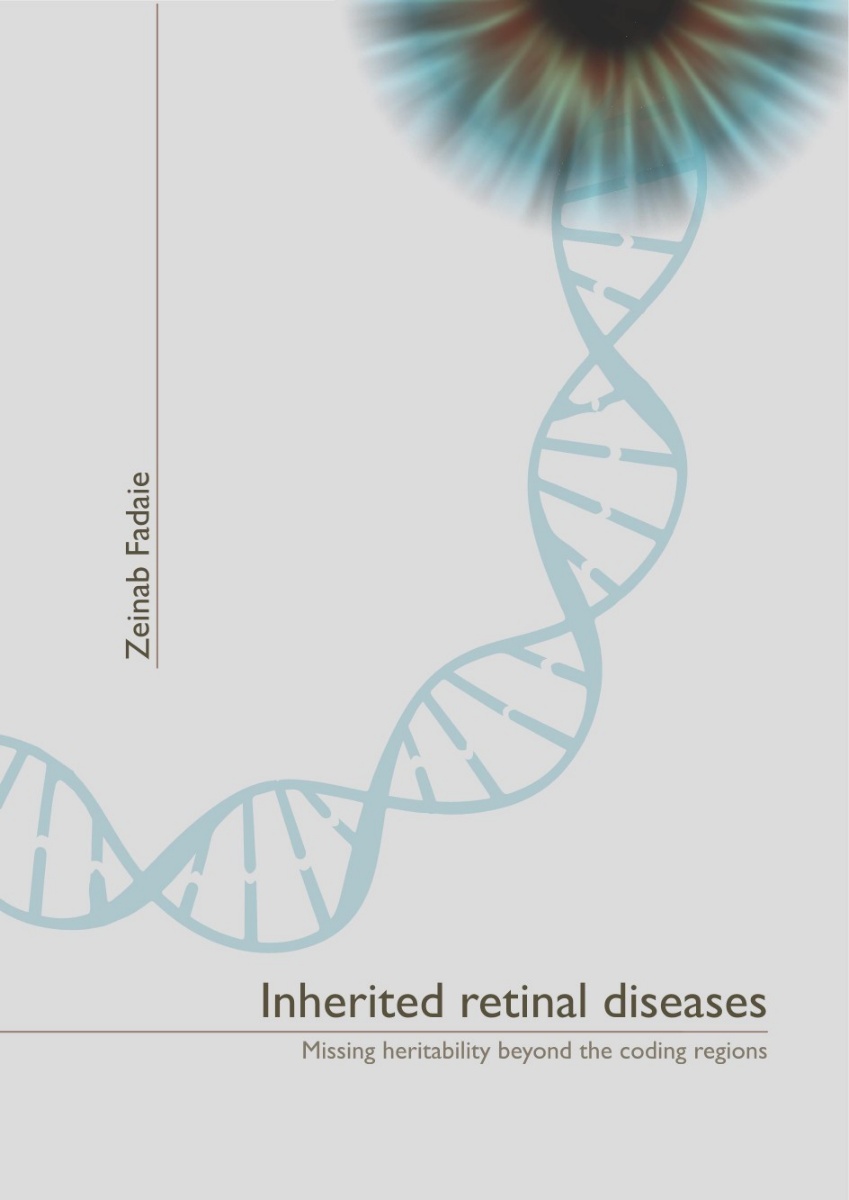
Zeinab Fadaie
Radboud Universiteit
Publicatiedatum: 18 november 2021
Universiteit: Radboud Universiteit
ISBN: 978-94-6423-432-9
Inherited retinal diseases
Samenvatting
Inherited retinal diseases (IRDs) are a group of rare genetic disorders that show a high degree of clinical and genetical heterogeneity and together account for ~2 million affected individuals worldwide. In recent years, with the introduction of new sequencing technologies, novel disease-associated genes and many pathogenic variants have been identified. However, much remains to be elucidated about these genetic diseases with regard to the molecular pathogenesis, the missing heritability and large variation in clinical presentation. This knowledge is important for an accurate counselling of patients and their families for their disease progression, and potential family planning. Moreover, an increase of knowledge and novel insights will create a window of opportunity for the development and implementation of therapeutic approaches. The aim of this thesis was to utilize different state-of-art technologies to provide a molecular diagnosis for different cases with an IRD. We employed several genotyping methods such as whole exome sequencing (WES), whole genome sequencing (WGS), Bionano optical genome mapping, and PacBio ‘single molecule real-time’ sequencing to detect single nucleotide variants as well as structural variants (SVs). Special attention was given to the functional characterization of non-coding variants, in particular those that are predicted to affect the splicing process. In vitro midigene splice assays were carried out in HEK293T cells to identify the splice defects. This combination of extensive genotyping and functional analyses allowed us to provide a genetic diagnosis for a portion of unsolved cases.
Chapter 1 provides a general introduction and is subdivided into three sections. Chapter 1.1 describes the background on visual perception, the structure of the eye and retina, the basics of retinal imaging and other clinical functional assessment technologies. Chapter 1.2 focuses on the genetics of IRDs by describing different molecular diagnostic approaches from coding to non-coding DNA sequencing methods. Additionally, it emphasizes the importance of different databases which are essential for variant classification as well as sharing information of newly identified variants. Chapter 1.3 describes the aim and outline of this thesis.
Chapter 2 discusses a comprehensive guideline of different technologies that were applied from the early 90s until now in IRD and hearing loss research to identify novel disease-associated genes and/or provide a definitive molecular diagnosis. Special attention was given to the third-generation sequencing technologies and their impact on the genetic diagnostic success rate for these two inherited sensory diseases. Moreover, the challenges and importance of variant interpretation in the clinical application were discussed. Finally, the future perspective on the application of optical genome mapping and multi-omics approaches were described as novel methodologies to increase the genetic diagnostic success rate in IRDs and inherited hearing loss.
In Chapter 3, we provide details of four studies that describe the functional analysis of non-coding variants in patients suffering from different IRDs. Chapter 3.1 describes the in vitro functional analysis of 19 non-coding variants in ABCA4 implicated in Stargardt disease. Three novel and 16 previously published rare non-canonical splice site and deep-intronic ABCA4 variants were selected upon splice site predictions, i.e. the disruption of canonical splice sites of ABCA4 exons or the activation of cryptic splice sites in intronic sequence (i.e. pseudoexon insertion), as well as the assessment of conserved motifs such as exonic splice enhancers and silencers. We demonstrate the importance of splice site sequences and conserved motifs when selecting the candidate variants. Chapter 3.2 describes the identification of a near-exon aberrant RNA splice site variant (c.718+23G>A) that is present outside the consensus splice site sequence in TULP1. The variant was identified by WES in two siblings with early-onset retinitis pigmentosa in whom the first pathogenic missense variant in TULP1 was previously found. The c.718+23G>A variant does not have a significant effect on the splice donor site of exon 7. However, it disturbs the balance between the enhancer and silencer motifs in this position and thus leads to a splice defect. This chapter highlights the important role of conserved motifs in the splicing processes. The emphasis of Chapter 3.3 is on the effect of variants in cis in the resulting protein function. We described two unrelated families with adult-onset vitelliform macula dystrophy carrying a complex allele in IMPG2 (c.[3023-15T>A,3023G>A]) upon analysis of WES data. The c.3023G>A variant is not only a putative pathogenic missense mutation by itself but acts as a modifier element for c.3023-15T>A as well by enhancing its splice defect. In both families, individuals carrying this complex allele in a heterozygous manner did not always develop macular dystrophy which highlights the importance of other genetic and environmental factors that contribute to this disease. Chapter 3.4 sheds light on the pathogenic role of a branchpoint variant (c.592-21A>T) in BBS1 in four unrelated families with non-syndromic retinitis pigmentosa, who carried c.1169T>G, the most frequent variant in BBS1, in the other allele. The branchpoint variant was identified through WGS analysis and its complex splice defect was revealed using in vitro midigene splice assays. This chapter characterizes the first pathogenic branchpoint variant reported in IRDs.
Chapter 4 describes a comprehensive study in which 100 individuals with different IRDs were assessed using WGS-based sequence analysis. The probands were previously screened by WES or targeted sequencing approaches and were genetically unsolved. The WGS analysis was performed with special attention to the non-coding variants and the putative causal variants were investigated by in vitro functional assays to prove the pathogenicity. We provide a molecular diagnosis for 27% of the pre-screened cases and suggest employing improved sequencing technologies and variant interpretation to increase the diagnostics yield for IRDs.
Chapter 5 illustrates the implementation of a novel strategy for identification of the genetic defect in IRDs with a strong genotype-phenotype correlation. In a family with choroideremia, previous RNA analysis of an affected proband showed CHM exon 12 skipping, but the underlying DNA defect remained elusive for 18 years. Using optical genome mapping and long-read WGS, an inverted duplication in CHM was identified. We provided a model that demonstrates the origin of the SV through fork stalling and a template switching/microhomology-mediated break-induced replication mechanism. Additionally, we speculated on the mechanism of the splice defect and proposed an altered RNA secondary structure that disrupted the splicing of exon 12. This chapter emphasizes the great opportunities of optical genome mapping and long-read WGS to unravel the hidden SVs in unsolved cases as well as the underappreciated role of an altered RNA secondary structure as a disease mechanism.
Finally, Chapter 6 provides a general discussion of the main findings in this thesis and their implications towards an improved diagnosis of IRDs. The application of different sequencing technologies and their advantages and disadvantages are explained. The importance of branchpoint variants, complex alleles, and variants which affect the RNA secondary structure were discussed. Additionally, the need of accurate splicing tools was explained by comparing different prediction algorithms and highlighting their importance in in vitro functional splice assays. Finally, potential reasons for missing pathogenic variants in the studied cohort were discussed, and it was postulated that application of long-read sequencing will be an important technology in the future of IRDs and other genetic conditions. Moreover, the different cellular systems for in vitro functional analysis can shed light on the currently missed causes of IRDs in the future.
Bekijk ook deze proefschriften



Abbey Leigh Marcotte
From the ashes: Hydrological and biogeochemical responses to wildfire in temperate peatlands
26 mei 2025
Wageningen University
Open Ebook
Achmad Fadillah
Milk Quality and Mastitis Control Strategies in Indonesian Smallholder Dairy Farms: An Integrated Epidemiological and Economic Analysis
9 april 2025
Wageningen University
Open Ebook
Theodore Paul Van Iersel
PATIENT CENTERED MANAGEMENT OF ANTERIOR SHOULDER INSTABILITY
27 maart 2025
Vrije Universiteit Amsterdam
Open Ebook
Samara Rosendo Machado
TRANSCRIPTIONAL REGULATION OF HOST RESPONSES TO VIRUS INFECTION IN AEDES AEGYPTI MOSQUITOES
27 november 2023
Radboud Universiteit
Open Ebook
Xiaomei Yue
Economic and production effects of bovine viral diarrhoea
30 juni 2022
Wageningen University
Open Ebook
Aafke Duizendstra
Rejection and Tolerance after Liver Transplantation
7 december 2021
Erasmus Universiteit Rotterdam
Open EbookWij drukken voor de volgende universiteiten