Fabio Gatti
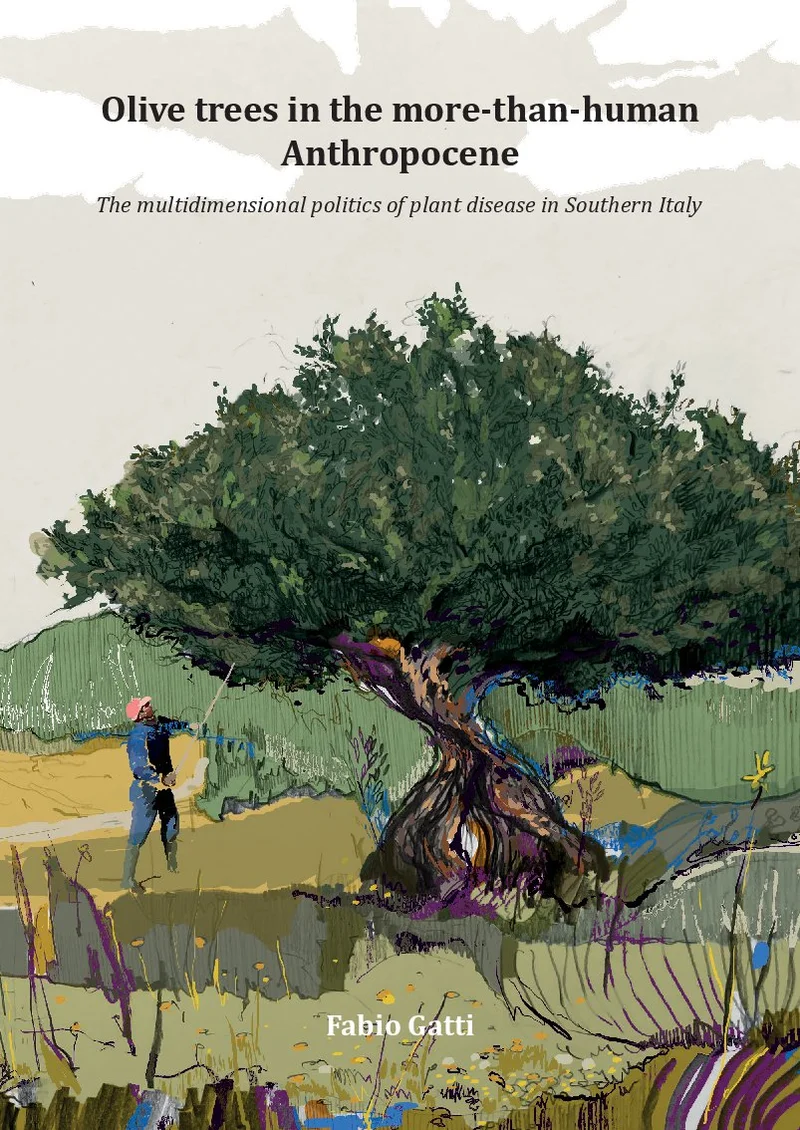


Olive trees in the more-than-human Anthropocene
This dissertation examines the conflict over the management of the Olive Quick Decline Syndrome (OQDS) in Apulia, southern Italy—a phytosanitary crisis that began after the detection of the bacterium Xylella fastidiosa subsp. pauca in the region in 2013. In little more than a decade, the epidemic has transformed one of the Mediterranean’s most iconic agricultural landscapes, affecting an estimated 21 million olive trees and placing centuries-old groves, rural livelihoods, and cultural identities under severe strain. The central question guiding the thesis is: how is the conflict over X. fastidiosa management in Apulia constituted as a multidimensional political problem, and how do its economic, ecological, epistemological, and ontological dimensions interact to shape its emergence and evolution? This question is unpacked through four interrelated sub-questions, each addressed in one of the empirical chapters: What are the historical and socio-ecological causes of OQDS? How has knowledge of the disease been constructed, and who has been granted authority to inform policy? To what extent can the conflict be understood as an ontological conflict? And to what extent do economic conditions and rural development policies shape the range of possible responses? Rather than adding another single-dimensional analysis to the growing social science literature on X. fastidiosa in Apulia, this thesis advances a different proposition: that political economy, political ecology, political epistemology, and political ontology are four analytically distinct yet empirically inseparable dimensions of the politics of plant disease in the more-than-human Anthropocene. Its overarching ambition is to show that the analytical force of each dimension is greatest when all four are brought together, rather than when they are treated as competing theoretical lenses. Theoretically, the thesis situates itself within the framework of the more-than- human Anthropocene. This framework draws attention to organisms, ecological processes, and material entities that escape human control and proliferate in unexpected ways, yet remain deeply shaped by human infrastructures and forms of landscape reordering. Xylella fastidiosa is understood in these terms as a feral proliferation: introduced into Europe through the global ornamental plant trade, it encountered in Apulia a landscape that centuries of monocultural olive production had rendered highly vulnerable to its spread. Methodologically, the research draws on more than five years of multispecies autoethnography in Apulia, combining over 40 semi-structured and informal interviews with farmers, plant scientists, agronomists, policymakers, and activists; extensive participant observation in olive groves, during harvests, at public meetings, and in scientific forums; and analysis of policy documents, court records, scientific publications, and media materials. Moreover, the author's biographical entanglement with Apulian olive landscapes—including direct involvement in farming on the family smallholding—informs the methodological orientation, serving as an analytically productive resource that enables forms of situated knowledge unavailable from more detached positions. Chapter 2 develops a historical-material account of the causes of the OQDS epidemic. In contrast to framings that treat the disease as an exogenous biological event, the chapter argues that the epidemic must be understood as an emergent outcome of historically produced socio-ecological conditions. It develops the notion of “plant disease detonators”: specific historical-material conjunctures that built momentum toward a phytopathological tipping point. Four detonators are identified—the plantation system, the lamp oil economy, globalization, and rural abandonment—which together show that the epidemic did not begin with the bacterium's arrival but with the long agrarian history that produced the landscape conditions in which X. fastidiosa could proliferate so rapidly and with such consequences. Chapter 3 examines how knowledge of OQDS has been produced, validated, and contested. Against the dominant representation of the controversy as a clash between science and science denialism, the chapter demonstrates that what unfolded in Apulia is better understood as a conflict involving multiple, interacting layers of knowledge politics cutting across heterogeneous social groups. It maps five distinct epistemic domains of contestation—conflict over causality, naming, and framing; boundary work between scientific and lay knowledge holders; intra-scientific disagreement; differentiation among farmers; and the institutional politics of scientific knowledge production—and argues that the case reveals not a homogeneous “science” confronting a homogeneous public, but a multiplicity of epistemic communities engaged in ongoing struggles for authority across disciplinary and institutional domains. Chapter 4 argues that the conflict is not only a dispute over facts or interests but also an ontological one—a struggle over what the entities at stake fundamentally are. Drawing on Annemarie Mol's concept of ontological politics and debates in political ontology, the chapter identifies three ontologies of the olive tree (relational being, productive asset, and landscape element) and three ontologies of disease (pathogenic invasion, socio-ecological syndrome, and political construct). It advances a non- relativist account of ontological pluralism, arguing that governance that recognizes only a single ontology—treating olive trees solely as productive assets and the disease solely as a pathogenic invasion—forecloses important dimensions of what is at stake and deepens rather than resolves the conflict. Chapter 5 examines the political economy of the crisis, showing how structural economic conditions determine which epidemic responses are materially possible and for whom. The chapter introduces the concept of a “conservation dilemma” to capture the structural tension between preserving olive farming as an economically viable sector and conserving olive trees as elements of biocultural landscapes. It analyzes three response pathways—restructuring for competitiveness, reshaping for preservation, and re-caring for coexistence—and shows that each is unevenly accessible, producing what the thesis terms a “class differentiation of care”: the concentration of landscape stewardship capacity among affluent actors, away from smallholders dependent on olive farming for their livelihoods. The general discussion synthesizes the four empirical chapters into an overarching analytical framework—the “4Ps”—that articulates political economy, political ecology, political epistemology, and political ontology as co-present and mutually constitutive dimensions of socio-environmental conflict. The thesis concludes by proposing an outline for a political agroecology of plant disease: an approach that takes the pathogen's biological reality seriously while acknowledging the ecological relations through which disease emerges, the agrarian conditions that shape farmers' capacities to respond, the politics of knowledge through which expertise is produced and contested, and the different ways olive trees are valued and cared for. Whether Apulian olive trees can be saved is ultimately less a technical question than a political one—about which agricultural futures and which infrastructures of care societies are willing to collectively sustain.
| Publicatiedatum | 7 oktober 2026 |
| Universiteit | Wageningen University |
| Auteur | Fabio Gatti |
| DOI nummer | 10.18174/681633 |