Eun-young You
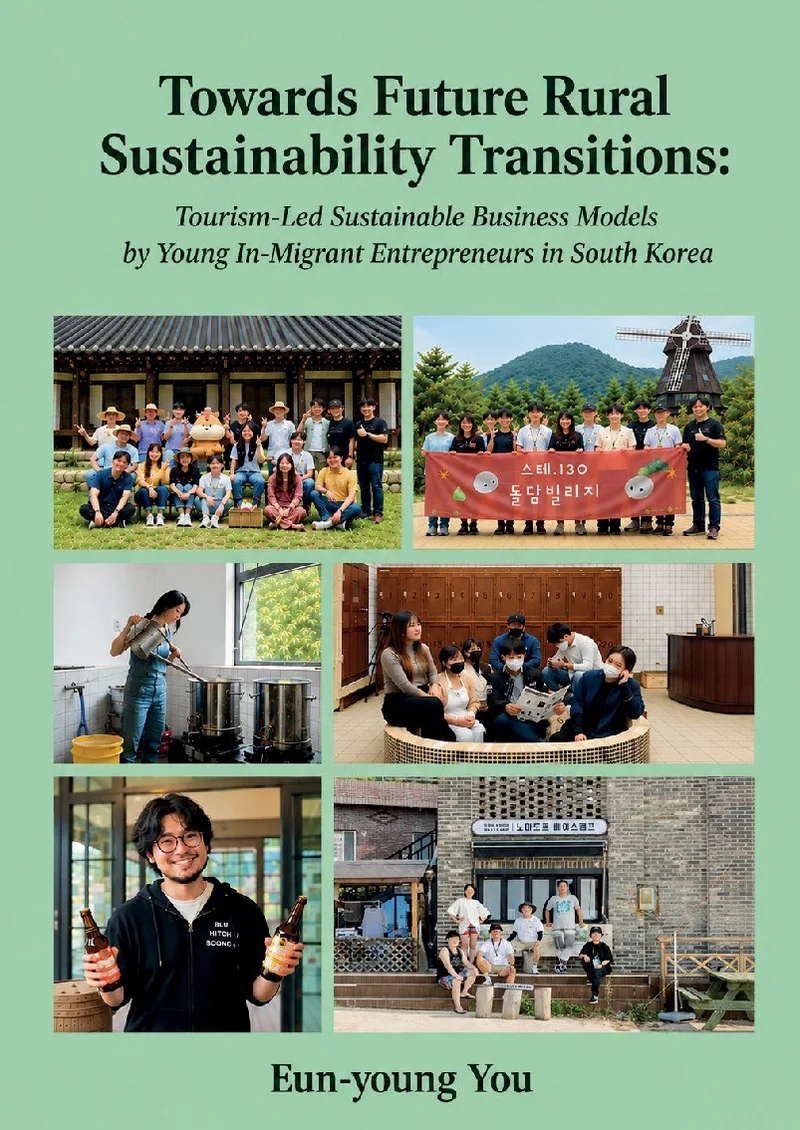


Towards Future Rural Sustainability Transitions
In response to the challenges of rural decline amid ongoing rural transformations, there has been increasing global debate on the future direction of rural revitalization. In this context, tourism has gained growing attention, as it can both address the demand for rural multifunctionality and serve as a potential driver of rural sustainability transitions. Against this backdrop, this study focuses on young in-migrant entrepreneurs (YMEs), who are considered to have significant potential to contribute to sustainable rural development through tourism, particularly in the context of labor shortages in rural areas. The emergence of YMEs in South Korea provides a valuable empirical opportunity. Accordingly, by examining YMEs in the South Korean rural tourism context, this research explores the dynamic and complex processes through which YMEs relocate to rural areas to realise their personal and entrepreneurial aspirations, establish tourism ventures, navigate local challenges, become embedded in rural communities, and ultimately contribute to sustainable rural development. In doing so, the study demonstrates how the pursuit of young in-migrant entrepreneurs' aspirations can generate pathways towards tourism-led rural sustainability transitions, while generating both theoretical and practical implications in a broader global context. Chapter 1 introduces the research by outlining the motivation behind the study, particularly the emergence of YMEs in South Korea and the need for a deeper understanding of their role in rural transformations. It situates the research within both global and South Korean contexts, emphasizing the need to connect discussions on rural tourism, young in-migration, and rural sustainability. The chapter defines the research objective as examining why and how YMEs establish tourism ventures in rural areas and how their activities contribute to sustainable rural development. To address this, the study is structured into three interrelated empirical investigations spanning micro (individual actors), meso (entrepreneurial practices), and macro (regional transitions) levels. Chapter 2 outlines the methodological framework of the research. Sampling and case selection followed a sequential and analytically connected logic, where insights from earlier stages informed subsequent case selection. The study employs multiple data collection methods, including interviews, field observations, and secondary data, all integrated across the three empirical studies. The data analysis is based on an interview-driven qualitative approach, focusing on how participants make sense of their experiences within specific rural contexts. The chapter also addresses researcher reflexivity, acknowledging how prior experiences and positionality may shape data generation and interpretation, and explains how reflexive awareness was maintained throughout the research process. Chapter 3 investigates the counter-urbanization of YMEs, who are drivers of the transition towards post-productivism and potential catalysts for rural revitalization. Using an analytical framework combining in-migrants involved in tourism research and Creative Class theory, this study analyzes interviews with 20 YMEs running tourism ventures, revealing their characteristics, motivations, and rural regional triggers. This research not only broadens in-migrants involved in tourism research but also extends the application of Creative Class theory—originally developed for metropolitan contexts—to the case of YMEs in rural areas. Moreover, it presents a comprehensive framework for understanding the spatial mobility patterns of YMEs running tourism ventures in South Korea. The insights from this study not only deepen academic understanding of global rural transitions but also offer practical guidance for rural development through counter-urbanization and tourism. Chapter 4 focuses on the background that rural tourism has become a dynamic domain of rural entrepreneurship, in which growth-oriented professional entrepreneurship and sustainability are both pursued as core and interdependent activities. However, empirical research remains limited on how, in rural tourism entrepreneurship, entrepreneurial opportunity-seeking is integrated with sustainability in practice and through what mechanisms this integration generates broader sustainability outcomes. This study addresses this gap by examining sustainable entrepreneurship (SE) among growth-oriented Millennial In-Migrant Entrepreneurs (MMEs) in the distinctive context of tourism development in rural South Korea. It explores the specific SE practices MMEs adopt, how these practices emerge through entrepreneurial decision-making logics, and how MMEs respond to social, cultural, and institutional contexts. The findings show that SE predominantly arises through effectual logics shaped by strong contextual embeddedness. Accordingly, three types of practices were identified: (1) prioritizing community well-being over profit, (2) identity-driven innovation in rural tourism, and (3) co-creating rural revitalization with local communities. Such embeddedness tempers entrepreneurs’ self-interests, fosters collective benefits for local communities, and highlights the transformative role of millennials in advancing rural tourism entrepreneurship. Chapter 5 explores pathways to rural sustainability transitions through tourism led by lifestyle-oriented YMEs, using a case study of Byeongyeong-myeon in Gangjin County, South Korea. Integrating sustainability transitions and evolutionary economic geography (EEG), the chapter examines how tourism led by YMEs contributes to regional transformation through tourism. The findings show that although tourism was initially promoted for economic revitalization, evolving interactions among local conditions, entrepreneurs, residents, and policy actors redirected development toward sustainability. The study highlights mechanisms of path dependence and path creation and demonstrates how tourism and lifestyle-oriented YMEs act as key drivers of sustainability transitions. It further shows that local cultural and environmental features, along with community openness, play critical roles in shaping these processes. Chapter 6 synthesizes the findings from the three empirical studies and presents the overall conclusions and contributions. It shows how different types of YMEs contribute to rural sustainability through tourism: growth-oriented entrepreneurs primarily through sustainable entrepreneurship, and lifestyle-oriented entrepreneurs through alternative tourism pathways. The study contributes theoretically by integrating rural tourism, young in-migration, and sustainability transitions, and by showing how entrepreneurial agency and rural contexts co-evolve. It also contributes to the sustainable business model literature by illustrating how such models emerge through the settlement and adaptation processes of in-migrant entrepreneurs. The chapter concludes by offering policy implications, emphasizing the need for context-sensitive strategies to attract and support YMEs in rural areas.
| Publicatiedatum | 26 oktober 2026 |
| Universiteit | Wageningen University |
| Auteur | Eun-young You |
| Order nummer | 19566 |
| ISBN nummer | 978-94-6534-641-0 |
| DOI nummer | 10.18174/682099 |